


Prevalence of decreased visual acuity among preschool-aged children in an American urban population: the Baltimore Pediatric Eye Disease Study, methods, and results
- PMID: 18538407
- PMCID: PMC2574567
- DOI: 10.1016/j.ophtha.2008.04.006
Prevalence of decreased visual acuity among preschool-aged children in an American urban population: the Baltimore Pediatric Eye Disease Study, methods, and results
Abstract
Objective: To determine the age- and ethnicity-specific prevalence of decreased visual acuity (VA) in white and black preschool-aged children.
Design: Cross-sectional study.
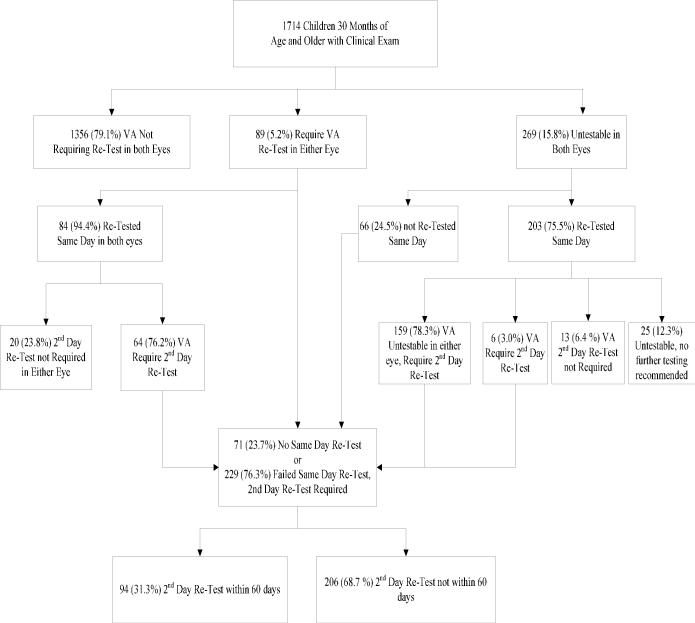
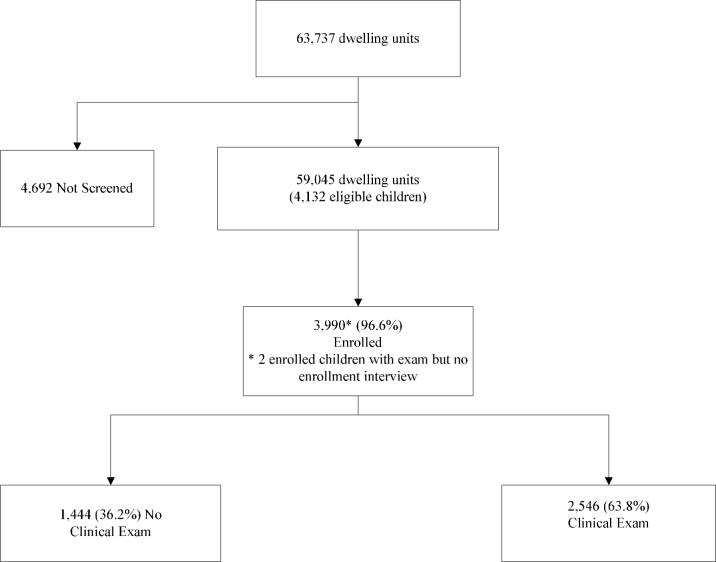
Participants: The Baltimore Pediatric Eye Disease Study is a population-based evaluation of the prevalence of ocular disorders in children 6 through 71 months of age in Baltimore, Maryland, United States. Among 4132 children identified, 3990 eligible children (97%) were enrolled and 2546 children (62%) were examined. This report focuses on 1714 of 2546 examined children (67%) who were 30 through 71 months of age.
Methods: Field staff identified 63 737 occupied dwelling units in 54 census tracts. Parents or guardians of eligible participants underwent an in-home interview, and eligible children underwent a comprehensive eye examination including optotype visual acuity (VA) testing in children 30 months of age and older, with protocol-specified retesting of children with VA worse than an age-appropriate standard.
Main outcome measures: The proportion of children 30 through 71 months of age testable for VA and the proportion with decreased VA as defined by preset criteria.
Results: Visual acuity was testable in 1504 of 1714 children (87.7%) 30 through 71 months of age. It was decreased at the initial test (wearing glasses if brought to the clinic) in both eyes of 7 of 577 white children (1.21%; 95% confidence interval [CI], 0.49-2.50) and 13 of 725 black children (1.79%; 95% CI, 0.95-3.08), a difference that is not statistically significant. Decreased VA in both eyes after retesting was found in 3 of 598 white children (0.50%; 95% CI, 0.10-1.48) and in 8 of 757 black children (1.06%, 95% CI = 0.45, 2.10), also not statistically significantly different. Uncorrected ametropia explained the decreased VA on initial testing in 10 of the 20 children.
Conclusions: Decreased VA in both eyes of children 30 through 71 months of age at presentation in urban Baltimore was 1.2% among white children and 1.8% among black children. After retesting within 60 days of the initial examination and with children wearing best refractive correction, the rate of decreased VA in both eyes was 0.5% among white children and 1.1% among black children.
Figures
References
-
- Simons K. Visual acuity norms in young children. Surv Ophthalmol. 1983;28:84–92. - PubMed
-
- Sprague JB, Stock LA, Connett JE, Bromberg J. Study of chart designs and optotypes for preschool vision screening. Am Orthopt J. 1988;38:18–23. - PubMed
-
- Holmes JM, Beck RW, Repka MX, et al. Pediatric Eye Disease Investigator Group The Amblyopia Treatment Study visual acuity testing protocol. Arch Ophthalmol. 2001;119:1345–53. - PubMed
-
- McGraw PV, Winn B, Gray LS, Elliott DB. Improving the reliability of visual acuity measures in young children. Ophthalmic Physiol Opt. 2000;20:173–84. - PubMed
-
- Vision in Preschoolers (VIP) Study Group Visual acuity results in school-aged children and adults: Lea Symbols chart versus Bailey-Lovie chart. Optom Vis Sci. 2003;80:650–4. - PubMed
Publication types
MeSH terms
Grants and funding
LinkOut - more resources
Full Text Sources
Medical
