


The role of abnormal vitreomacular adhesion in age-related macular degeneration: spectral optical coherence tomography and surgical results
- PMID: 18538742
- PMCID: PMC2735863
- DOI: 10.1016/j.ajo.2008.04.027
The role of abnormal vitreomacular adhesion in age-related macular degeneration: spectral optical coherence tomography and surgical results
Abstract
Purpose: To assess the incidence of vitreomacular adhesion and traction in age-related macular degeneration (AMD), and to evaluate surgical treatment in a subset of patients with choroidal neovascularization (CNV) nonresponsive to anti-neovascular growth factor (anti-VEGF) treatment.
Design: Retrospective observational case-control and interventional case series.
Methods: Spectral optical coherence tomography, combined with simultaneous scanning laser ophthalmoscope (Spectral OCT/SLO), was performed in 170 eyes of 94 elderly patients, 61 with exudative AMD, 59 with nonexudative AMD, and 50 control eyes. The presence of hyaloid adhesion to the posterior pole, and vitreomacular traction (VMT) were determined. Five patients with VMT underwent surgical hyaloid removal. Best-corrected visual acuity (BCVA) and retinal thickness were evaluated as outcomes.
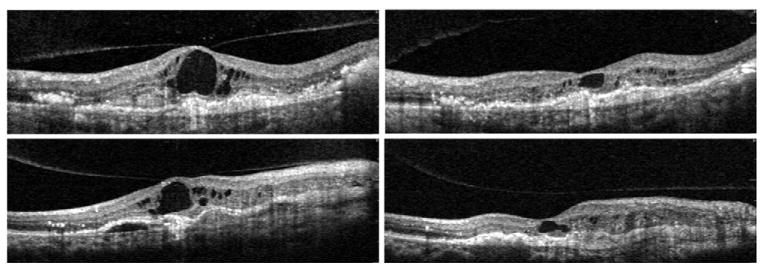
Results: Hyaloid adhesion was present in 17 eyes with exudative AMD (27.8%), 15 eyes with nonexudative AMD (25.4%), and eight control eyes (16%). Significant difference was found among the groups (P = .002). Among the eyes with hyaloid adhesion, VMT was shown in 10 eyes (59%) with exudative AMD, two eyes (13%) with nonexudative AMD, and one control eye (12%). VMT was associated with the severity of AMD (P = .0082). The area of hyaloid adhesion was significantly smaller than and concentric to the area of CNV complex in eyes with exudative AMD. Eyes with VMT that underwent surgery experienced a modest improvement of BCVA and decrease of retinal thickness.
Conclusions: Hyaloid adhesion to the macula is associated with AMD, and frequently causes VMT in eyes with CNV. Tractional forces may antagonize the effect of anti-VEGF treatment, and cause pharmacological resistance in a subpopulation of patients. Future studies are needed to define the role of vitreoretinal surgery in such cases. Spectral OCT/SLO allows careful diagnosis and follow-up.
Figures
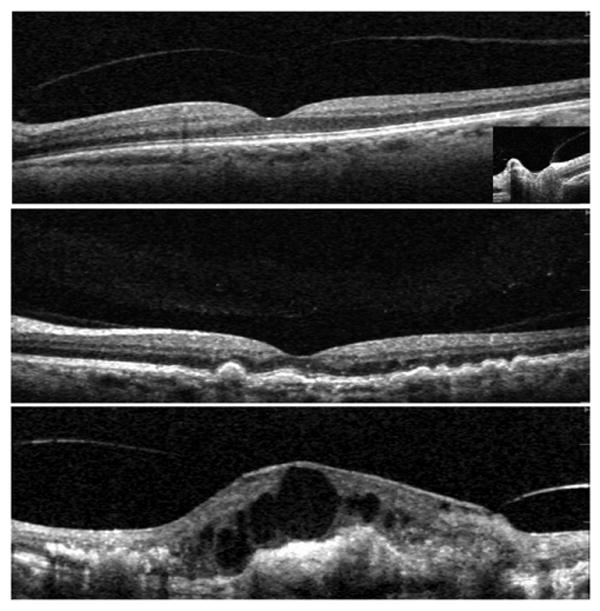
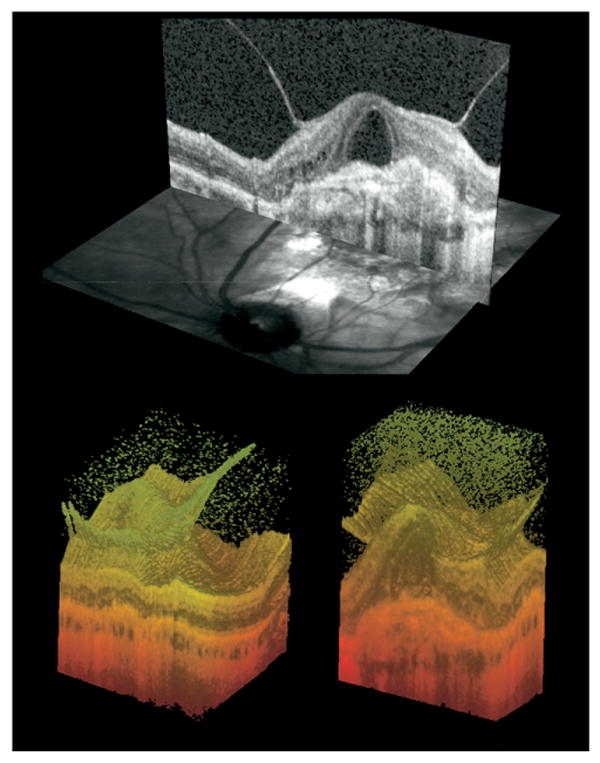
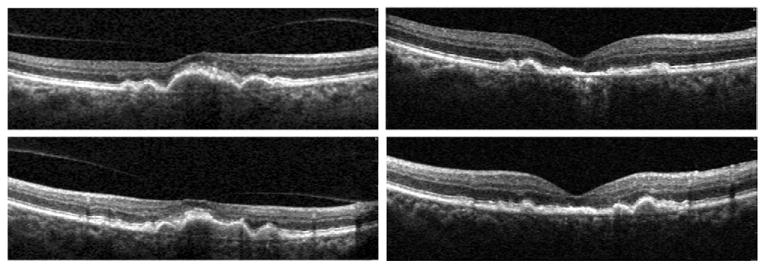
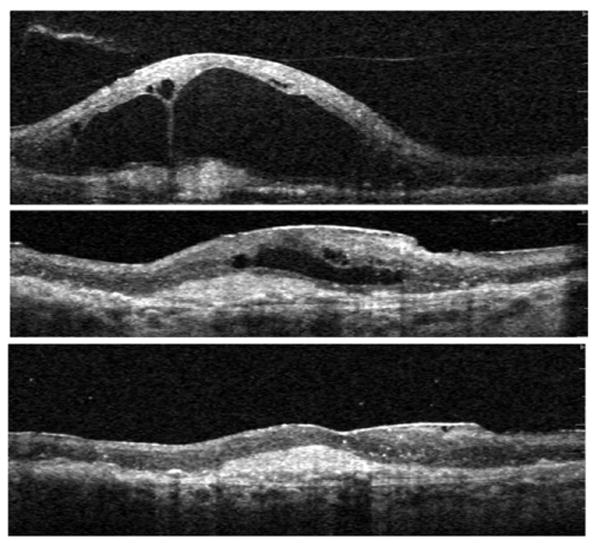
Comment in
-
Anti-Vascular Endothelial Growth Factor Injection for Exudative Age-related Macular Degeneration in Patients with Vitreo-Macular Traction.Am J Ophthalmol. 2009 Feb;147(2):375-6; author reply 376-7. doi: 10.1016/j.ajo.2008.10.008. Am J Ophthalmol. 2009. PMID: 19166716 No abstract available.
References
-
- La Cour M, Kiilgaard JF, Nissen MH. Age-related macular degeneration: epidemiology and optimal treatment. Drugs Aging. 2002;19:101–133. - PubMed
-
- Congdon N, O'Colmain B, Klaver CC, et al. Causes and prevalence of visual impairment among adults in the United States. Arch Ophthalmol. 2004;122:477–485. - PubMed
-
- Klein R, Klein BE, Lee KE, Cruickshanks KJ, Gangnon RE. Changes in visual acuity in a population over a 15-year period: the Beaver Dam Eye Study. Am J Ophthalmol. 2006;142:539–549. - PubMed
-
- Dewan A, Liu M, Hartman S, et al. HTRA1 promoter polymorphism in wet age-related macular degeneration. Science. 2006;314:989–992. - PubMed
