


Phenotype, genotype, and worldwide genetic penetrance of LRRK2-associated Parkinson's disease: a case-control study
- PMID: 18539534
- PMCID: PMC2832754
- DOI: 10.1016/S1474-4422(08)70117-0
Phenotype, genotype, and worldwide genetic penetrance of LRRK2-associated Parkinson's disease: a case-control study
Abstract
Background: Mutations in LRRK2, the gene that encodes leucine-rich repeat kinase 2, are a cause of Parkinson's disease (PD). The International LRRK2 Consortium was established to answer three key clinical questions: can LRRK2-associated PD be distinguished from idiopathic PD; which mutations in LRRK2 are pathogenic; and what is the age-specific cumulative risk of PD for individuals who inherit or are at risk of inheriting a deleterious mutation in LRRK2?
Methods: Researchers from 21 centres across the world collaborated on this study. The frequency of the common LRRK2 Gly2019Ser mutation was estimated on the basis of data from 24 populations worldwide, and the penetrance of the mutation was defined in 1045 people with mutations in LRRK2 from 133 families. The LRRK2 phenotype was defined on the basis of 59 motor and non-motor symptoms in 356 patients with LRRK2-associated PD and compared with the symptoms of 543 patients with pathologically proven idiopathic PD.
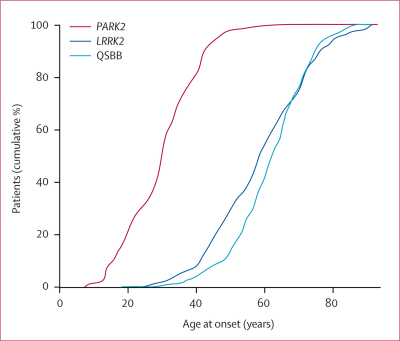
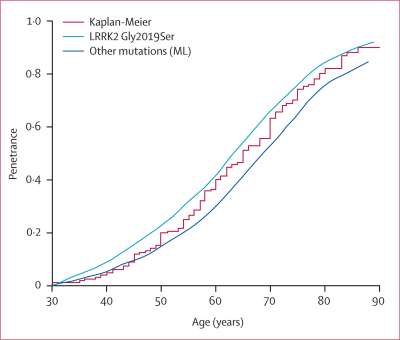
Findings: Six mutations met the consortium's criteria for being proven pathogenic. The frequency of the common LRRK2 Gly2019Ser mutation was 1% of patients with sporadic PD and 4% of patients with hereditary PD; the frequency was highest in the middle east and higher in southern Europe than in northern Europe. The risk of PD for a person who inherits the LRRK2 Gly2019Ser mutation was 28% at age 59 years, 51% at 69 years, and 74% at 79 years. The motor symptoms (eg, disease severity, rate of progression, occurrence of falls, and dyskinesia) and non-motor symptoms (eg, cognition and olfaction) of LRRK2-associated PD were more benign than those of idiopathic PD.
Interpretation: Mutations in LRRK2 are a clinically relevant cause of PD that merit testing in patients with hereditary PD and in subgroups of patients with PD. However, this knowledge should be applied with caution in the diagnosis and counselling of patients.
Funding: UK Medical Research Council; UK Parkinson's Disease Society; UK Brain Research Trust; Internationaal Parkinson Fonds; Volkswagen Foundation; National Institutes of Health: National Institute of Neurological Disorders and Stroke and National Institute of Aging; Udall Parkinson's Disease Centre of Excellence; Pacific Alzheimer Research Foundation Centre; Italian Telethon Foundation; Fondazione Grigioni per il Morbo di Parkinson; Michael J Fox Foundation for Parkinson's Research; Safra Global Genetics Consortium; US Department of Veterans Affairs; French Agence Nationale de la Recherche.
Figures
Comment in
-
LRRK2: bridging the gap between sporadic and hereditary Parkinson's disease.Lancet Neurol. 2008 Jul;7(7):562-4. doi: 10.1016/S1474-4422(08)70118-2. Epub 2008 Jun 6. Lancet Neurol. 2008. PMID: 18539536 No abstract available.
-
LRRK2 mutations in Basque patients with Parkinson's disease.Lancet Neurol. 2008 Oct;7(10):866-7; author reply 867. doi: 10.1016/S1474-4422(08)70204-7. Lancet Neurol. 2008. PMID: 18848304 No abstract available.
References
-
- Hardy J, Cai H, Cookson MR, Gwinn-Hardy K, Singleton A. Genetics of Parkinson's disease and parkinsonism. Ann Neurol. 2006;60:389–3898. - PubMed
-
- Paisan-Ruiz C, Jain S, Evans EW. Cloning of the gene containing mutations that cause PARK8-linked Parkinson's disease. Neuron. 2004;44:595–5600. - PubMed
-
- Zimprich A, Biskup S, Leitner P. Mutations in LRRK2 cause autosomal-dominant parkinsonism with pleomorphic pathology. Neuron. 2004;44:601–6007. - PubMed
-
- Whaley NR, Uitti RJ, Dickson DW, Farrer MJ, Wszolek ZK. Clinical and pathologic features of families with LRRK2-associated Parkinson's disease. J Neural Transm. 2006;70:221–2229. - PubMed
-
- Lesage S, Durr A, Tazir M, for the French Parkinson's disease genetics study group LRRK2 G2019S as a cause of Parkinson's disease in north African Arabs. N Engl J Med. 2006;354:422–4223. - PubMed
Publication types
MeSH terms
Substances
Grants and funding
LinkOut - more resources
Full Text Sources
Other Literature Sources
Medical
Miscellaneous
