. 2008 Aug 15;283(33):22529-40.
doi: 10.1074/jbc.M801925200. Epub 2008 Jun 6.

Direct and potent regulation of gamma-secretase by its lipid microenvironment

Affiliations

Direct and potent regulation of gamma-secretase by its lipid microenvironment

Pamela Osenkowski et al. J Biol Chem. .

Abstract

gamma-Secretase is an unusual and ubiquitous aspartyl protease with an intramembrane catalytic site that cleaves many type-I integral membrane proteins, most notably APP and Notch. Several reports suggest that cleavage of APP to produce the Abeta peptide is regulated in part by lipids. As gamma-secretase is a multipass protein complex with 19 transmembrane domains, it is likely that the local lipid composition of the membrane can regulate gamma-activity. To determine the direct contribution of the lipid microenvironment to gamma-secretase activity, we purified the human protease from overexpressing mammalian cells, reconstituted it in vesicles of varying lipid composition, and examined the effects of individual phospholipids, sphingolipids, cholesterol, and complex lipid mixtures on substrate cleavage. A conventional gamma-activity assay was modified to include a detergent-removal step to facilitate proteoliposome formation, and this increased baseline activity over 2-fold. Proteoliposomes containing sphingolipids significantly increased gamma-secretase activity over a phosphatidylcholine-only baseline, whereas the addition of phosphatidylinositol significantly decreased activity. Addition of soluble cholesterol in the presence of phospholipids and sphingolipids robustly increased the cleavage of APP- and Notch-like substrates in a dose-dependent manner. Reconstitution of gamma-secretase in complex lipid mixtures revealed that a lipid raft-like composition supported the highest level of activity compared with other membrane compositions. Taken together, these results demonstrate that membrane lipid composition is a direct and potent modulator of gamma-secretase and that cholesterol, in particular, plays a major regulatory role.


Figures
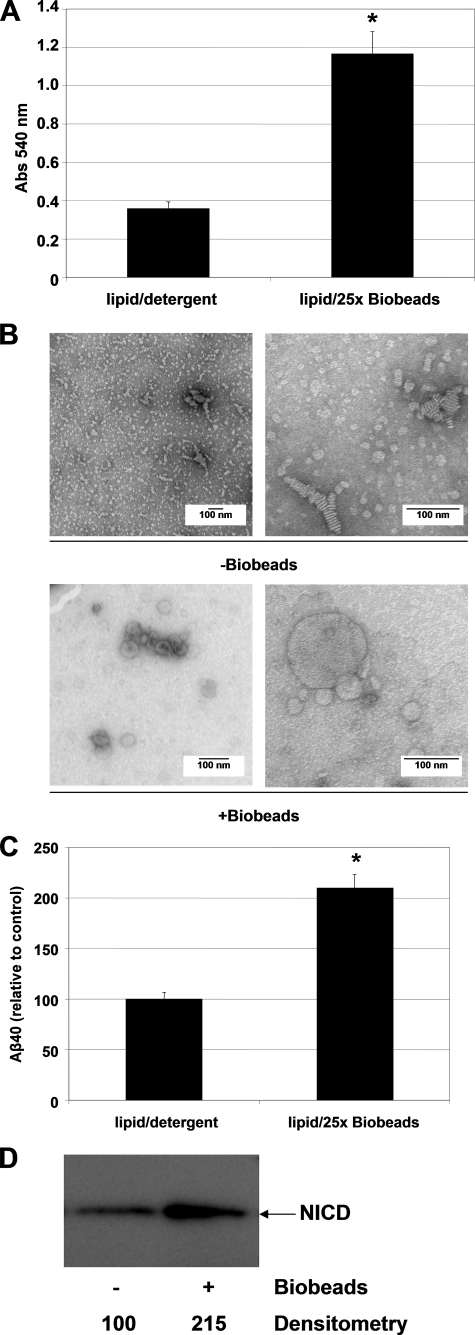
FIGURE 1.
FIGURE 1.
Effect of Bio-Bead-mediated detergent removal on the in vitro γ-secretase activity assay. A, effect of Bio-Bead detergent removal on the turbidity (measured at 540 nm) of the γ-secretase reaction mixture containing 0.1% PC and 0.025% PE (w/v) in 0.25% CHAPSO-HEPES. Incubation with and then removal of Bio-Beads led to a 3.1-fold increase in turbidity. Error bars represent mean ± S.E. Data were statistically analyzed using the unpaired, two-tailed Student's t test. * indicates statistical significance of p < 0.0001. B, negative stain EM of the γ-secretase reaction mixture before versus after Bio-Bead-mediated detergent removal. Liposomes of 50–500 nm were only observed upon detergent removal. C, effect of Bio-Bead detergent removal on the cleavage efficiency of the C100FLAG substrate by purified γ-secretase. Aβ40 levels were measured by ELISA (see “Experimental Procedures”). Maximum potentiation of Aβ40 production occurred at a 25× Bio-Bead to lipid ratio (w/w). Error bars represent mean ± S.E. Data were statistically analyzed using the unpaired, two-tailed Student's t test. * indicates statistical significance of p < 0.0001. D, effect of Bio-Bead detergent removal on the cleavage efficiency of the N100FLAG substrate by purified γ-secretase. NICD was probed with the 1744 antibody (Cell Signaling Technologies).
FIGURE 2.
FIGURE 2.
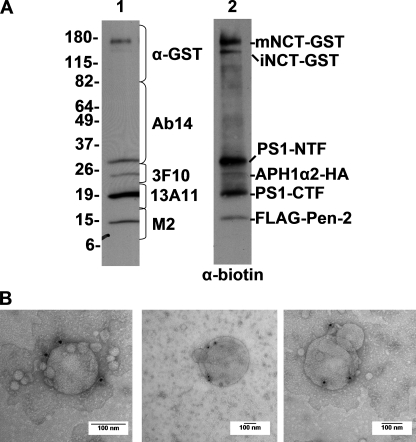
Labeling of γ-secretase within the proteoliposomes. A, Western blot of purified γ-secretase run on a 4–20% Tris glycine gel and probed with γ-secretase antibodies specific for NCT-GST, PS1-NTF, APH1α2-HA, PS1-CTF, and FLAG-Pen-2, before in vitro biotinylation (lane 1) and then probed with anti-biotin after biotinylation (lane 2). B, immunogold EM of proteoliposomes probed with anti-biotin antibody plus 10-nm conjugated Protein A-gold, and counterstained with uranyl acetate.
FIGURE 3.
FIGURE 3.
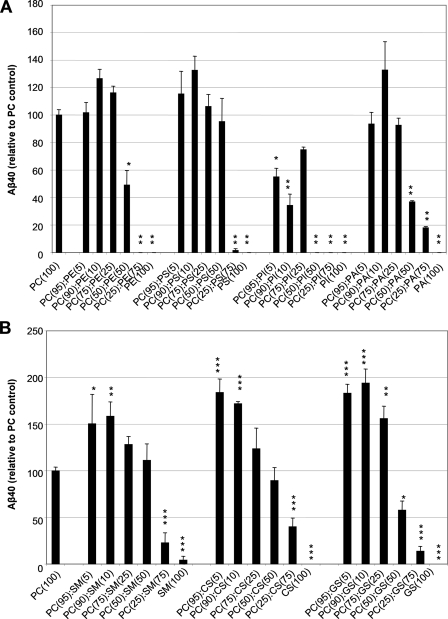
Effects of individual phospholipids and sphingolipids on the cleavage efficiency of C100FLAG substrate by purified γ-secretase reconstituted in detergent-free proteoliposomes. A, effect of increasing concentrations of PC, PE, PS, PI, or PA on the cleavage efficiency of the C100FLAG substrate, as measured by Aβ40 ELISA. Total lipid concentration in the mixtures was 1.25 mg/ml under all conditions. Error bars represent mean ± S.E. Data were statistically analyzed using the unpaired, two-tailed Student's t test with Bonferroni correction. Statistical significance of p < 0.01 (*) and p < 0.0001 (**) versus the PC(100) control is indicated. B, effect of increasing concentrations of SM, CS, or GS on the cleavage efficiency of the C100FLAG substrate, as measured by Aβ40 ELISA. Total lipid concentration was 1.25 mg/ml under all conditions. Error bars represent mean ± S.E. Data were statistically analyzed using the unpaired, two-tailed Student's t test with Bonferroni correction. Statistical significance of p < 0.05 (*), p < 0.001 (**), and p < 0.0001 (***) versus the PC(100) control is indicated.
FIGURE 4.
FIGURE 4.
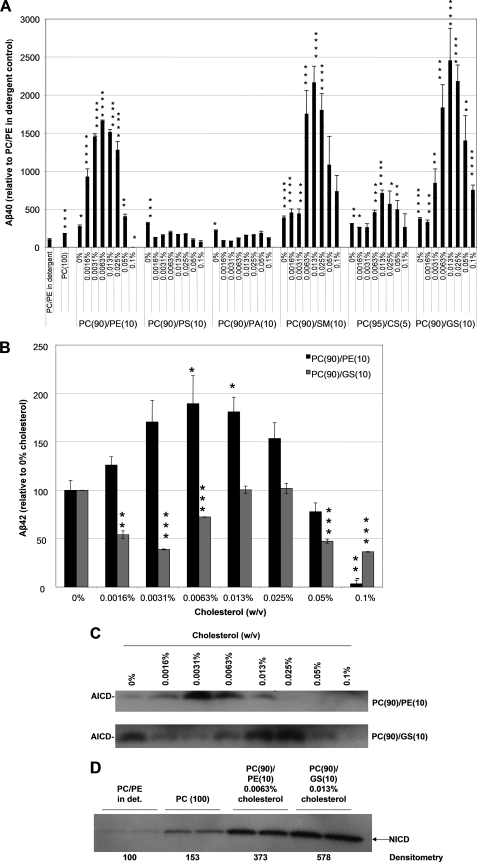
Effect of cholesterol on the cleavage efficiency of purified γ-secretase in detergent-free proteoliposomes. A, the effect of various concentrations of cholesterol on Aβ40 production in proteoliposomes of optimal phospholipid or sphingolipid compositions from Fig. 3 (PC(90)/PE(10), PC(90)/PS(10), PC(90)/PA(10), PC(90)/SM(10), PC(95)/CS(5), PC(90)/GS(10)) was examined. Error bars represent mean ± S.E. Data were statistically analyzed using the unpaired, two-tailed Student's t test with Bonferroni correction. Statistical significance of p < 0.05 (*), p < 0.01 (**), p < 0.001 (***), and p < 0.0001 (****) versus the PC/PE-detergent-containing control is indicated. B, the effect of various concentrations of cholesterol on Aβ42 production in proteoliposomes (PC(90)/PE(10) and PC(90)/GS(10)) was examined. Error bars represent mean ± S.E. Data were statistically analyzed using the unpaired, two-tailed Student's t test with Bonferroni correction. Statistical significance of p < 0.05 (*), p < 0.001 (**), and p < 0.0001 (***) versus the 0% cholesterol control is indicated. C, AICD levels of samples from the C100FLAG assay in A and B were analyzed by Western blot. AICD fragments were detected with the M2 FLAG antibody. D, the effect of various concentrations of cholesterol on NICD production in proteoliposomes of PC/PE in detergent, PC(100), PC(90)/PE(10)/0.0063% cholesterol, and PC(90)/GS(10)/0.013% cholesterol was examined. NICD levels were analyzed by Western blot and the NICD was detected with the 1744 antibody (Cell Signaling Technologies).
FIGURE 5.
FIGURE 5.
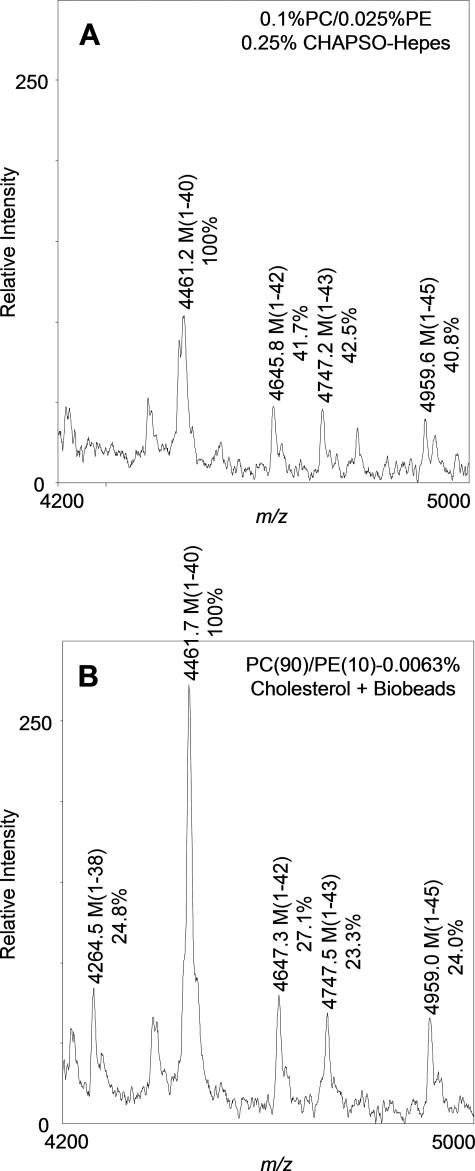
Mass spectral analysis of Aβ peptides generated under detergent-containing conditions (0.1% PC, 0.025% PE, 0.25% CHAPSO-HEPES) (A) and post-Bio-Bead treatment plus cholesterol (PC(90)/PE(10)/0.0063% cholesterol) (B). The γ-secretase cleavage products generated after incubation with the C100FLAG substrate were captured with the 4G8 monoclonal anti-Aβ antibody and subjected to MALDI-TOF analysis using a Voyager-DE STR mass spectrometer. All Aβ-related peptides are labeled. The ratio of Aβ/Aβ40 peak heights is shown as a percent below the corresponding Aβ peak.
FIGURE 6.
FIGURE 6.
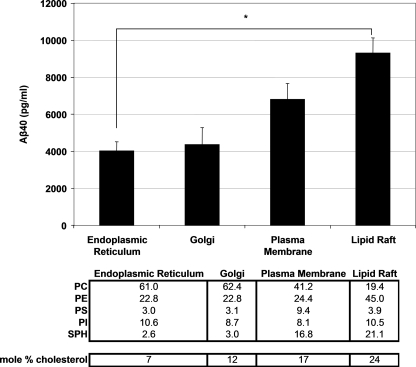
Effect of organelle-like lipid compositions (see table below) on the cleavage efficiency of the C100FLAG substrate. Aβ40 production was measured by ELISA. Lipid compositions are expressed as percent of total phospholipids (w/w), except for cholesterol, which is expressed as mole percent. The final lipid concentration was 1.25 mg/ml. A representative experiment from three independent experiments is shown. Error bars represent mean ± S.E. Data were statistically analyzed using one-way analysis of variance with Tukey-Kramer post-testing. Statistical significance of p < 0.05 (*) is indicated.
FIGURE 7.
FIGURE 7.
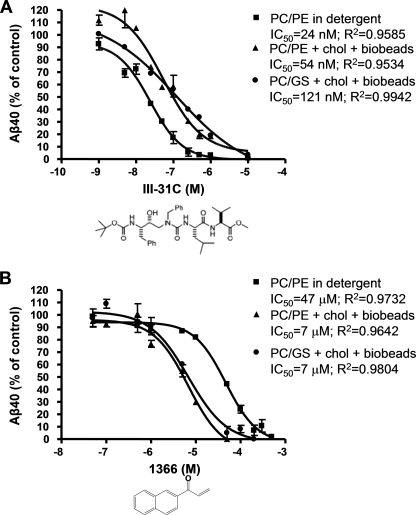
Effect of reported inhibitors on Aβ40 generation by purified γ-secretase. γ-Secretase, prepared in the standard assay conditions (0.1% PC, 0.025% PE, 0.25% CHAPSO-HEPES), in the optimal phospholipid condition (PC(90)/PE(10)/0.0063% cholesterol + Bio-Bead detergent removal), or in the optimal sphingolipid condition (PC(90)/GS(10)/0.013% cholesterol + Bio-Bead detergent removal) was incubated at 37 °C for 4 h in the presence of 1 μm C100FLAG substrate and increasing concentrations of either III-31C (A) or 1366 (B). Aβ40 was measured by ELISA.

References

    1. Selkoe, D. J. (2001) Physiol. Rev. 81 741-766 - PubMed
    1. Kimberly, W. T., LaVoie, M. J., Ostaszewski, B. L., Ye, W., Wolfe, M. S., and Selkoe, D. J. (2003) Proc. Natl. Acad. Sci. U. S. A. 100 6382-6387 - PMC - PubMed
    1. Edbauer, D., Winkler, E., Regula, J. T., Pesold, B., Steiner, H., and Haass, C. (2003) Nat. Cell Biol. 5 486-488 - PubMed
    1. Takasugi, N., Tomita, T., Hayashi, I., Tsuruoka, M., Niimura, M., Takahashi, Y., Thinakaran, G., and Iwatsubo, T. (2003) Nature 422 438-441 - PubMed
    1. Kopan, R., and Ilagan, M. X. (2004) Nat. Rev. Mol. Cell. Biol. 5 499-504 - PubMed

Publication types