. 2008 Aug;190(15):5291-9.
doi: 10.1128/JB.00288-08. Epub 2008 Jun 6.

Global regulation by (p)ppGpp and CodY in Streptococcus mutans

Affiliations

Global regulation by (p)ppGpp and CodY in Streptococcus mutans

José A Lemos et al. J Bacteriol. 2008 Aug.

Abstract

The RelA, RelP, and RelQ enzymes are responsible for the production of the alarmone (p)ppGpp in Streptococcus mutans. A strain lacking all three synthetases (DeltarelAPQ) does not grow in minimal medium lacking the branched-chain amino acids (BCAA) leucine or valine but grows well if isoleucine is also omitted. Here, we investigated whether there was a correlation between growth in the absence of leucine and valine with (p)ppGpp pools and the activation of CodY. By using a combination of single, double, and triple mutants lacking the (p)ppGpp synthetase enzymes, we demonstrated that the ability to grow in the absence of leucine or valine required basal levels of (p)ppGpp production by RelP and RelQ. The introduction of a codY mutation into the DeltarelAPQ strain fully restored growth in medium lacking leucine or valine, revealing that the growth-defective phenotype of DeltarelAPQ was directly linked to CodY. Lowering GTP levels through the addition of decoyinine did not alleviate CodY repression or affect the expression of genes involved in BCAA biosynthesis, suggesting that S. mutans CodY is not activated by GTP. The results of phenotypic studies revealed that the codY mutant had a reduced capacity to form biofilms and that its growth was more sensitive to low pH, showing a role for CodY in two key virulence properties of S. mutans. Microarray results revealed the extent of the CodY regulon. Notably, the identification of putative CodY-binding boxes upstream of genes that were downregulated in the codY mutant indicates that CodY may also function as a transcriptional activator in S. mutans.


Figures

FIG. 1.
FIG. 1.
Growth curves of S. mutans UA159 (wild type), JLT1 (ΔrelAPQ), and JLQ1 (ΔrelAPQ ΔcodY) in FMC lacking leucine (A) or valine (B). The results are representative of those of at least four independent experiments.
FIG. 2.
FIG. 2.
Effects of decoyinine and mupirocin on GTP/(p)ppGpp ratios and ilvE gene expression. (A) TLC depicting GTP and (p)ppGpp pools in S. mutans UA159 (wild type) grown in the presence of decoyinine (DEC) or treated for 30 min with 500 μg ml−1 decoyinine (0.5 DEC), 1.5 mg ml−1 decoyinine (1.5 DEC) or 500 ng ml−1 mupirocin (MUP). (B) Real-time PCR was used to quantify ilvE mRNA in S. mutans strain UA159 and the ΔcodY strain treated for 30 min with decoyinine or mupirocin (500 μg ml−1 and 500 ng ml−1, respectively). The data represent the means and standard deviations (error bars) of the results of four independent experiments. Differences that were found to be statistically significant (Student's t test) are indicated by brackets.
FIG. 3.
FIG. 3.
Biofilm formation by S. mutans UA159 (wild type) and its derivatives. Cultures were grown in a microtiter plate containing BM supplemented with glucose (A) or sucrose (B) at 37°C for 24 h. The graph shows the averages and standard deviations (error bars) of the results of three independent experiments. Asterisks indicate results that differ significantly from the results for UA159 (P ≤ 0.05; Student's t test).
FIG. 4.
FIG. 4.
Growth of S. mutans UA159 and its derivatives on BHI plates adjusted to pH 7.0 or 5.0. Strains were grown in BHI to an OD600 of 0.3 and serially diluted in PBS, and 5-μl aliquots were spotted onto plates that were incubated at 37°C for 72 h. Numbers correspond to the dilution factors for each individual culture, and images representative of the results of three individual experiments are shown.
FIG. 5.
FIG. 5.
Number of genes, grouped in functional categories, that were differentially expressed in strain JLcodY (ΔcodY) relative to their levels of expression in UA159 (wild type). Gene annotations are based on information provided by the Los Alamos National Laboratory (www.oralgen.lanl.gov) or by published literature available at the same website.
FIG. 6.
FIG. 6.
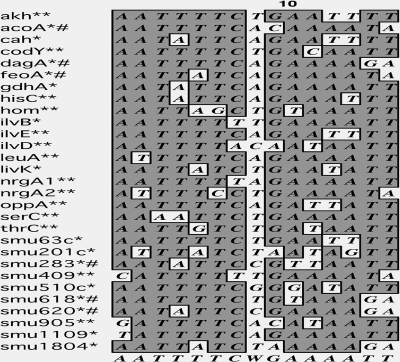
ClustalW alignment of putative CodY-binding boxes in upstream regions of S. mutans genes. Conserved regions are in shaded boxes, and a consensus sequence is shown below the alignments. Symbols: *, gene was flagged on microarray experiments with ΔcodY strain (JLcodY); **, gene was identified by Guédon et al. (12); #, gene was downregulated in JLcodY.

References

    1. Abranches, J., M. M. Candella, Z. T. Wen, H. V. Baker, and R. A. Burne. 2006. Different roles of EIIABMan and EIIGlc in regulation of energy metabolism, biofilm development, and competence in Streptococcus mutans. J. Bacteriol. 1883748-3756. - PMC - PubMed
    1. Ahn, S. J., J. A. Lemos, and R. A. Burne. 2005. Role of HtrA in growth and competence of Streptococcus mutans UA159. J. Bacteriol. 1873028-3038. - PMC - PubMed
    1. Ahn, S. J., Z. T. Wen, and R. A. Burne. 2007. Effects of oxygen on virulence traits of Streptococcus mutans. J. Bacteriol. 1898519-8527. - PMC - PubMed
    1. Ajdic, D., W. M. McShan, R. E. McLaughlin, G. Savic, J. Chang, M. B. Carson, C. Primeaux, R. Tian, S. Kenton, H. Jia, S. Lin, Y. Qian, S. Li, H. Zhu, F. Najar, H. Lai, J. White, B. A. Roe, and J. J. Ferretti. 2002. Genome sequence of Streptococcus mutans UA159, a cariogenic dental pathogen. Proc. Natl. Acad. Sci. USA 9914434-14439. - PMC - PubMed
    1. Banas, J. A., and M. M. Vickerman. 2003. Glucan-binding proteins of the oral streptococci. Crit. Rev. Oral Biol. Med. 1489-99. - PubMed

Publication types

MeSH terms