


Ion exclusion by sub-2-nm carbon nanotube pores
- PMID: 18539773
- PMCID: PMC2582302
- DOI: 10.1073/pnas.0710437105
Ion exclusion by sub-2-nm carbon nanotube pores
Abstract
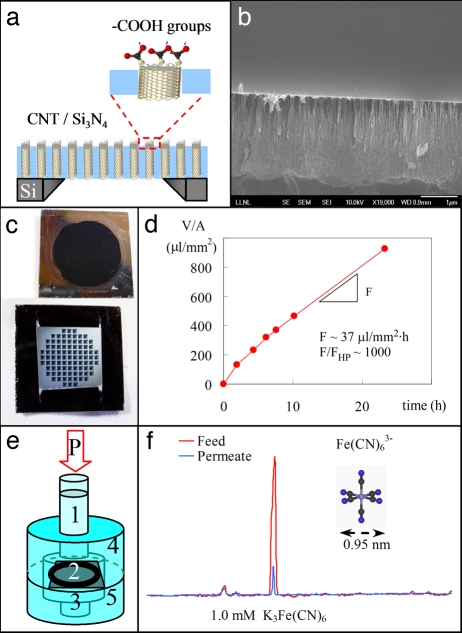
Biological pores regulate the cellular traffic of a large variety of solutes, often with high selectivity and fast flow rates. These pores share several common structural features: the inner surface of the pore is frequently lined with hydrophobic residues, and the selectivity filter regions often contain charged functional groups. Hydrophobic, narrow-diameter carbon nanotubes can provide a simplified model of membrane channels by reproducing these critical features in a simpler and more robust platform. Previous studies demonstrated that carbon nanotube pores can support a water flux comparable to natural aquaporin channels. Here, we investigate ion transport through these pores using a sub-2-nm, aligned carbon nanotube membrane nanofluidic platform. To mimic the charged groups at the selectivity region, we introduce negatively charged groups at the opening of the carbon nanotubes by plasma treatment. Pressure-driven filtration experiments, coupled with capillary electrophoresis analysis of the permeate and feed, are used to quantify ion exclusion in these membranes as a function of solution ionic strength, pH, and ion valence. We show that carbon nanotube membranes exhibit significant ion exclusion that can be as high as 98% under certain conditions. Our results strongly support a Donnan-type rejection mechanism, dominated by electrostatic interactions between fixed membrane charges and mobile ions, whereas steric and hydrodynamic effects appear to be less important.
Conflict of interest statement
The authors declare no conflict of interest.
Figures


References
-
- Hille B. Ion Channel of Excitable Membranes. Sunderland, MA: Sinauer; 2001.
-
- Sui HX, Han B-G, Lee JK, Walian P, Jap BK. Structural basis of water-specific transport through the AQP1 water channel. Nature. 2001;414:872–878. - PubMed
-
- Murata K, et al. Structural determinants of water permeation through aquaporin-1. Nature. 2000;407:599–605. - PubMed
-
- Wikstrom M. Proton translocation by bacteriorhodopsin and heme-copper oxidases. Curr Opin Struct Biol. 1998;8:480–488. - PubMed
-
- Wikstrom M, Verkhovsky MI, Hummer G. Water-gated mechanism of proton translocation by cytochrome c oxidase. BBA Bioenergetics. 2003;1604:61–65. - PubMed
Publication types
MeSH terms
Substances
LinkOut - more resources
Full Text Sources
Other Literature Sources
