. 2008 Aug;74(15):4853-66.
doi: 10.1128/AEM.02756-07. Epub 2008 Jun 6.

SEL, a selective enrichment broth for simultaneous growth of Salmonella enterica, Escherichia coli O157:H7, and Listeria monocytogenes

Affiliations

SEL, a selective enrichment broth for simultaneous growth of Salmonella enterica, Escherichia coli O157:H7, and Listeria monocytogenes

Hyochin Kim et al. Appl Environ Microbiol. 2008 Aug.

Abstract

Multipathogen detection on a single-assay platform not only reduces the cost for testing but also provides data on the presence of pathogens in a single experiment. To achieve this detection, a multipathogen selective enrichment medium is essential to allow the concurrent growth of pathogens. SEL broth was formulated to allow the simultaneous growth of Salmonella enterica, Escherichia coli O157:H7, and Listeria monocytogenes. The results were compared to those obtained with the respective individual selective enrichment broths, Rappaport-Vassiliadis (RV) for S. enterica, modified E. coli broth with 20 mg of novobiocin/liter for E. coli O157:H7, and Fraser broth for L. monocytogenes, and a currently used universal preenrichment broth (UPB). The growth of each pathogen in SEL inoculated at 10(1) or 10(3) CFU/ml was superior to that in the respective individual enrichment broth, except in the case of RV, in which Salmonella cells inoculated at both concentrations grew equally well. In mixed-culture experiments with cells of the three species present in equal concentrations or at a 1:10:1,000 ratio, the overall growth was proportional to the initial inoculation levels; however, the growth of L. monocytogenes was markedly suppressed when cells of this species were present at lower concentrations than those of the other two species. Further, SEL was able to resuscitate acid- and cold-stressed cells, and recovery was comparable to that in nonselective tryptic soy broth containing 6% yeast extract but superior to that in the respective individual selective broths. SEL promoted the growth of all three pathogens in a mixture in ready-to-eat salami and in turkey meat samples. Moreover, each pathogen was readily detected by a pathogen-specific immunochromatographic lateral-flow or multiplex PCR assay. Even though the growth of each pathogen in SEL was comparable to that in UPB, SEL inhibited greater numbers of nontarget organisms than did UPB. In summary, SEL was demonstrated to be a promising new multiplex selective enrichment broth for the detection of the three most prominent food-borne pathogens by antibody- or nucleic acid-based methods.


Figures
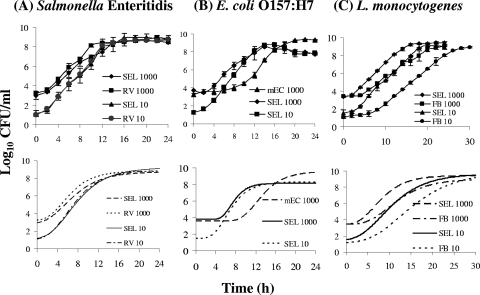
FIG. 1.
FIG. 1.
Growth curves for the individual pathogens Salmonella serovar Enteritidis (A), E. coli O157:H7 (B), and L. monocytogenes (C) in SEL inoculated at two different concentrations (10 and 1,000 CFU/ml). The growth of each pathogen in SEL was compared with that in the respective individual selective enrichment broth: RV broth for Salmonella, mEC+n for E. coli, and FB for Listeria. The broths were inoculated at the indicated concentrations, and the cultures were incubated at 37°C in a shaker incubator. The top panels show the actual growth curves, and the plots in the bottom panels are corresponding Gompertz fitted curves.
FIG. 2.
FIG. 2.
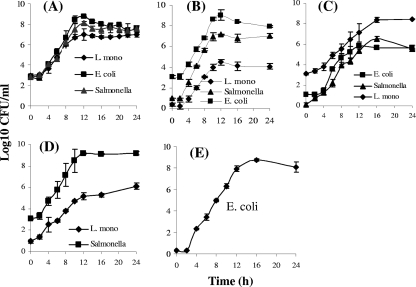
(A to D) Growth curves for the three pathogens Salmonella serovar Enteritidis, E. coli O157:H7, and L. monocytogenes (L. mono) mixed at various ratios in SEL: Salmonella CFU/E. coli CFU/L. monocytogenes culture ratios, 1:1:1 (A), 10:1,000:1 (B), and 1:10:1,000 (C), and Salmonella CFU/L. monocytogenes culture ratio, 1,000:10 (D). (E) Growth curve for E. coli O157:H7 alone after inoculation at ∼1 CFU/ml.
FIG. 3.
FIG. 3.
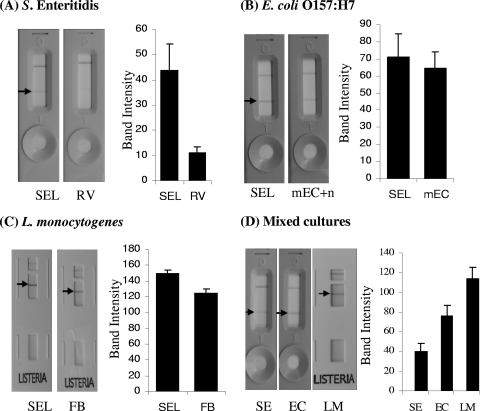
Results from ICLFA showing the reaction patterns of cells of the pathogens Salmonella serovar Enteritidis (SE) (A and D), E. coli O157:H7 (EC) (B and D), and L. monocytogenes (LM) (C and D) grown individually (with each pathogen inoculated at 103 CFU/ml) (A to C) or in mixed cultures (with each pathogen inoculated at ca. 3 × 10² CFU/ml) set up in SEL (D). The ICLFA reaction patterns were also compared with those of cells grown in the respective selective enrichment broths (RV broth, mEC+n, and FB). Cultures were incubated at 37°C for 16 to 18 h in a shaker incubator. The lateral-flow strips were loaded with 120-μl samples of Salmonella serovar Enteritidis and E. coli O157:H7 live cultures or 135 μl of heat-killed L. monocytogenes cells, and the antibody reaction intensities (band densities in pixels) were quantified by using software (Scion Crop., Frederick, MD) and presented as bar graphs.
FIG. 4.
FIG. 4.
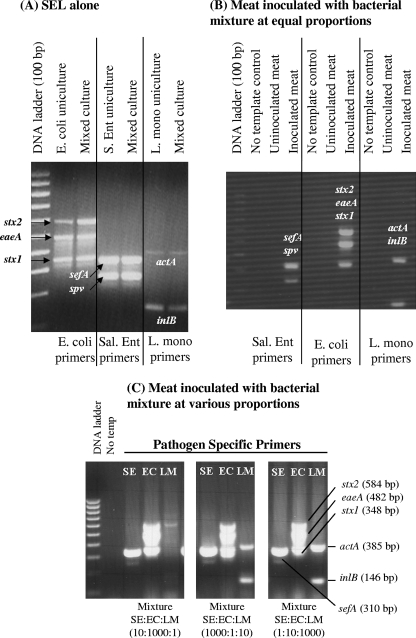
Results from multiplex PCR assays for the detection of Salmonella serovar Enteritidis, E. coli O157:H7, and L. monocytogenes bacteria grown individually (ca. 3 × 10² CFU/ml) in SEL broth (A) or in mixtures in meat (B and C). (A) Cultures were incubated at 37°C for 16 to 18 h in a shaker incubator and analyzed by PCR assays using species-specific primer sets: primers targeting sefA (310 bp) and spv (250 bp) for Salmonella serovar Enteritidis (S. Ent, or Sal. Ent), actA (395 bp) and inlB (146 bp) for L. monocytogenes (L. mono), and stx2 (584 bp), eaeA (482 bp), and stx1 (348 bp) for E. coli O157:H7. (B) Ready-to-eat sliced turkey meat samples were inoculated with Salmonella serovar Enteritidis (SE), E. coli O157:H7 (EC), and L. monocytogenes (LM) cultures at equal concentrations (ca. 3 × 10² CFU/ml) and analyzed by PCR after 18 h of enrichment in SEL broth. (C) Meat samples were inoculated with three mixtures of Salmonella serovar Enteritidis, E. coli, and L. monocytogenes CFU prepared with the bacteria at various ratios as indicated, enriched for 18 h, and assayed by multiplex PCR using Salmonella serovar Enteritidis-, E. coli-, or L. monocytogenes-specific primers. No temp, no-template DNA control.
FIG. 5.
FIG. 5.
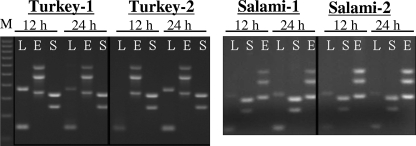
Results from PCR assays of Salmonella serovar Enteritidis-, L. monocytogenes-, and E. coli O157:H7-inoculated ready-to-eat turkey and salami samples. The meat samples (25 g each) were inoculated (ca. 3 × 10² CFU of each pathogen/g), mixed with 225 ml of SEL, and incubated for 12 and 24 h with agitation. In panel A, PCR lanes are as follows, from left to right: M, 100-bp ladder DNA marker; L, Listeria primers targeting genes actA (395 bp) and inlB (146 bp); E, E. coli O157:H7 primers targeting genes stx2 (584 bp), eaeA (482 bp), and stx1 (348 bp); and S, Salmonella primers targeting genes sefA (310 bp) and spv (250 bp). An ICLFA also showed positive reactions with Salmonella serovar Enteritidis, E. coli O157:H7, and L. monocytogenes antigens for corresponding samples (see Fig. S1 in the supplemental material).

References

    1. Abdul-Raouf, U. M., L. R. Beuchat, and M. S. Ammar. 1993. Survival and growth of Escherichia coli O157:H7 in ground, roasted beef as affected by pH, acidulants, and temperature. Appl. Environ. Microbiol. 59:2364-2368. - PMC - PubMed
    1. Bailey, J. S., and N. A. Cox. 1992. Universal preenrichment broth for the simultaneous detection of Salmonella and Listeria in foods. J. Food Prot. 55:256-259. - PubMed
    1. Benjamin, M. M., and A. R. Datta. 1995. Acid tolerance of enterohemorrhagic Escherichia coli. Appl. Environ. Microbiol. 61:1669-1672. - PMC - PubMed
    1. Bhagwat, A. A. 2006. Microbiological safety of fresh-cut produce: where are we now?, p. 121-165. In K. R. Mathews (ed.), Microbiology of fresh produce. ASM Press, Washington, DC.
    1. Bhagwat, A. A. 2003. Simultaneous detection of Escherichia coli O157:H7, Listeria monocytogenes and Salmonella strains by real-time PCR. Int. J. Food Microbiol. 84:217-224. - PubMed

Publication types

MeSH terms

LinkOut - more resources