. 2008 Jun 17;98(12):1975-84.
doi: 10.1038/sj.bjc.6604356. Epub 2008 Jun 10.

PDK-1 regulates lactate production in hypoxia and is associated with poor prognosis in head and neck squamous cancer

Affiliations

PDK-1 regulates lactate production in hypoxia and is associated with poor prognosis in head and neck squamous cancer

S M Wigfield et al. Br J Cancer. .

Abstract

Here we describe the expression and function of a HIF-1-regulated protein pyruvate dehydrogenase kinase-1 (PDK-1) in head and neck squamous cancer (HNSCC). Using RNAi to downregulate hypoxia-inducible PDK-1, we found that lactate and pyruvate excretion after 16-48 h of hypoxia was suppressed to normoxic levels. This indicates that PDK-1 plays an important role in maintaining glycolysis. Knockdown had no effect on proliferation or survival under hypoxia. The immunohistochemical expression of PDK-1 was assessed in 140 cases of HNSCC. PDK-1 expression was not expressed in normal tissues but was upregulated in HNSCC and found to be predominantly cytoplasmic with occasional strong focal nuclear expression. It was strongly related to poor outcome (P=0.005 split by median). These results indicate that HIF regulation of PDK-1 has a key role in maintaining lactate production in human cancer and that the investigation of PDK-1 inhibitors should be investigated for antitumour effects.


Figures
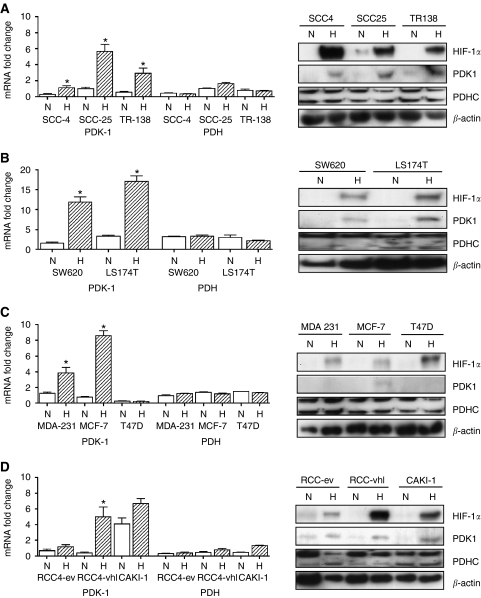
Figure 1
Figure 1
mRNA and protein expression of PDK-1 and PDH in (A) head and neck cancer cells, (B) colon cancer cells, (C) breast cancer cells and (D) renal cancer cells. *P<0.05 between hypoxia and normoxia.
Figure 2
Figure 2
(A) mRNA and (B) protein expression of PDK-1 in TR-138 cells in normoxia and hypoxia having been treated with scramble (scr), HIF-1α RNAi (HIF1-) and HIF-2α RNAi (HIF2-) siRNA. * indicates P<0.05 between scramble normoxia and hypoxia. ** indicates P<0.05 between RNAi-treated cells and scramble-treated cells in hypoxia.
Figure 3
Figure 3
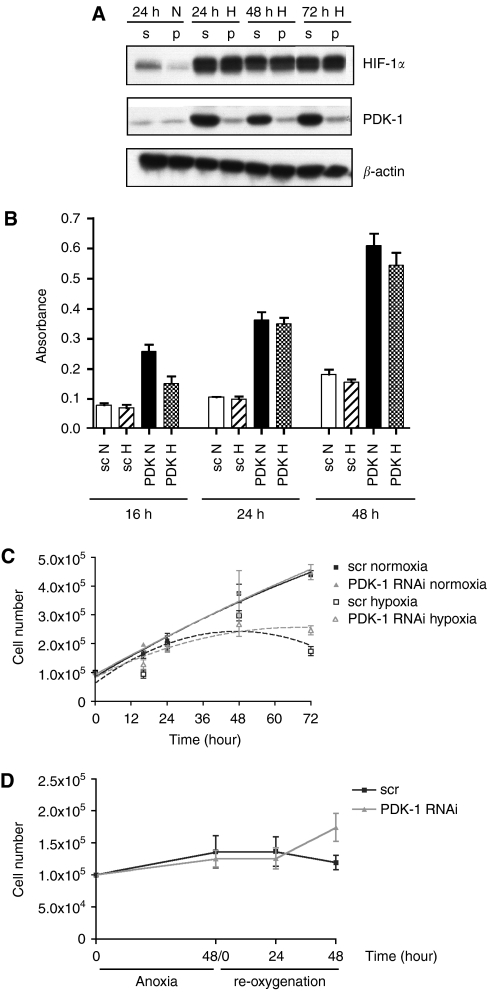
(A) RNAi time course for inhibition of PDK-1 (p) expression and scramble siRNA control (s) on PDK-1 expression (B) Measurement of PDH activity using CellTiter 96 non-radioactive cell proliferation assay TR-138 cells treated with PDK-1 and scramble (sc) RNAi after 16, 24 and 48 normoxia and hypoxia. (C) Cell growth of TR-138 cells treated with PDK-1 RNAi after 16, 24, 48 and 72 h in normoxia and hypoxia, (D) Re-oxygenation after 48 h anoxia. Mean and s.e. of three experiments, each performed in triplicate.
Figure 4
Figure 4
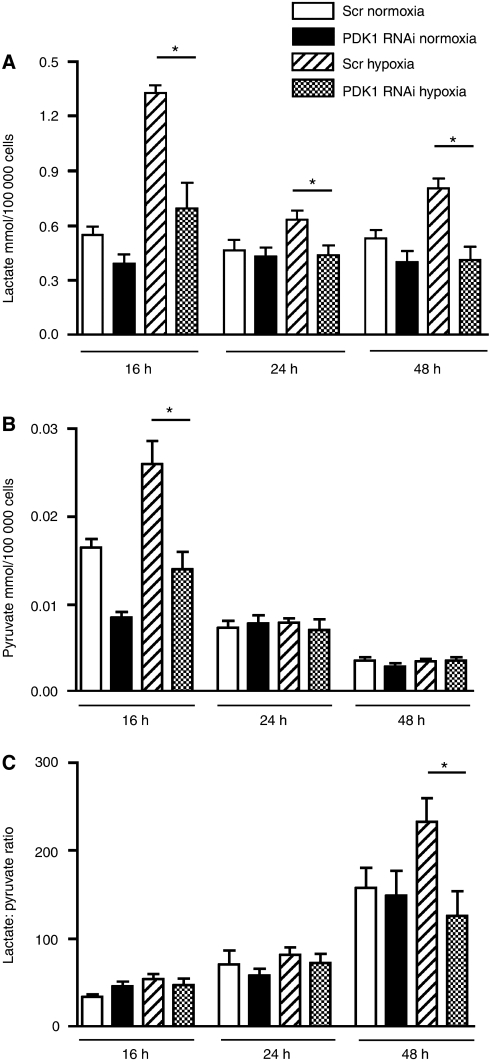
Lactate and Pyruvate assays for metabolites in the conditioned medium of TR-138 cells treated with Scramble (scr) and PDK-1 RNAi. Assayed at 16, 24 and 48 h exposure to 21% oxygen and 0.1% hypoxia for 16 h. (A) Lactate and (B) Pyruvate (mmol/100 000 cells). (C) lactate/pyruvate ratio. *P<0.05. Results of triplicates, representative of three experiments.
Figure 5
Figure 5
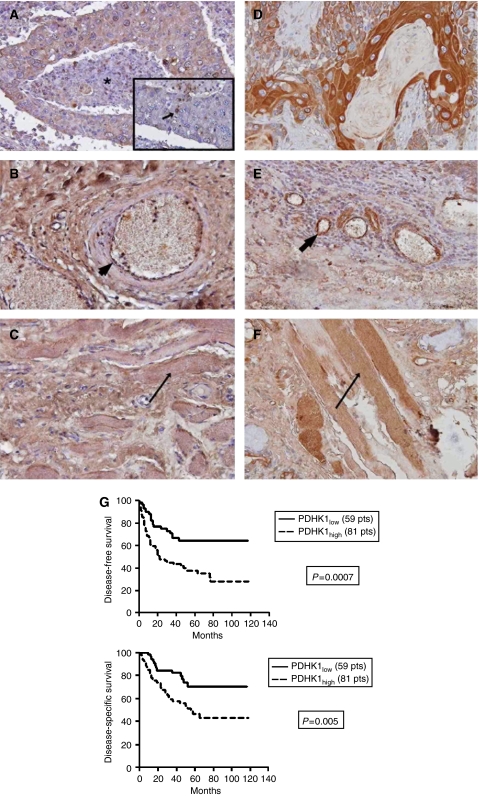
Immunohistochemical expression of PDK-1 (AC) and PDH (DF). (A) PDK-1 expression surrounding necrosis (*). Inset nuclear expression (arrow). (B) PDK-1 expression in vascular endothelium (large arrow). (C) PDK-1 expression in skeletal muscle (small arrow). (D) PDH expression in well-differentiated tumour cells. (E) PDH expression in vascular endothelium (large arrow). (F) PDH expression in skeletal muscle (small arrow). (G) Correlation with PDK-1 expression and disease-free survival and disease-specific survival.

References

    1. Berridge MV, Tan AS (1993) Characterization of the cellular reduction of 3-(4,5-dimethylthiazol-2-yl)-2,5-diphenyltetrazolium bromide (MTT): subcellular localization, substrate dependence, and involvement of mitochondrial electron transport in MTT reduction. Arch Biochem Biophys 303: 474–482 - PubMed
    1. Bowker-Kinley M, Popov KM (1999) Evidence that pyruvate dehydrogenase kinase belongs to the ATPase/kinase superfamily. Biochem J 344(Part 1): 47–53 - PMC - PubMed
    1. Brahimi-Horn MC, Chiche J, Pouysségur J (2007) Hypoxia signalling controls metabolic demand. Curr Opin Cell Biol 19: 1–7 - PubMed
    1. Brizel DM, Schroeder T, Scher RL, Walenta S, Clough RW, Dewhirst MW, Mueller-Klieser W (2001) Elevated tumor lactate concentrations predict for an increased risk of metastases in head-and-neck cancer. Int J Radiat Oncol Biol Phys 51: 349–353 - PubMed
    1. Cairns RA, Papandreou I, Sutphin PD, Denko NC (2007) Metabolic targeting of hypoxia and HIF1 in solid tumors can enhance cytotoxic chemotherapy. Proc Natl Acad Sci USA 104: 9445–9450 - PMC - PubMed

Substances