


Value of risk stratification to increase the predictive validity of HbA1c in screening for undiagnosed diabetes in the US population
- PMID: 18543044
- PMCID: PMC2517991
- DOI: 10.1007/s11606-008-0661-6
Value of risk stratification to increase the predictive validity of HbA1c in screening for undiagnosed diabetes in the US population
Abstract
Background: Opportunistic screening using hemoglobin A1c (HbA1c) may improve detection of undiagnosed diabetes but remains controversial.
Objective: To evaluate the predictive validity of HbA1c as a screening test for undiagnosed diabetes in a risk-stratified sample of the US population.
Design: Weighted cross-sectional analysis of diabetes risk factors, HbA1c, and fasting plasma glucose (FPG) in National Health and Nutrition Examination Survey (NHANES), 1999-2004.
Subjects: Six thousand seven hundred and twenty-three NHANES participants from morning examination session, aged > or = 18 years and without prior physician-diagnosed diabetes.
Measurements: HbA1c and undiagnosed diabetes defined by FPG > or = 7.0 mmol/l (126 mg/dl).
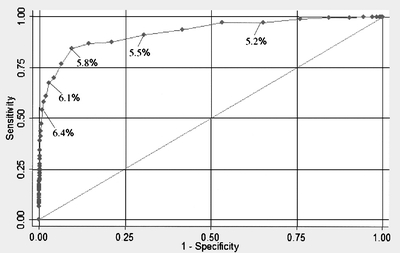
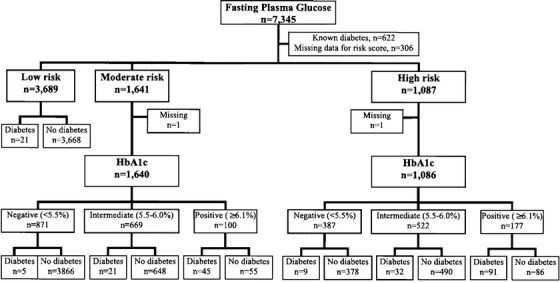
Results: The estimated prevalence of undiagnosed diabetes in the US population was 2.8% (5.5 million people). HbA1c had strong correlation with undiagnosed diabetes, with an area under the receiver-operating characteristic curve of 0.93. Independent predictors of undiagnosed diabetes were older age, male sex, black race, hypertension, elevated waist circumference, elevated triglycerides, and low high-density lipoprotein cholesterol. We derived a risk score for undiagnosed diabetes and stratified participants into low (0.44% prevalence), moderate (4.1% prevalence), and high (11.1% prevalence) risk subgroups. In moderate and high risk groups, a threshold HbA1c value > or = 6.1% identified patients requiring confirmatory FPG; HbA1c < or = 5.4% identified patients for whom diabetes could be reliably excluded. Intermediate HbA1c (5.5-6.0%) may exclude diabetes in moderate, but not high risk groups).
Conclusions: Risk stratification improves the predictive validity of HbA1c in screening for undiagnosed diabetes in the US population. Although opportunistic screening with HbA1c would improve detection of undiagnosed diabetes, cost-effectiveness studies are needed before implementation of specific screening strategies using HbA1c.
Figures
References
-
- Centers for Disease Control and Prevention. National diabetes fact sheet: general information and national estimates on diabetes in the United States, 2005. Rev ed. Atlanta, GA: US Department of Health and Human Services, Centers for Disease Control and Prevention, 2005.
-
- {'text': '', 'ref_index': 1, 'ids': [{'type': 'DOI', 'value': '10.2337/dc06-0062', 'is_inner': False, 'url': 'https://doi.org/10.2337/dc06-0062'}, {'type': 'PubMed', 'value': '16732006', 'is_inner': True, 'url': 'https://pubmed.ncbi.nlm.nih.gov/16732006/'}]}
- Cowie CC, Rust KF, Byrd-Holt DD, et al. Prevalence of diabetes and impaired fasting glucose in adults in the US population. Diabetes Care. 2006; 29:1263–8. - PubMed
-
- {'text': '', 'ref_index': 1, 'ids': [{'type': 'DOI', 'value': '10.2337/diacare.15.7.815', 'is_inner': False, 'url': 'https://doi.org/10.2337/diacare.15.7.815'}, {'type': 'PubMed', 'value': '1516497', 'is_inner': True, 'url': 'https://pubmed.ncbi.nlm.nih.gov/1516497/'}]}
- Harris MI, Klein R, Welborn TA, Knullman MW. Onset of NIDDM occurs at least 4–7 years before clinical diagnosis. Diabetes Care. 1992;15:815–9. - PubMed
-
- US Department of Health and Human Services. Healthy people 2010. 2nd ed. With understanding and improving health and objectives for improving health. Section 5: Diabetes. Washington, DC: US Government Printing Office, November 2000.
-
- {'text': '', 'ref_index': 1, 'ids': [{'type': 'PubMed', 'value': '12558361', 'is_inner': True, 'url': 'https://pubmed.ncbi.nlm.nih.gov/12558361/'}]}
- US Preventive Services Task Force. Screening for type 2 diabetes mellitus in adults: Recommendations and rationale. Ann Intern Med. 2003;1:212–4. - PubMed
Publication types
MeSH terms
Substances
LinkOut - more resources
Full Text Sources
Medical
