


Review
doi: 10.1089/ten.teb.2008.0038.
Modulation of the inflammatory response for enhanced bone tissue regeneration
Affiliations
- PMID: 18544015
- PMCID: PMC2962857
- DOI: 10.1089/ten.teb.2008.0038
Item in Clipboard
Review
Modulation of the inflammatory response for enhanced bone tissue regeneration
Tissue Eng Part B Rev.
2008 Jun.
Abstract
Proinflammatory cytokines are infamous for their catabolic effects on tissues and joints in both inflammatory diseases and following the implantation of biomedical devices. However, recent studies indicate that many of these same molecules are critical for triggering tissue regeneration following injury. This review will discuss the role of inflammatory signals in regulating bone regeneration and the impact of both immunomodulatory and antiinflammatory pharmacologic agents on fracture healing, to demonstrate the importance of incorporating rational control of inflammation into the design of tissue engineering strategies.
Figures
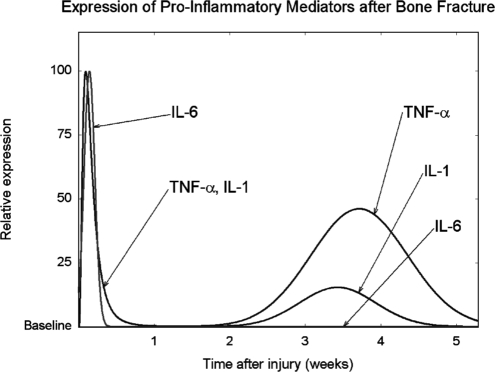
Schematic depicting the temporal pattern expression of three proinflammatory signals, tumor necrosis factor α (TNF-α), interleukin-1 (IL-1), and IL-6, after bone injury. The levels of each molecule are expressed as a percentage of the maximal level observed over the time period indicated. This graphic representation does not indicate concentrations of one molecule relative to another. Schematic is based on quantitative analysis of in vivo mRNA expression following bone injury.,
References
-
- Freed L.E. Guilak F. Guo X.E. Gray M.L. Tranquillo R. Holmes J.W. Radisic M. Sefton M.V. Kaplan D. Vunjak-Novakovic G. Advanced tools for tissue engineering: scaffolds, bioreactors, and signaling. Tissue Eng. 2006;12:3285. - PubMed
-
- Langer R. Tirrell D.A. Designing materials for biology and medicine. Nature. 2004;428:487. - PubMed
-
- Rundle C.H. Wang H. Yu H. Chadwick R.B. Davis E.I. Wegedal J.E. Lau K.-H.W. Mohan S. Ryaby J.T. Baylink D.J. Microarray analysis of gene expression during the inflammation and endochondral bone formation stages of rat femur fracture repair. Bone. 2006;38:521. - PubMed
-
- Hecht J. Kuhl H. Haas S.A. Bauer S. Poustka A.J. Lienau J. Schell H. Stiege A.C. Seitz V. Reinhardt R. Duda G.N. Mundolos S. Robinson P.N. Gene identification and analysis of transcripts differentially regulated in fracture healing by EST sequencing in the domestic sheep. BMC Genomics. 2006;7:172. - PMC - PubMed
-
- Ingber D.E. Mow V.C. Butler D. Niklason L. Huard J. Mao J. Yannas I. Kaplan D. Vunjak-Novakovic G. Tissue engineering and developmental biology: going bio-mimetic. Tissue Eng. 2006;12:3265. - PubMed
Publication types
MeSH terms
Substances
Grants and funding
LinkOut - more resources
Full Text Sources
Other Literature Sources
