Review
. 2008:267:299-342.
doi: 10.1016/S1937-6448(08)00632-1.

Biology and biophysics of the nuclear pore complex and its components

Affiliations
Review

Biology and biophysics of the nuclear pore complex and its components

Roderick Y H Lim et al. Int Rev Cell Mol Biol. 2008.

Abstract

Nucleocytoplasmic exchange of proteins and ribonucleoprotein particles occurs via nuclear pore complexes (NPCs) that reside in the double membrane of the nuclear envelope (NE). Significant progress has been made during the past few years in obtaining better structural resolution of the three-dimensional architecture of NPC with the help of cryo-electron tomography and atomic structures of domains from nuclear pore proteins (nucleoporins). Biophysical and imaging approaches have helped elucidate how nucleoporins act as a selective barrier in nucleocytoplasmic transport. Nucleoporins act not only in trafficking of macromolecules but also in proper microtubule attachment to kinetochores, in the regulation of gene expression and signaling events associated with, for example, innate and adaptive immunity, development and neurodegenerative disorders. Recent research has also been focused on the dynamic processes of NPC assembly and disassembly that occur with each cell cycle. Here we review emerging results aimed at understanding the molecular arrangement of the NPC and how it is achieved, defining the roles of individual nucleoporins both at the NPC and at other sites within the cell, and finally deciphering how the NPC serves as both a barrier and a conduit of active transport.


Figures
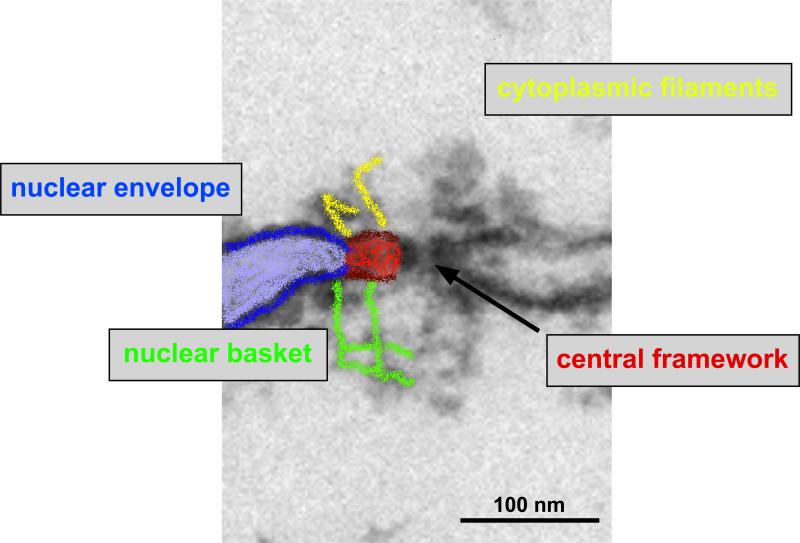
Figure 1
Figure 1
Electron micrograph with partially overlayed schematic representation of a cross-sectioned nuclear pore complex. The major structural components include the central framework, the cytoplasmic filaments and a nuclear basket.
Figure 2
Figure 2
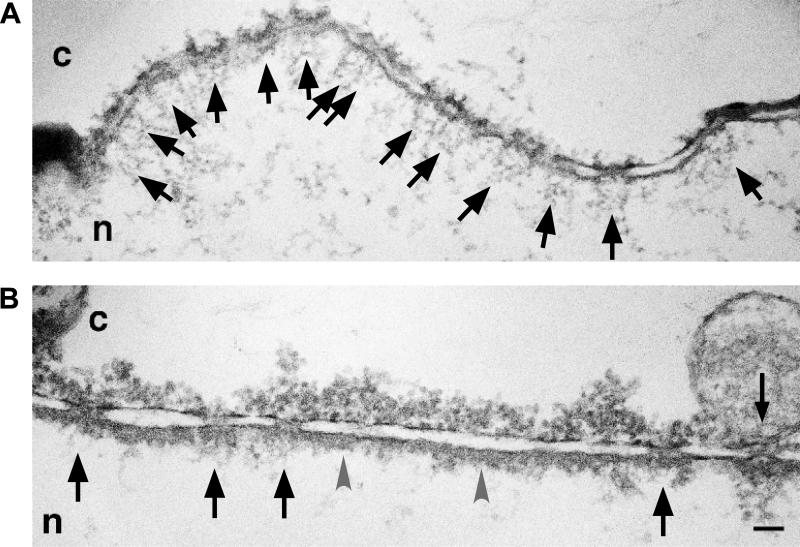
Electron micrographs of cross-sections along a nuclear envelope of isolated Xenopus oocyte nuclei. (A) The nuclear envelope of a stage 6 nucleus is characterized by a high density of nuclear pore complexes (black arrows). (B) Overexpression of human lamin A in these Xenopus oocyte nuclei causes a decrease in nuclear pore complex (black arrows) density and a thickened nuclear lamina (grey arrowheads). c, cytoplasm; n, nucleus. Scale bar, 100 nm.
Figure 3
Figure 3
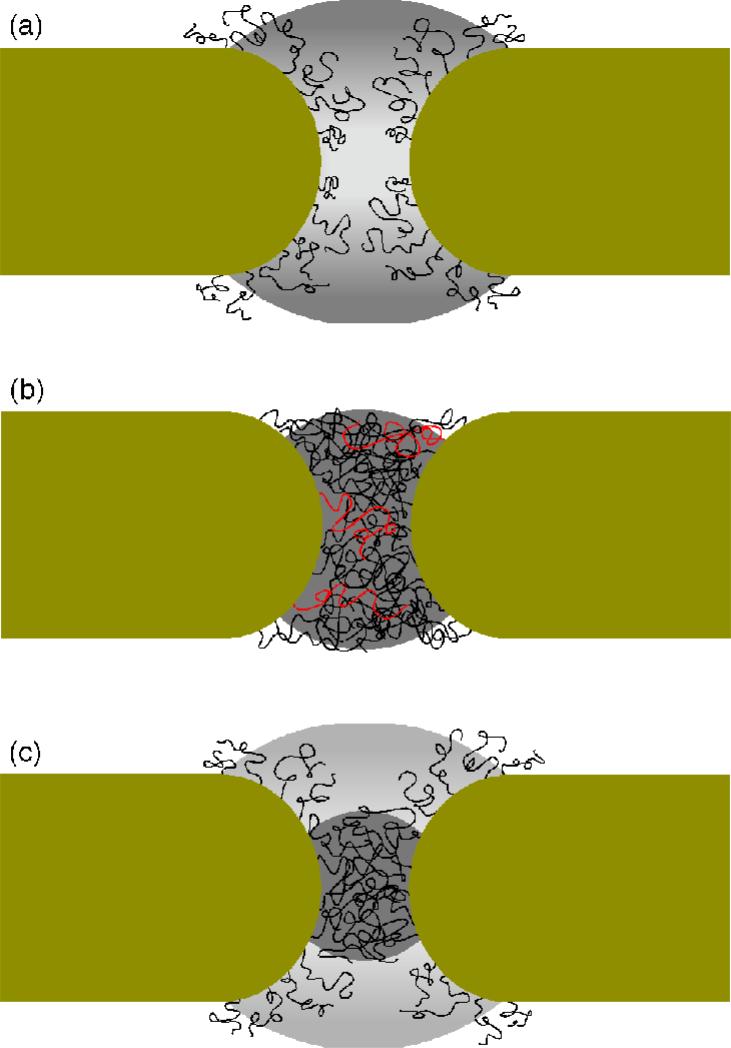
Main models of selective gating in the NPC. (A) The Brownian/virtual gating model (Rout, M. P. et al., 2003; Rout, M. P. et al., 2000) predicts that the entropic fluctuations of the unfolded FG-domains form an effective barrier to passive cargo. Although the central pore appears unobstructed, the highly stochastic motion of the elongated FG-domains (shaded area) generates a high-density FG-domain entropic barrier or “cloud” that surrounds and extends beyond the immediate peripheries of the NPC (dark). (B) The selective phase model predicts that hydrophobic interactions between the FG-repeats drive the FG-domains to form an randomly interconnected gel-like meshwork within the central pore that acts as a sieve to passive, hydrophilic cargo (Ribbeck, K., and Gorlich, D., 2002). Receptor-cargo complexes can dissolve through and negotiate the meshwork by breaking the “links” between the FG-domains via receptor-FG interactions. The gray area denotes the “range” of the meshwork while three FG-domains are drawn in red to emphasize that the FG-domains have to be elongated in order to cross-link with each other. (C) By combining aspects of Brownian gating and the selective phase, the two-gate model suggests that the more central GLFG-domains form a cohesive meshwork in the central pore while the peripheral FxFG-domains give rise to an entropic barrier (Patel, S. S. et al., 2007). The shaded areas represent the locations of the two gates.

References

    1. Akey CW. Visualization of transport-related configurations of the nuclear pore transporter. Biophys J. 1990;58:341–355. - PMC - PubMed
    1. Akey CW, Radermacher M. Architecture of the Xenopus nuclear pore complex revealed by three-dimensional cryo-electron microscopy. J Cell Biol. 1993;122:1–19. - PMC - PubMed
    1. Antonin W, Franz C, Haselmann U, Antony C, Mattaj IW. The integral membrane nucleoporin pom121 functionally links nuclear pore complex assembly and nuclear envelope formation. Mol Cell. 2005;17:83–92. - PubMed
    1. Antonin W, Mattaj IW. Nuclear pore complexes: round the bend? Nat Cell Biol. 2005;7:10–12. - PubMed
    1. Arnaoutov A, Azuma Y, Ribbeck K, Joseph J, Boyarchuk Y, Karpova T, McNally J, Dasso M. Crm1 is a mitotic effector of Ran-GTP in somatic cells. Nat Cell Biol. 2005;7:626–632. - PubMed

Publication types

Substances

LinkOut - more resources