


The natural history of primary hyperparathyroidism with or without parathyroid surgery after 15 years
- PMID: 18544625
- PMCID: PMC2567863
- DOI: 10.1210/jc.2007-1215
The natural history of primary hyperparathyroidism with or without parathyroid surgery after 15 years
Abstract
Context: Primary hyperparathyroidism (PHPT) often presents without classical symptoms such as overt skeletal disease or nephrolithiasis. We previously reported that calciotropic indices and bone mineral density (BMD) are stable in untreated patients for up to a decade, whereas after parathyroidectomy, normalization of biochemistries and increases in BMD ensue.
Objective: The objective of the study was to provide additional insights in patients with and without surgery for up to 15 yr.
Design: The study had an observational design.
Setting: The setting was a referral center.
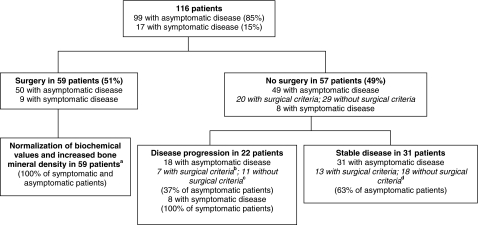
Patients: Patients included 116 patients (25 men, 91 women); 99 (85%) were asymptomatic.
Intervention: Fifty-nine patients (51%) underwent parathyroidectomy and 57 patients were followed up without surgery.
Main outcome measure: BMD was measured.
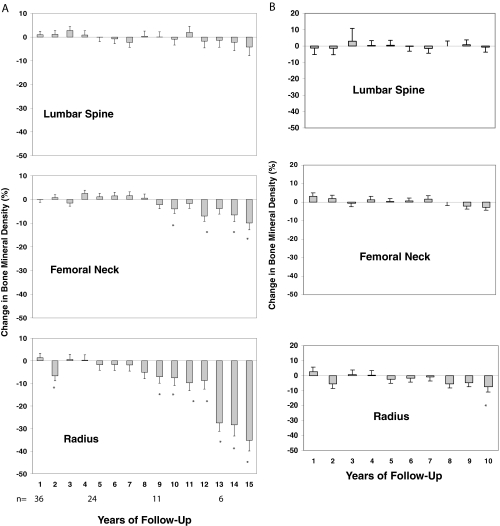
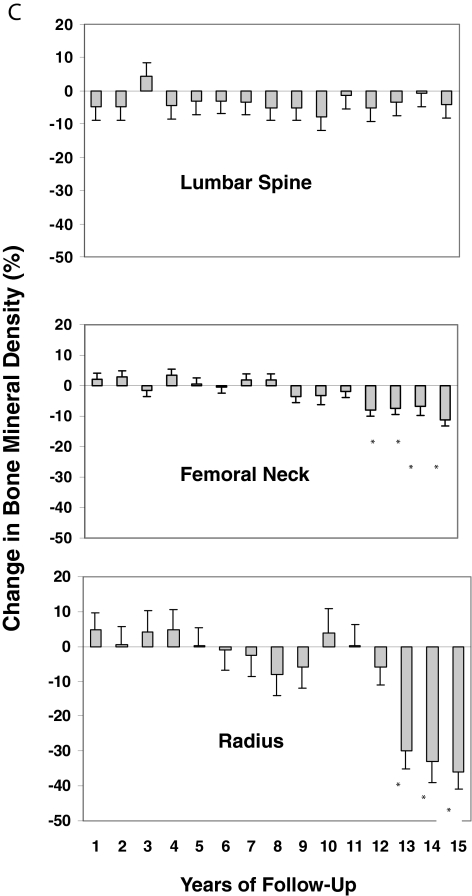
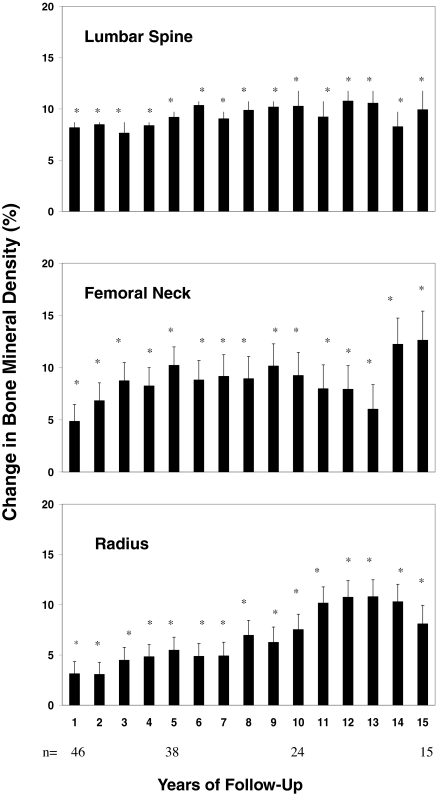
Results: Lumbar spine BMD remained stable for 15 yr. However, BMD started to fall at cortical sites even before 10 yr, ultimately decreasing by 10 +/- 3% (mean +/- sem; P < 0.05) at the femoral neck, and 35 +/- 5%; P < 0.05 at the distal radius, in the few patients observed for 15 yr. Thirty-seven percent of asymptomatic patients showed disease progression (one or more new guidelines for surgery) at any time point over the 15 yr. Meeting surgical criteria at baseline did not predict who would have progressive disease. BMD increases in patients who underwent surgery were sustained for the entire 15 yr.
Conclusions: Parathyroidectomy led to normalization of biochemical indices and sustained increases in BMD. Without surgery, PHPT progressed in one third of individuals over 15 yr; meeting surgical criteria at the outset did not predict this progression. Cortical bone density decreased in the majority of subjects with additional observation time points and long-term follow-up. These results raise questions regarding how long patients with PHPT should be followed up without intervention.
Figures
References
-
- Albright F, Reifenstein EC 1948 The parathyroid glands and metabolic bone disease. Baltimore: Williams & Wilkins Co.
-
- Heath 3rd H, Hodgson SF, Kennedy MA 1980 Primary hyperparathyroidism. Incidence, morbidity, and potential economic impact in a community. N Engl J Med 302:189–193 - PubMed
-
- Silverberg SJ, Shane E, Jacobs TP, Siris E, Bilezikian JP 1999 A 10-year prospective study of primary hyperparathyroidism with or without parathyroid surgery. N Engl J Med 341:1249–1255 - PubMed
-
- NIH conference 1991 Diagnosis and management of asymptomatic primary hyperparathyroidism: consensus development conference statement. Ann Intern Med 114:593–597 - PubMed
-
- Locker FG, Silverberg SJ, Bilezikian JP 1997 Optimal dietary calcium intake in primary hyperparathyroidism. Am J Med 102:543–550 - PubMed
Publication types
MeSH terms
Substances
Grants and funding
LinkOut - more resources
Full Text Sources
Other Literature Sources
