. 2008 Oct 1;112(7):2810-6.
doi: 10.1182/blood-2008-03-145755. Epub 2008 Jun 10.

Polyphosphate enhances fibrin clot structure

Affiliations

Polyphosphate enhances fibrin clot structure

Stephanie A Smith et al. Blood. .

Abstract

Polyphosphate, a linear polymer of inorganic phosphate, is present in platelet dense granules and is secreted on platelet activation. We recently reported that polyphosphate is a potent hemostatic regulator, serving to activate the contact pathway of blood clotting and accelerate factor V activation. Because polyphosphate did not alter thrombin clotting times, it appeared to exert all its procoagulant actions upstream of thrombin. We now report that polyphosphate enhances fibrin clot structure in a calcium-dependent manner. Fibrin clots formed in the presence of polyphosphate had up to 3-fold higher turbidity, had higher mass-length ratios, and exhibited thicker fibers in scanning electron micrographs. The ability of polyphosphate to enhance fibrin clot turbidity was independent of factor XIIIa activity. When plasmin or a combination of plasminogen and tissue plasminogen activators were included in clotting reactions, fibrin clots formed in the presence of polyphosphate exhibited prolonged clot lysis times. Release of polyphosphate from activated platelets or infectious microorganisms may play an important role in modulating fibrin clot structure and increasing its resistance to fibrinolysis. Polyphosphate may also be useful in enhancing the structure of surgical fibrin sealants.


Figures
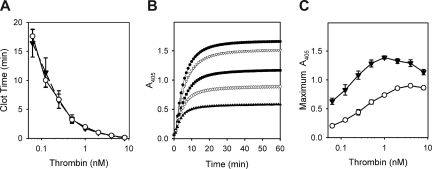
Figure 1
Figure 1
Polyphosphate increases final clot turbidity but does not alter clotting time over a wide range of thrombin concentrations. Clotting reactions contained 2.6 mg/mL of citrate-free fibrinogen, which was preincubated for 15 minutes in the presence of 2.5 mM CaCl2, with or without polyphosphate (polyP), before clot initiation by thrombin. (A) Clotting times of reactions containing 1 mM polyP (▼) or no polyP (○) as a function of various thrombin concentrations. Data are mean plus or minus SE (n = 3). (B) Time courses of fibrin formation (turbidity increase) in reactions containing 0 (▲), 188 μM (◇), 375 μM (■), 750 μM (▼), or 1.5 mM (●) polyP, with clotting initiated by 3 nM thrombin. Data are from a representative experiment. (C) Maximum fibrin clot turbidities in reactions containing 1 mM polyP (▼) or no polyP (○) as a function of various thrombin concentrations. Data are mean plus or minus SE (n = 3).
Figure 2
Figure 2
The concentrations of both polyP and Ca2+ influence fibrin clot turbidity. The final turbidities of clots formed from fibrinogen/thrombin mixtures were quantified as described in “Measurements of clot turbidity.” Reactions contained 2.6 mg/mL citrate-free fibrinogen, which was preincubated for 15 minutes with CaCl2 and the indicated concentrations of polyP (x-axis), after which clotting was initiated with 1 nM thrombin. Ca2+ concentrations were 0 (●), 2 mM (▼), 2.5 mM (□), 3 mM (▼), and 5 mM (◇). Data are mean plus or minus SE (n = 3).
Figure 3
Figure 3
polyP influences clot turbidity to a much greater extent than does heparin. The final turbidities of clots formed with fibrinogen mixed with thrombin were quantified as described in “Measurements of clot turbidity.” Reactions contained 2.6 mg/mL fibrinogen preincubated for 15 minutes in the presence of: various heparin concentrations without CaCl2 (□); various heparin concentrations with 2.5 mM CaCl2 (○); various polyP concentrations with 2.5 mM CaCl2 (▼); or various polyP concentrations with 2.5 mM CaCl2 and 5 U/mL heparin (♦). Clotting was then initiated with 1 nM thrombin. Heparin and polyP concentrations are indicated on the x-axes. Data are mean plus or minus SE (n = 4).
Figure 4
Figure 4
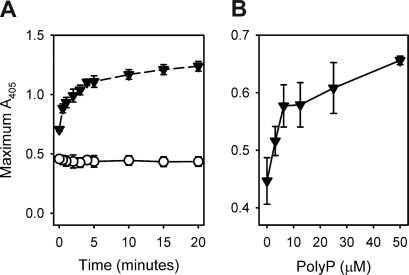
Preincubation of fibrinogen with polyP and Ca2+ influences final clot turbidity. (A) Final turbidities of clots formed with fibrinogen mixed with thrombin were quantified as described in “Measurements of clot turbidity.” Reactions contained 2.6 mg/mL fibrinogen preincubated for the indicated times in the presence of 2.5 mM CaCl2 with 1 mM polyP (▼) or without polyP (○), after which clotting was initiated with 8 nM thrombin. Data are mean plus or minus SE (n = 3). (B) Final turbidities of clots formed with prothrombin-deficient plasma mixed with thrombin were quantified as described in “Measurements of clot turbidity.” Reactions contained citrated plasma (80%) with added CaCl2 (13.7 mM) and were preincubated for 15 minutes with polyP concentrations as indicated on the x-axis. Clotting was then initiated with 10 nM thrombin. Data are mean plus or minus SE (n = 4).
Figure 5
Figure 5
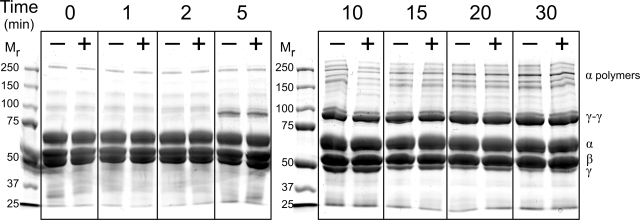
The rate and extent of fibrin cross-linking are not influenced by polyP. Fibrin cross-linking was examined using SDS-PAGE for reactions containing 2.6 mg/mL citrate-free fibrinogen (containing a small amount of contaminating factor XIII), which was preincubated for 15 minutes in the presence of 2.5 mM CaCl2 with 1 mM polyP (+) or without polyP (−). Thrombin (1 nM) was then added, and reactions were stopped at the indicated times. (Left) Mr markers. (Right) Locations of fibrin chains (α, β, γ, cross-linked γ-γ dimers and cross-linked α chain polymers).
Figure 6
Figure 6
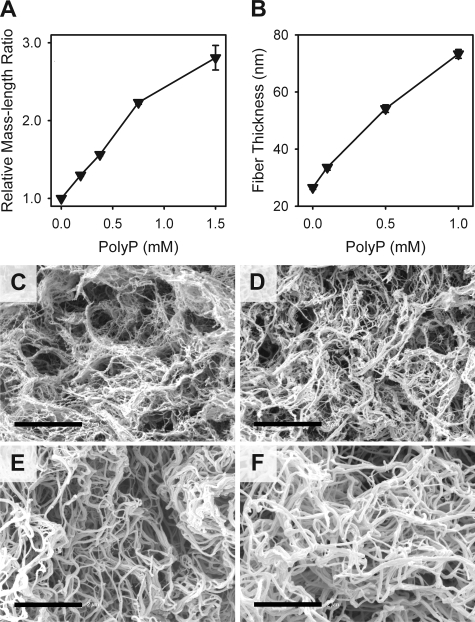
polyP increases the thickness of fibrin fibrils. Clots were formed by preincubating 2.6 mg/mL of fibrinogen for 15 minutes in the presence of 2.5 mM CaCl2 plus the indicated polyP concentrations, after which clotting was initiated with 3 nM thrombin. (A) Mass-length ratios of the resulting fibrin preparations (relative to the condition without polyP), calculated from scans of optical densities from 400 to 800 nm as described in “Determination of fibril thickness.” Data are mean plus or minus SE (n = 4). (B) Fiber thickness is measured from scanning electron micrographs, as described in “Scanning electron microscopy.” Data are mean plus or minus SE (n = 120). (C-F) Representative scanning electron micrographs of fibrin clots formed in the presence of (C) no polyP, (D) 100 μM polyP, (E) 500 μM polyP, and (F) 1 mM polyP. Bar represents 2 μm.
Figure 7
Figure 7
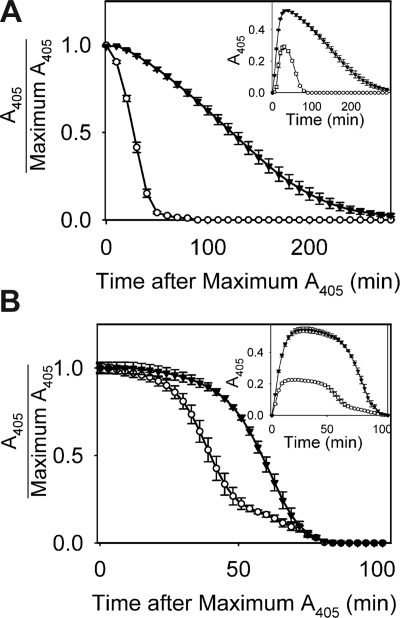
polyP slows the rate of fibrinolysis. (A) Lysis of clots formed by preincubating 1.0 mg/mL fibrinogen for 15 minutes in the presence of 2.5 mM CaCl2 with 1 mM polyP (▼) or without polyP (○), after which 8 nM plasmin was added followed immediately by 1 nM thrombin. Data are mean plus or minus SE (n = 8). (B) Lysis of clots formed by preincubating 1.0 mg/mL fibrinogen and 200 nM plasminogen for 15 minutes in the presence of 2.5 mM CaCl2 with 1 mM polyP (▽) or without polyP (○), after which 375 pM tPA and 1 nM thrombin were added to initiate clotting. In both panels, absorbance data were normalized to the maximal A405 value for each curve, plotted versus time after reaching maximal A405. The insets show the entire turbidity profiles from the point of thrombin addition, without normalization. Data are mean plus or minus SE (n = 4).

Comment in

References

    1. Wolberg AS. Thrombin generation and fibrin clot structure. Blood Rev. 2007;21:131–142. - PubMed
    1. Di Stasio E, Nagaswami C, Weisel JW, Di Cera E. Cl regulates the structure of the fibrin clot. Biophys J. 1998;75:1973–1979. - PMC - PubMed
    1. Nair CH, Shah GA, Dhall DP. Effect of temperature, pH and ionic strength and composition on fibrin network structure and its development. Thromb Res. 1986;42:809–816. - PubMed
    1. Carr ME, Jr, Gabriel DA, McDonagh J. Influence of Ca2+ on the structure of reptilase-derived and thrombin-derived fibrin gels. Biochem J. 1986;239:513–516. - PMC - PubMed
    1. Lauricella AM, Quintana I, Castanon M, Sassetti B, Kordich L. Influence of homocysteine on fibrin network lysis. Blood Coagul Fibrinolysis. 2006;17:181–186. - PubMed

Publication types