. 2007 Aug;3(3):181-9.
doi: 10.1017/S1740925X08000094.

Supportive or information-processing functions of the mature protoplasmic astrocyte in the mammalian CNS? A critical appraisal

Affiliations

Supportive or information-processing functions of the mature protoplasmic astrocyte in the mammalian CNS? A critical appraisal

Harold K Kimelberg. Neuron Glia Biol. 2007 Aug.

Abstract

It has been proposed that astrocytes should no longer be viewed purely as support cells for neurons, such as providing a constant environment and metabolic substrates, but that they should also be viewed as being involved in affecting synaptic activity in an active way and, therefore, an integral part of the information-processing properties of the brain. This essay discusses the possible differences between a support and an instructive role, and concludes that any distinction has to be blurred. In view of this, and a brief overview of the nature of the data, the new evidence seems insufficient to conclude that the physiological roles of mature astrocytes go beyond a general support role. I propose a model of mature protoplasmic astrocyte function that is drawn from the most recent data on their structure, the domain concept and their syncytial characteristics, of an independent rather than integrative functioning of the ends of each process where the activities that affect synaptic activity and blood vessel diameter will be concentrated.

Keywords: Homeostasis; information processing; support roles; vesicular release; voltage clamp.


Figures
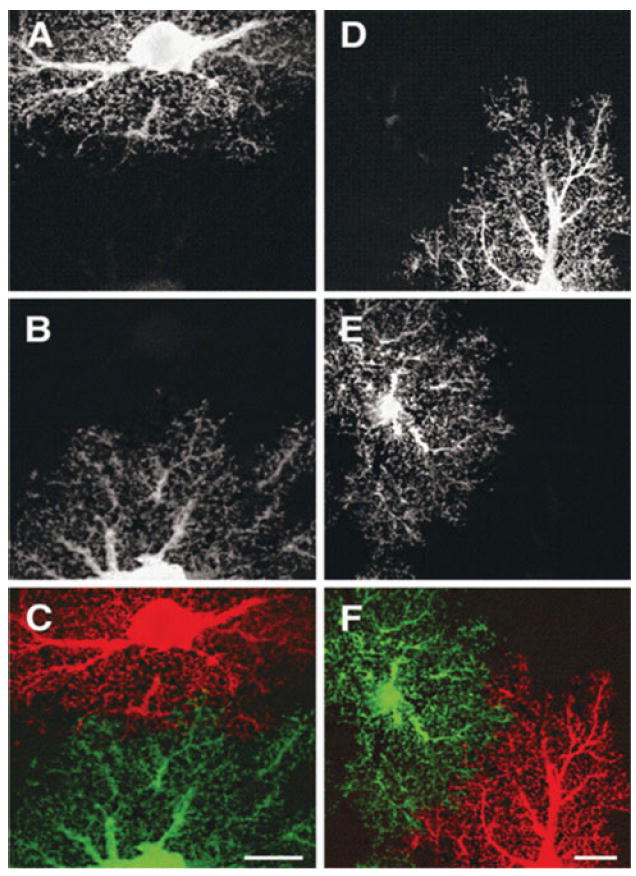
Fig. 1
Fig. 1. Astrocytes at PND 21 (A–C) and at 1 month (D–F) from CA1
Images are maximum projections of dye-filled astrocytes in optical slices through 1 μm of tissue. Scale bars, 10 μm. Reproduced, with permission, from Bushong et al. (2004).
Fig. 2
Fig. 2. Cells stained for GLAST
Cells filled with biocytin through a patch pipette were immunohistochemically stained for GLAST and images encompassing the entire z dimension of the syncytium were acquired by confocal microscopy. (A) An example of a highly coupled GLAST(+), passive, recorded cell. This is a projection image acquired along the entire z axis of the biocytin-Cy2-Streptavidin channel. (B,C) The smaller panels on the right show portions of single z planes for Biocytin (B) and anti-GLAST (C) from the left image. Arrows point to the recorded and injected cell body. From a P7 rat. Scale bar, 20 μm. Reproduced, with permission, from Schools et al. (2006).
Fig. 3
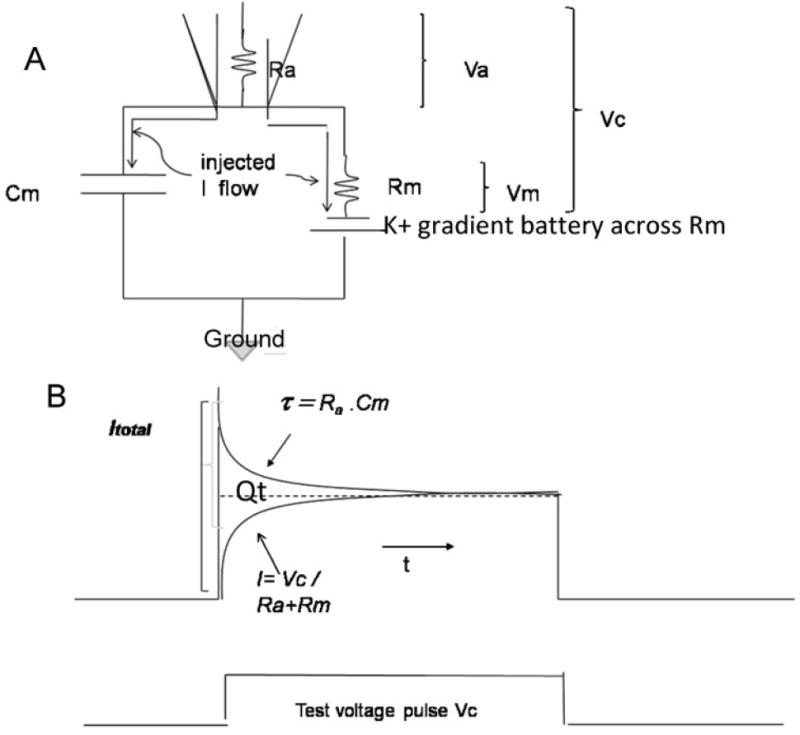
Fig. 3. Membrane tests
(A) Circuit and (B) pCLAMP9 membrane test. Ra = access resistance of the pipette, Rm = effective membrane resistance and Cm the effective capacitance. Effective means what is measured by the electrode. Vc is the command potential. Va is the voltage drop across Ra and Vm the voltage drop across Rm. Adapted from pCLAMP 9, 2003 Axon Instruments, Inc. See text for further details.
Fig. 4
Fig. 4. Whole cell recordings from cells in situ
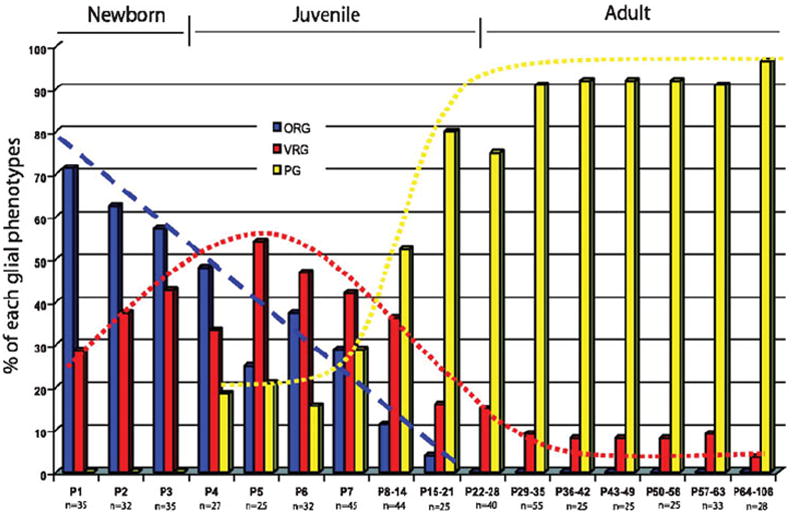
(a–c) Whole cell recordings in response to the voltage steps shown in d for the three types of electrophysiological phenotypes seen for cells in situ. The insert (a) shows Na+ currents. Reproduced, with permission, from Zhou et al. (2006).
Fig. 5
Fig. 5. Electrophysiological phenotypes of glial cells
The percentage of glial cells, as first recognized by their morphology in differential interference contrast optics, in a living hippocampal slice that correspond to the three electrophysiological phenotypes shown in Fig. 4. The numbers on the x axis show the postnatal age or age range and n = number of cells recorded in newborn, juvenile and adult stages. Reproduced, with permission, from Zhou et al. (2006).
Fig. 6
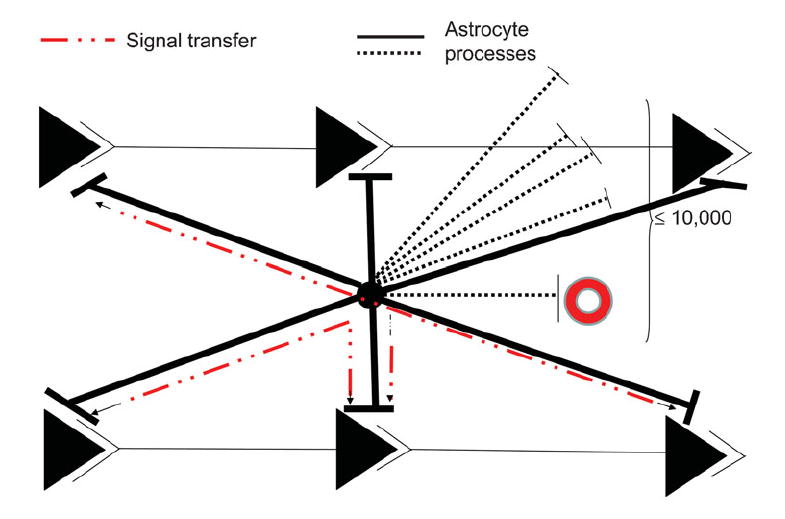
Fig. 6. Schematic of astrocyte processes interacting with synapses and one blood vessel (red circle)
The black circle in the center represents an astrocyte cell body whose processes extend to many synapses (≤10 000). Shown are six synapses in two parallel neuronal circuits. Dashed black lines show members of part of the extensive astrocyte process domain in other planes. The postulated information pathway between astrocyte processes and some of the synapses of the same circuit, or between parallel synapses, is shown as a dashed red line. Astrocytes do not fire action potentials, so the signal is viewed as a spread of either intracellular Ca2+ or another intracellular messenger or messenger system. It is unlikely to be an electrotonic spread of a local depolarization based on calculations of the length constant of astrocytes in situ (Trachtenberg and Pollen, 1970). It is proposed that the perisynaptic astrocyte processes serve to maintain the local environment around the synapses for optimal functioning by localizing key proteins involved in uptake of, for example, glutamate and H+ and channels or transporters for K+ clearance released at the active synapse, and the activity of these fluxes is controlled by local feedback loops. These two possibilities (synaptic homeostasis based on feedback versus an instructional role based on initiating and integrative functions) are extremely difficult to distinguish either in situ or in vivo and, so far, there seem to be insufficient reasons to postulate the latter. See text for a fuller discussion.

References

    1. Amiry-Moghaddam M, Ottersen OP. The molecular basis of water transport in the brain. Nature Reviews Neuroscience. 2003;4:991–1001. - PubMed
    1. Araque A, Li NZ, Doyle RT, Haydon PG. SNARE protein-dependent glutamate release from astrocytes. Journal of Neuroscience. 2000;20:666–673. - PMC - PubMed
    1. Araque A, Parpura V, Sanzgiri RP, Haydon PG. Tripartite synapses: glia, the unacknowledged partner. Trends in Neurosciences. 1999;22:208–215. - PubMed
    1. Aschner M. Neuron-astrocyte interactions: Implications for cellular energetics and antioxidant levels. NeuroToxicology. 2000;21:1101–1107. - PubMed
    1. Berl S, Lajtha A, Waelsch H. Amino acid and protein metabolism–VI cerebral compartments of glutamic acid metabolism. Journal of Neurochemistry. 1961;7:186–197. - PubMed

LinkOut - more resources