. 2008 Aug;159(2):342-50.
doi: 10.1111/j.1365-2133.2008.08655.x. Epub 2008 Jun 28.

Obesity in psoriasis: leptin and resistin as mediators of cutaneous inflammation

Affiliations

Obesity in psoriasis: leptin and resistin as mediators of cutaneous inflammation

A Johnston et al. Br J Dermatol. 2008 Aug.

Abstract

Background: Obesity is a significant risk factor for psoriasis and body mass index (BMI) correlates with disease severity. Objectives To investigate the relationship between obesity and psoriasis, focusing on the role of adipokines such as leptin and resistin.

Patients/methods: Patients with psoriasis (n = 30) were recruited and their BMI, waist circumference and disease severity [Psoriasis Area and Severity Index (PASI)] were recorded. Fasting serum samples were obtained on enrolment and after a course of ultraviolet (UV) B treatment. Age-, sex- and BMI-matched healthy controls were also recruited.

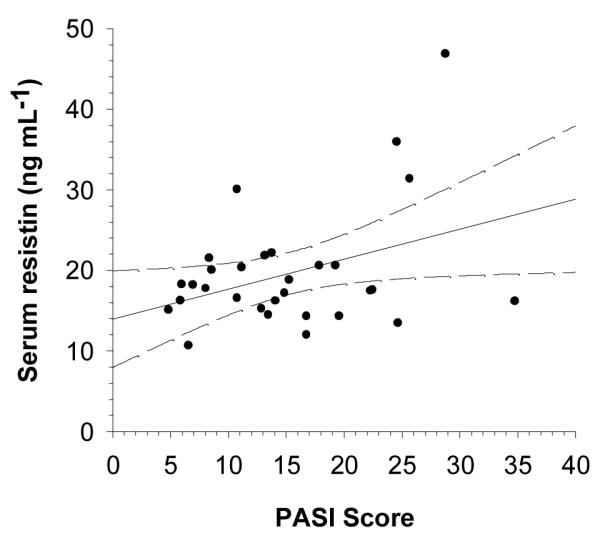
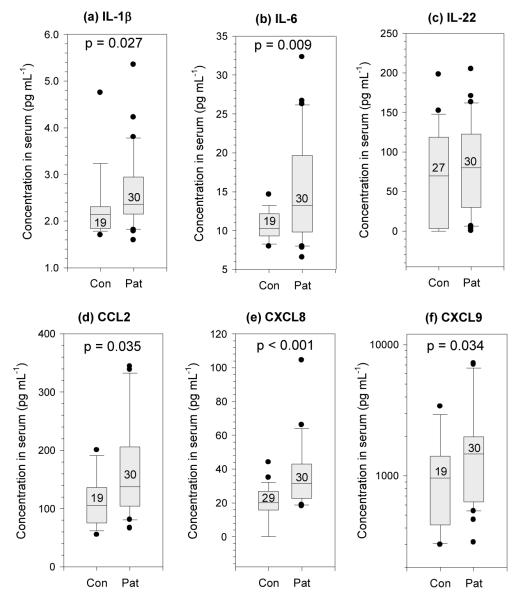
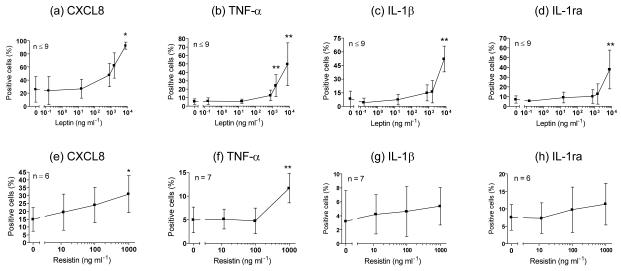
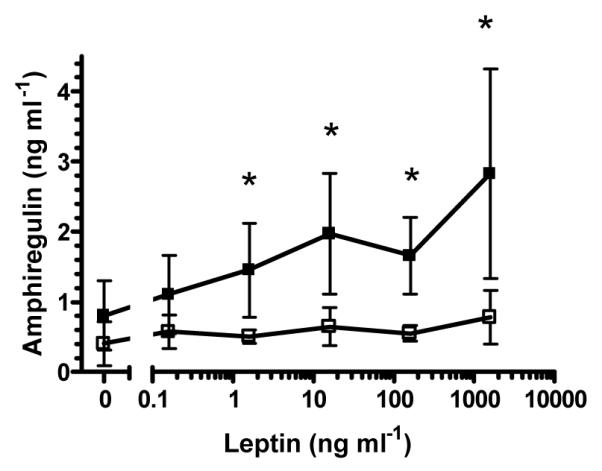
Results: On enrolment, serum leptin and soluble leptin receptor levels were not raised compared with the controls. However, resistin, interleukin (IL)-1beta, IL-6, and chemokines CCL2, CXCL8 and CXCL9 were all significantly elevated in the patient group and serum resistin correlated with disease severity (r = 0.372, P = 0.043). Improvement after UVB treatment was accompanied by decreased serum CXCL8. In vitro, both leptin and resistin could induce CXCL8 and tumour necrosis factor-alpha production by blood monocytes, and leptin could additionally induce IL-1beta and IL-1 receptor antagonist production. Leptin also dose dependently increased secretion of the growth factor amphiregulin by ex vivo-cultured lesional psoriasis skin.

Conclusions: These data support the view that leptin and resistin may be involved in the pathogenesis of psoriasis in overweight individuals, possibly by augmenting the cytokine expression by the inflammatory infiltrate.


Figures
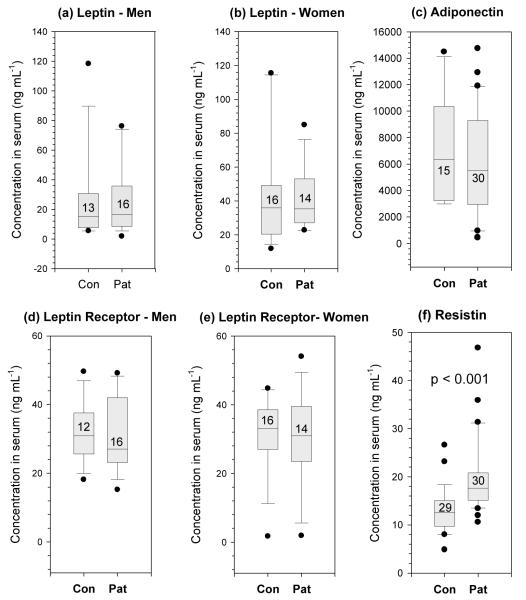
Figure 1
Figure 1. Adipokine levels in serum from patients and matched controls
Adipokines were measured by ELISA in the serum of psoriasis patients and healthy BMI, age and sex matched controls after overnight fast. Leptin, soluble leptin receptor and adiponectin were found not to be elevated in patients compared with matched controls. Resistin, however, was significantly increased. Boxes represent median and interquartile range, whiskers indicate the 10th and 90th percentiles, with values outside this range plotted individually; numbers within boxes indicate the number of individuals tested.
Figure 2
Figure 2
Disease severity (PASI) correlates with patients’ serum resistin concentration (n = 30, r = 0.372, p = 0.043). Dashed lines indicate 95% confidence intervals.
Figure 3
Figure 3. Cytokine levels in serum from patients and controls
Cytokines were measured in fasting serum by multiplex assay or ELISA. IL-1β, IL-6, CCL2 (MCP-1), CXCL8 (IL-8) and CXCL9 (MIG) were all significantly elevated in patients compared with matched healthy controls. Boxes and whiskers are described in Figure 1.
Figure 4
Figure 4. Exogenous leptin (a-d) and resistin (e-h) induce blood monocytes from healthy volunteers to produce pro-inflammatory cytokines ex vivo in a dose-dependent manner
Plots show proportion of cytokine+ CD14+ monocytes detected by intracellular cytokine staining and flow cytometry (mean ± SD). Statistical significance indicated as * p < 0.05, ** p < 0.01, by 1-way ANOVA with Dunnett’s test.
Figure 5
Figure 5. Exogenous leptin induces in vitro cultured psoriasis skin to express the growth factor amphiregulin in a dose-dependent manner
Control skin- open squares, psoriasis skin — filled squares, mean (n = 3) ± S.D. * p < 0.05 1-tailed t-test.
Figure 6
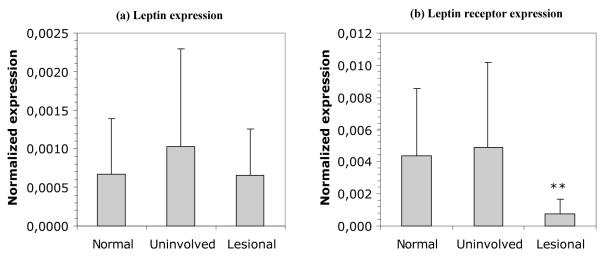
Figure 6. Evalution of (a) leptin and (b) leptin receptor mRNA expression levels in skin by QRT-PCR
Leptin mRNA levels are of similar magnitude in healthy, symptomless psoriasis and lesional psoriasis skin. However, leptin receptor mRNA expression is significantly diminished in lesional psoriasis skin compared with both healthy and symptomless skin. Mean (n = 13) ± SD ** p < 0.005, 2-tailed t-test.
Figure 7
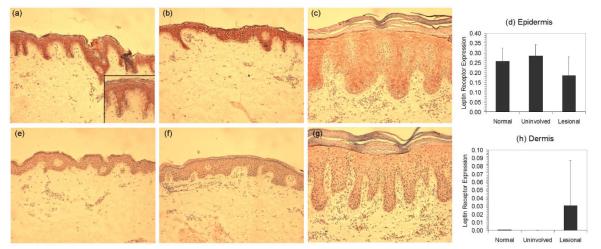
Figure 7. Immunohistochemical evaluation of leptin receptor expression in (a) healthy skin, (b) uninvolved and (c) lesional psoriasis skin
Following immunohistochemical detection of leptin receptor in skin biopsies from 3 healthy and 3 psoriatic donors the strength and extent of receptor expression (red staining) was evaluated in the (d) epidermal and (h) dermal compartments using automated analysis with Image Pro software. For comparison isotype control staining is also shown (e-g).

References

    1. Christophers E. Psoriasis - epidemiology and clinical spectrum. Clin Exp Dermatol. 2001;26:314–20. - PubMed
    1. Griffiths CE, Christophers E, Barker JN, et al. A classification of psoriasis vulgaris according to phenotype. Br J Dermatol. 2007;156:258–62. - PubMed
    1. Valdimarsson H. The genetic basis of psoriasis. Clinics in Dermatology. 2007;23:563–67. - PubMed
    1. Nair RP, Stuart PE, Nistor I, et al. Sequence and haplotype analysis supports HLA-C as the psoriasis susceptibility 1 gene. Am J Hum Genet. 2006;78:827–51. - PMC - PubMed
    1. Valdimarsson H, Baker BS, Jonsdottir I, et al. Psoriasis: a T-cell-mediated autoimmune disease induced by streptococcal superantigens?*1. Immunology Today. 1995;16:145–9. - PubMed

MeSH terms