


Two randomized placebo-controlled trials to evaluate the efficacy and tolerability of mirtazapine for the treatment of obstructive sleep apnea
- PMID: 18548827
- PMCID: PMC2442407
- DOI: 10.1093/sleep/31.6.824
Two randomized placebo-controlled trials to evaluate the efficacy and tolerability of mirtazapine for the treatment of obstructive sleep apnea
Abstract
Objective: Mirtazapine is an a2A antagonist and mixed 5-HT2/5-HT3 antagonist that has been proposed as a potential treatment for obstructive sleep apnea (OSA). A small, randomized, controlled trial has previously found an approximate halving in the severity of OSA with daily doses of 4.5 and 15 mg. We aimed to confirm and extend these findings in 2 randomized placebo-controlled, proof-of-concept trials.
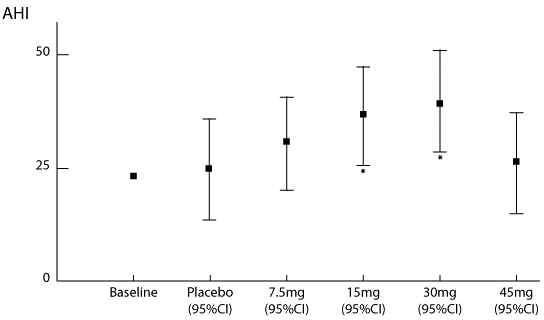
Methods: Two randomized, double-blind, placebo-controlled trials of mirtazapine for OSA (apnea-hypopnea index 10-40/h). Study 1: 3-way crossover, dose-finding study testing the self-administration of mirtazapine (7.5, 15, 30, and/or 45 mg) or placebo 30 minutes prior to bedtime for 2 weeks at each dose. Twenty patients were randomly assigned to 1 of 6 different dose-sequence groups, with each patient exposed to a maximum of 3 doses. Study 2: 3-arm, randomized, parallel-group trial of mirtazapine at 15 mg or mirtazapine 15 mg + Compound CD0012 or placebo for 4 weeks in 65 patients with OSA.
Results: Two patients withdrew from Study 1 after complaints of unacceptable lethargy. Fifteen patients were withdrawn from study 2, 7 after complaints of unacceptable lethargy or other side-effects. No measurement of sleep apnea improved due to mirtazapine in either study. Weight gain was significantly greater on mirtazapine than on placebo in both trials.
Conclusions: Mirtazapine did not improve sleep apnea in either trial. Mirtazapine caused weight gain, which may further worsen OSA. Therefore, mirtazapine is not recommended for the treatment of OSA.
Figures

References
-
- Young T, Peppard PE, Gottlieb DJ. Epidemiology of obstructive sleep apnea: a population health perspective. Am J Respir Crit Care Med. 2002;165:1217–39. - PubMed
-
- Peppard P, Young T, Palta M, et al. Prospective study of the association between sleep-disordered breathing and hypertension. New Eng J Med. 2000;342:1378–84. - PubMed
-
- Peppard PE, Szklo-Coxe M, Hla KM, et al. Longitudinal association of sleep-related breathing disorder and depression. Arch Intern Med. 2006;166:1709–15. - PubMed
-
- Lavie P, Herer P, Peled R, et al. Mortality in sleep apnea patients—a multivariate analysis of risk factors. Sleep. 1995;18:149–57. - PubMed
-
- Marti S, Sampol G, Munoz X, et al. Mortality in severe sleep apnoea/hypopnoea syndrome patients: impact of treatment. Eur Respir J. 2002;20:1511–8. - PubMed
Publication types
MeSH terms
Substances
LinkOut - more resources
Full Text Sources
Other Literature Sources
