Comparative Study
. 2008 Oct;7(5):622-9.
doi: 10.1111/j.1474-9726.2008.00409.x. Epub 2008 Jul 24.

Moderate caloric restriction initiated in rodents during adulthood sustains function of the female reproductive axis into advanced chronological age

Affiliations
Free PMC article
Comparative Study

Moderate caloric restriction initiated in rodents during adulthood sustains function of the female reproductive axis into advanced chronological age

Kaisa Selesniemi et al. Aging Cell. 2008 Oct.
Free PMC article

Abstract

Age-related ovarian failure in women heralds the transition into postmenopausal life, which is characterized by a loss of fertility and increased risk for cardiovascular disease, osteoporosis and cognitive dysfunction. Unfortunately, there are no options available for delaying loss of ovarian function with age in humans. Rodent studies have shown that caloric restriction (CR) can extend female fertile lifespan; however, much of this work initiated CR at weaning, which causes stunted adolescent growth and a delayed onset of sexual maturation. Herein we tested in mice if CR initiated in adulthood could delay reproductive aging. After 4 months of CR, the ovarian follicle reserve was doubled compared to ad libitum (AL)-fed age-matched controls, which in mating trials exhibited a loss of fertility by 15.5 months of age. In CR females returned to AL feeding at 15.5 months of age, approximately one-half remained fertile for 6 additional months and one-third continued to deliver offspring through 23 months of age. Notably, fecundity of CR-then-AL-fed females and postnatal offspring survival rates were dramatically improved compared with aging AL-fed controls. For example, between 10 and 23 months of age, only 22% of the 54 offspring delivered by AL-fed females survived. In contrast, over 73% of the 94 pups delivered by 15.5- to 23-month-old CR-then-AL-fed mice survived without any overt complications. These data indicate that in mice adult-onset CR maintains function of the female reproductive axis into advanced age and dramatically improves postnatal survival of offspring delivered by aged females.


Figures
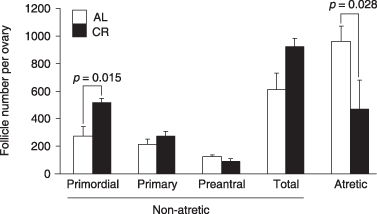
Fig. 1
Fig. 1
Impact of adult-onset caloric restriction (CR) on the ovarian follicle reserve. Number of non-atretic and atretic immature follicles per ovary in continuously ad libitum (AL)-fed or CR female mice at 8 months of age, after initiation of CR 4 months earlier. These data are the mean ± SEM of combined results from analysis of 5 (CR) or 6 (AL-fed) mice, with significant differences in mean values indicated.
Fig. 2
Fig. 2
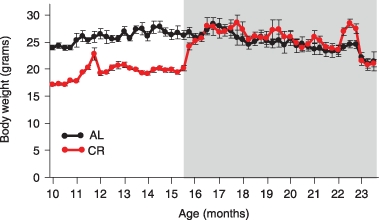
Effect of adult-onset caloric restriction (CR) on body weight. Weekly weight measurements (mean ± SEM) of continuously ad libitum (AL)-fed and CR/CR-then-AL-fed female mice between 10 and 23 months of age. Note the return of body weight in CR mice to continuously AL-fed control levels within 2 weeks after resumption of AL-feeding at 15.5 months of age (CR-then-AL-fed), highlighted by grey shading.
Fig. 3
Fig. 3
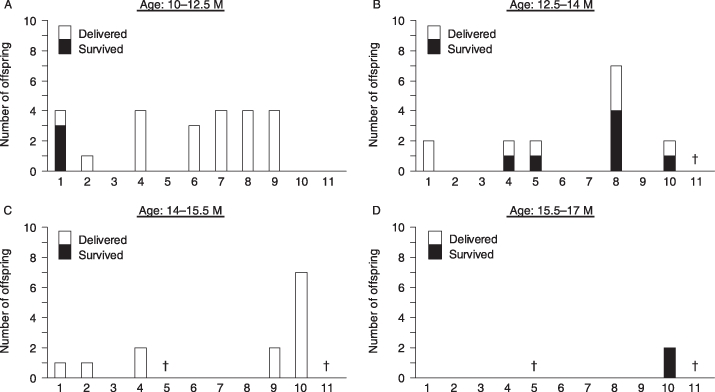
Natural decline in fertility of continuously ad libitum (AL)-fed control females with age. (A–D) Fertility of continuously AL-fed females between 10 and 12.5 (A), 12.5 and 14 (B), 14 and 15.5 (C), and 15.5 and 17 (D) months (M) of age (each mouse is represented by a number on the x-axis). The total number of offspring delivered and that survived for each female that became pregnant are indicated. Crosses designate mice that had to be euthanized due to severe health complications or that died of natural causes during the study period.
Fig. 4
Fig. 4
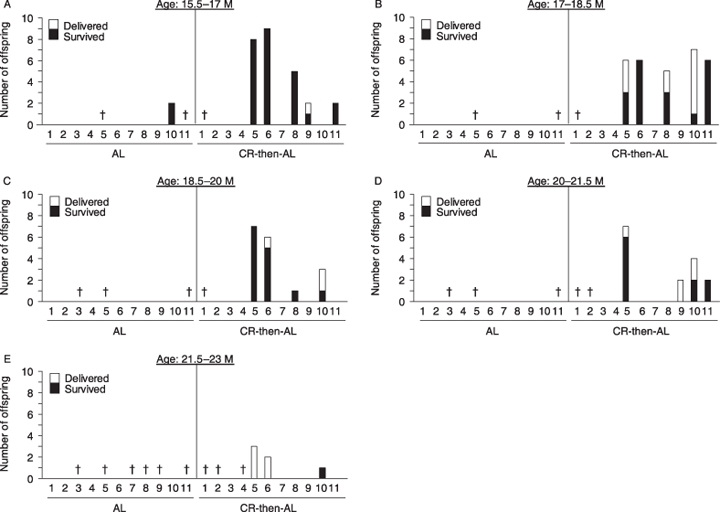
Reproductive performance of aging calorie-restricted (CR) females after re-initiation of ad libitum (AL) feeding at 15.5 months of age. (A–E) Fertility outcomes are shown for each continuously AL-fed control (AL) or CR-then-AL-fed female between 15.5 and 17 (A), 17 and 18.5 (B), 18.5 and 20 (C), 20 and 21.5 (D), and 21.5 and 23 (E) months (M) of age (each mouse is represented by a number on the x-axis) run in parallel mating trials with the same males randomly rotated among the cages. The total number of offspring delivered and that survived for each female that became pregnant are indicated. Crosses designate mice that had to be euthanized due to severe health complications or that died of natural causes during the study period.
Fig. 5
Fig. 5
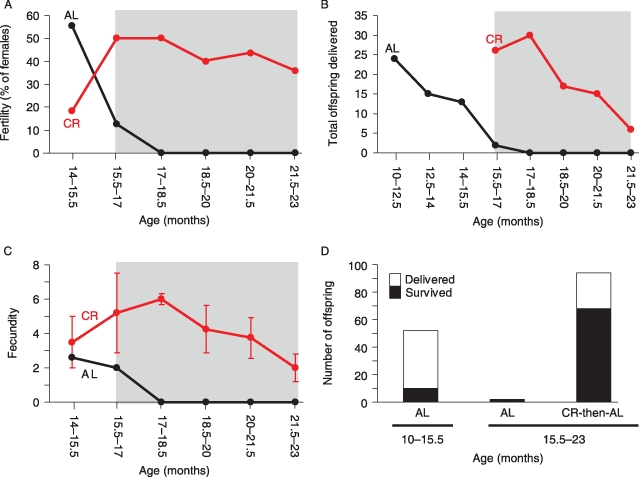
Adult-onset caloric restriction (CR) improves fertility, fecundity and offspring survival rates in aging females. (A–D) Summary of the fertile potential (A, expressed as the percentage of females in each group tested that achieved a pregnancy), total offspring delivered (B), fecundity (C, pups per litter; mean ± SEM), and offspring survival rates (D) in mating trials of continuously AL-fed control females (black lines in A–C) and in CR or CR-then-AL-fed females (red lines in A–C) at the indicated ages. Adult-onset CR females were allowed to resume AL feeding at 15.5 months of age for the remainder of the study period, as highlighted by grey shading in panels A–C. Note the improved outcomes in every endpoint analyzed (A–D) for CR females at each age bracket once AL feeding was resumed.

References

    1. Austad SN. Vertebrate aging research 2006. Aging Cell. 2007;6:135–138. - PubMed
    1. Ball ZB, Barnes RH, Visscher MB. The effects of dietary caloric restriction on maturity and senescence, with particular reference to fertility and longevity. Am. J. Physiol. 1947;150:511–519. - PubMed
    1. Baur JA, Sinclair DA. Therapeutic potential of resveratrol: the in vivo evidence. Nat. Rev. Drug Discov. 2006;5:493–506. - PubMed
    1. Berg BN. Nutrition and longevity in the rat. I. Food intake in relation to size, health and fertility. J. Nutr. 1960;71:242–254. - PubMed
    1. Bodkin NL, Alexander TM, Ortmeyer HK, Johnson E, Hansen BC. Mortality and morbidity in laboratory-maintained rhesus monkeys and effects of long-term dietary restriction. J. Gerontol. A Biol. Sci. Med. Sci. 2003;58A:212–219. - PubMed

Publication types