


Changes in the mechanical properties of the respiratory system during the development of interstitial lung edema
- PMID: 18549493
- PMCID: PMC2442065
- DOI: 10.1186/1465-9921-9-51
Changes in the mechanical properties of the respiratory system during the development of interstitial lung edema
Abstract
Background: Pulmonary edema induces changes in airway and lung tissues mechanical properties that can be measured by low-frequency forced oscillation technique (FOT). It is preceded by interstitial edema which is characterized by the accumulation of extravascular fluid in the interstitial space of the air-blood barrier. Our aim was to investigate the impact of the early stages of the development of interstitial edema on the mechanical properties of the respiratory system.
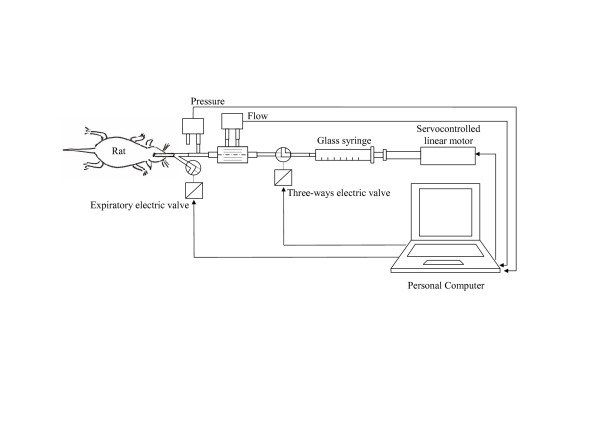
Methods: We studied 17 paralysed and mechanically ventilated closed-chest rats (325-375 g). Total input respiratory system impedance (Zrs) was derived from tracheal flow and pressure signals by applying forced oscillations with frequency components from 0.16 to 18.44 Hz distributed in two forcing signals. In 8 animals interstitial lung edema was induced by intravenous infusion of saline solution (0.75 ml/kg/min) for 4 hours; 9 control animals were studied with the same protocol but without infusion. Zrs was measured at the beginning and every 15 min until the end of the experiment.
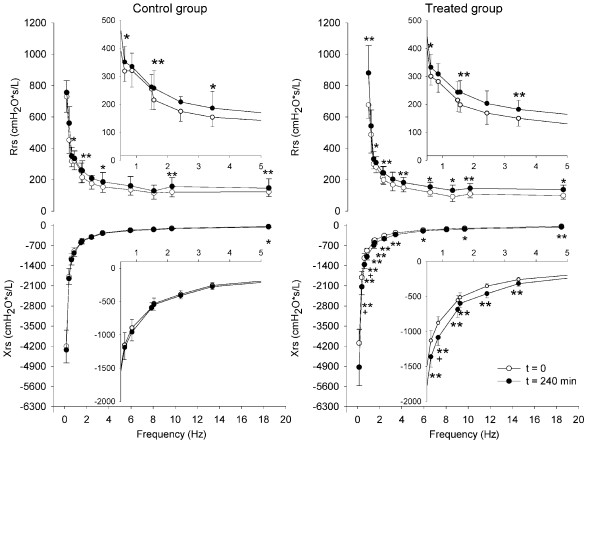
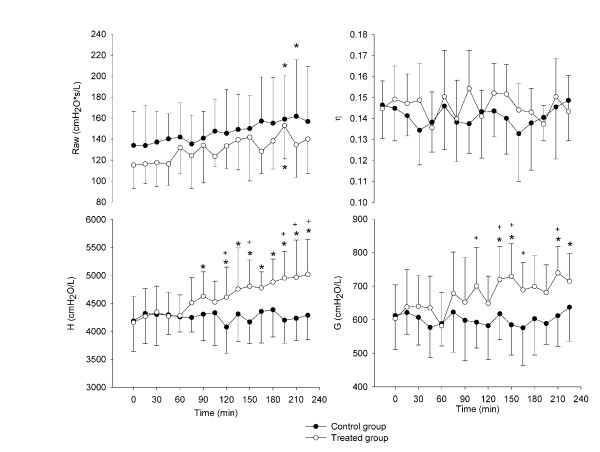
Results: In the treated group the lung wet-to-dry weight ratio increased from 4.3 +/- 0.72 to 5.23 +/- 0.59, with no histological signs of alveolar flooding. Resistance (Rrs) increased in both groups over time, but to a greater extent in the treated group. Reactance (Xrs) did not change in the control group, while it decreased significantly at all frequencies but one in the treated. Significant changes in Rrs and Xrs were observed starting after ~135 min from the beginning of the infusion. By applying a constant phase model to partition airways and tissue mechanical properties, we observed a mild increase in airways resistance in both groups. A greater and significant increase in tissue damping (from 603.5 +/- 100.3 to 714.5 +/- 81.9 cmH2O/L) and elastance (from 4160.2 +/- 462.6 to 5018.2 +/- 622.5 cmH2O/L) was found only in the treated group.
Conclusion: These results suggest that interstitial edema has a small but significant impact on the mechanical features of lung tissues and that these changes begin at very early stages, before the beginning of accumulation of extravascular fluid into the alveoli.
Figures
References
-
- JuulSE. TN W, VC H. Proteoglycans. In: Crystal RG and West JB, editor. The Lung: scientific foundations. New York, Raven; 1991. pp. 413–420.
-
- Hascall VC, Jr., Kimura JH. Biosynthesis, secretion, and aggregation of proteoglycans by rat chondrosarcoma chondrocytes. Ala J Med Sci. 1981;18:29–35. - PubMed
-
- FRANK NR. Influence of acute pulmonary vascular congestion on recoiling force of excised cats' lung. J Appl Physiol. 1959;14:905–908. - PubMed
-
- FRANK NR, RADFORD EP, Jr., Whittenberger JL. Static volumepressure interrelations of the lungs and pulmonary blood vessels in excised cats' lungs. J Appl Physiol. 1959;14:167–173. - PubMed
Publication types
MeSH terms
Substances
LinkOut - more resources
Full Text Sources
Medical
