. 2008 Jul 1;64(1):48-61.
doi: 10.1016/j.biopsych.2008.04.024.

The social-emotional processing stream: five core constructs and their translational potential for schizophrenia and beyond

Affiliations

The social-emotional processing stream: five core constructs and their translational potential for schizophrenia and beyond

Kevin N Ochsner. Biol Psychiatry. .

Abstract

Background: Cognitive neuroscience approaches to translational research have made great strides toward understanding basic mechanisms of dysfunction and their relation to cognitive deficits, such as thought disorder in schizophrenia. The recent emergence of Social Cognitive and Affective Neuroscience has paved the way for similar progress to be made in explaining the mechanisms underlying the social and emotional dysfunctions (i.e., negative symptoms) of schizophrenia and that characterize virtually all DSM Axis I and II disorders more broadly.

Methods: This article aims to provide a roadmap for this work by distilling from the emerging literature on the neural bases of social and emotional abilities a set of key constructs that can be used to generate questions about the mechanisms of clinical dysfunction in general and schizophrenia in particular.

Results: To achieve these aims, the first part of this article sketches a framework of five constructs that comprise a social-emotional processing stream. The second part considers how future basic research might flesh out this framework and translational work might relate it to schizophrenia and other clinical populations.

Conclusions: Although the review suggests there is more basic research needed for each construct, two in particular--one involving the bottom-up recognition of social and emotional cues, the second involving the use of top-down processes to draw mental state inferences--are most ready for translational work.


Figures
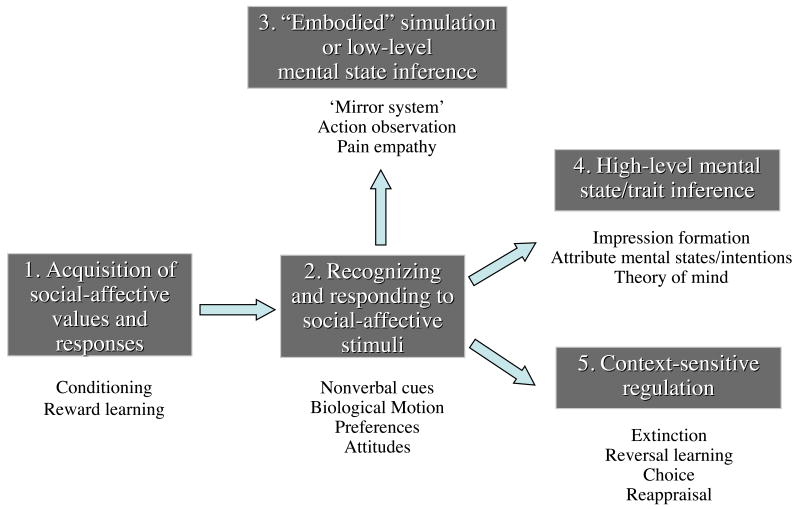
Figure 1
Figure 1
Diagrammatic illustration of the relationships between five proposed core abilities/constructs for social and emotional behavior. Exemplars of each are listed underneath the box naming each ability/construct. For illustrative purposes a linear flow of information is shown between the systems underlying each proposed ability/construct, although in principle the systems underlying each construct may operate independently or in various combinations. See text for details.
Figure 2
Figure 2
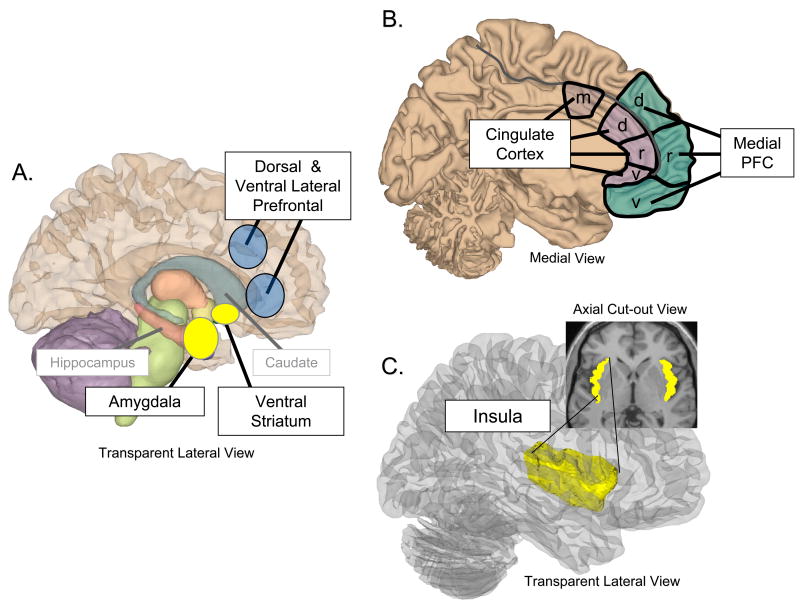
Regions implicated primarily in ability/construct 2, as well as constructs 1 and 3-5. A. Transparent view of right hemisphere showing subcortical regions (amygdala and ventral striatum) involved in conditioning and reward learning. Nearby strctures (hippocampus and caudate) are also shown to provide anatomical reference points). Dorsal and lateral regions implicated in the regulation of affective responses (Constuct 4) also are shown here. B. Medial view of left hemisphere showing cingulate and frontal cortical regions described in the text. m = mid; d = dorsal; r = rostral; v = ventral. Mid cingulate has been implicated in pain and pain empathy (construct 3). Ventral regions have been implicated in the contextual aspects of affective learning (construct 2). Dorsal/rostral regions have been implicated in higher level mental state inference and regulation (constructs 4-5). C. Transparent lateral and axial cut-out views of the insula, which is involved in representing somatovisceral information involved in multiple constructs (2-5). See text for details.
Figure 3
Figure 3
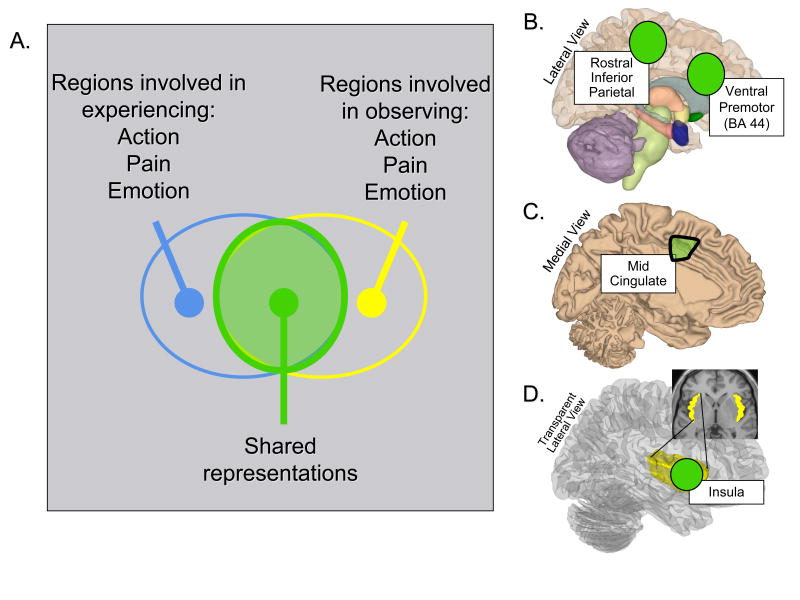
The logic behind and regions implicated in studies of shared representations (see construct 3). A. Venn diagram showing the shared representation logic. The idea is that regions commonly activated during the first person experience of an action, pain, or motion (blue circle) may also be activated when observing others experiencing action, pain, or motion (yellow circle). To the extent that these regions overlap (green circle), the information represented there may play a dual or shared role in supporting the direct experiential understanding of one's own and others actions. B. Semi-transparent lateral view of the right hemisphere showing inferior parietal and ventral premotor regions implicated in the putative “mirror system” for programming and recognizing intentional actions. C. Medial view of the left hemisphere showing a mid cingulate region implicated in pain experience and pain empathy. D. Transparent lateral and axial pop out views of the right hemisphere showing the insular cortex. Highlighted in green are anterior regions of the insula implicated in pain experience, pain empathy, disgust experience and disgust empathy, and negative affective experience more generally. See text for details.
Figure 4
Figure 4
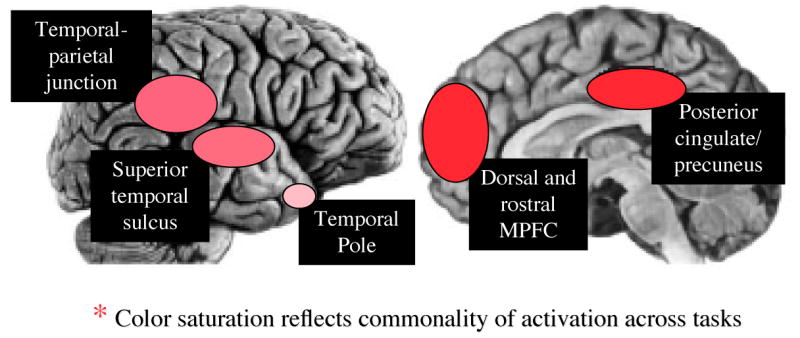
Regions implicated in high level mental state inference (see construct 4). The color saturation of each oval indicates the degree to which it has been commonly activated across multiple kinds of tasks that depend upon the ability to understand others' behavior in terms of internal beliefs, feelings, goals and intentions. See text for details.
Figure 5
Figure 5
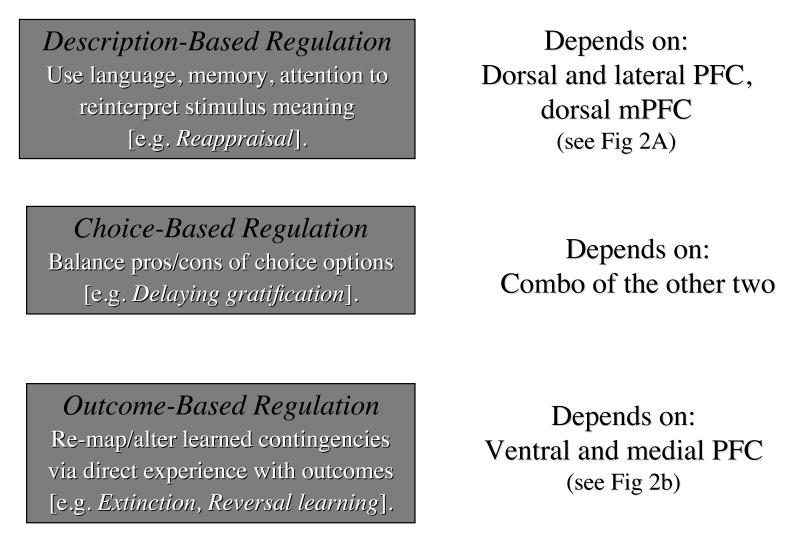
Diagrammatic illustration of three types of context type and appropriate regulation (see construct 5). (Also provide brief descriptions of each form of regulation whereas right panels list neural systems upon which they depend. The relative position of the boxes representing each type of regulation illustrates relationships among them. See text for details.
Figure 6
Figure 6
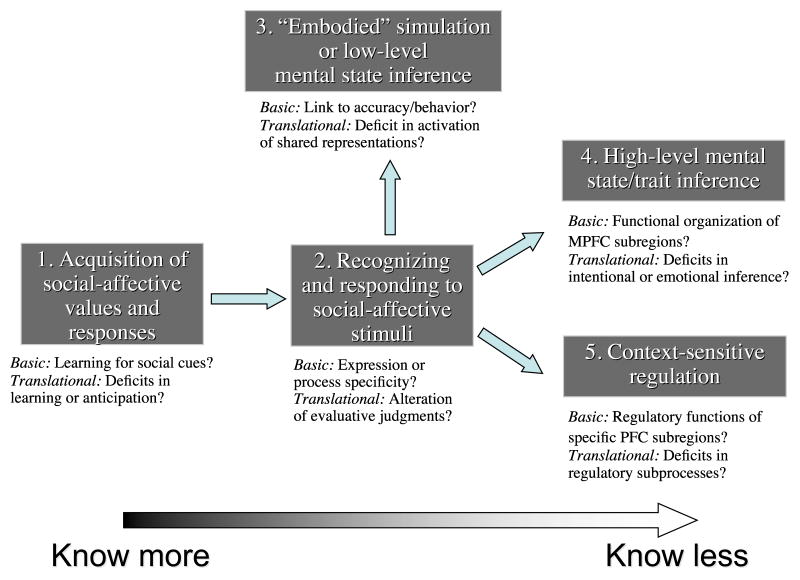
Diagrammatic illustration modified from Figure 1 to show how each proposed ability/construct can be used to generate questions for future research. Basic questions include issues of current controversy and debate about the fundamental neural bases at each ability/construct. Translational questions apply insights gained from basic research to understanding dysfunction in schizophrenia or other clinical disorders more generally. The gradient at the bottom of the Figure roughly represents our current state of basic knowledge about each ability/construct. Thus, the greatest amount of research has been devoted to understanding the first ability/construct and the least has been devoted to understanding ability/constructs 4 and 5.

References

    1. Barch DM, Carter CS, MacDonald AW, 3rd, Braver TS, Cohen JD. Context-processing deficits in schizophrenia: diagnostic specificity, 4-week course, and relationships to clinical symptoms. J Abnorm Psychol. 2003;112:132–143. - PubMed
    1. Carter CS, Barch DM. Cognitive neuroscience-based approaches to measuring and improving treatment effects on cognition in schizophrenia: the CNTRICS initiative. Schizophrenia bulletin. 2007;33:1131–1137. - PMC - PubMed
    1. Holmes AJ, MacDonald A, 3rd, Carter CS, Barch DM, Andrew Stenger V, Cohen JD. Prefrontal functioning during context processing in schizophrenia and major depression: an event-related fMRI study. Schizophr Res. 2005;76:199–206. - PubMed
    1. MacDonald AW, 3rd, Carter CS, Kerns JG, Ursu S, Barch DM, Holmes AJ, et al. Specificity of prefrontal dysfunction and context processing deficits to schizophrenia in never-medicated patients with first-episode psychosis. The American journal of psychiatry. 2005;162:475–484. - PubMed
    1. Lieberman MD. Social cognitive neuroscience: a review of core processes. Annu Rev Psychol. 2007;58:259–289. - PubMed

Publication types

MeSH terms

Substances