Comparative Study
. 2008 Sep;25(9):1877-87.
doi: 10.1093/molbev/msn133. Epub 2008 Jun 12.

Genome evolution of Wolbachia strain wPip from the Culex pipiens group

Affiliations
Comparative Study

Genome evolution of Wolbachia strain wPip from the Culex pipiens group

Lisa Klasson et al. Mol Biol Evol. 2008 Sep.

Abstract

The obligate intracellular bacterium Wolbachia pipientis strain wPip induces cytoplasmic incompatibility (CI), patterns of crossing sterility, in the Culex pipiens group of mosquitoes. The complete sequence is presented of the 1.48-Mbp genome of wPip which encodes 1386 coding sequences (CDSs), representing the first genome sequence of a B-supergroup Wolbachia. Comparisons were made with the smaller genomes of Wolbachia strains wMel of Drosophila melanogaster, an A-supergroup Wolbachia that is also a CI inducer, and wBm, a mutualist of Brugia malayi nematodes that belongs to the D-supergroup of Wolbachia. Despite extensive gene order rearrangement, a core set of Wolbachia genes shared between the 3 genomes can be identified and contrasts with a flexible gene pool where rapid evolution has taken place. There are much more extensive prophage and ankyrin repeat encoding (ANK) gene components of the wPip genome compared with wMel and wBm, and both are likely to be of considerable importance in wPip biology. Five WO-B-like prophage regions are present and contain some genes that are identical or highly similar in multiple prophage copies, whereas other genes are unique, and it is likely that extensive recombination, duplication, and insertion have occurred between copies. A much larger number of genes encode ankyrin repeat (ANK) proteins in wPip, with 60 present compared with 23 in wMel, many of which are within or close to the prophage regions. It is likely that this pattern is partly a result of expansions in the wPip lineage, due for example to gene duplication, but their presence is in some cases more ancient. The wPip genome underlines the considerable evolutionary flexibility of Wolbachia, providing clear evidence for the rapid evolution of ANK-encoding genes and of prophage regions. This host-Wolbachia system, with its complex patterns of sterility induced between populations, now provides an excellent model for unraveling the molecular systems underlying host reproductive manipulation.


Figures
F<sc>IG</sc>. 1.—
FIG. 1.—
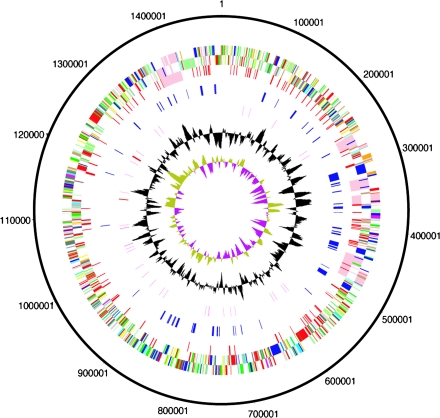
Circular representations of the genome of Wolbachia pipientis. The circles represent from the outside in: 1 + 2, all genes (transcribed clockwise and counterclockwise); 3, mobile elements (pink: prophage, red: IS elements); 4, ankyrin repeat genes (blue); 5, RNA genes (red: rRNAs, purple: tRNAs); 6, G + C content (plotted using a 10-kb window); 7, GC deviation ([G − C]/[G + C] plotted using a 10-kb window; khaki indicates values >1, purple <1). Color coding for genes in circles 1 + 2: dark blue, cell processes/adaptation/pathogenicity; black, energy metabolism; red, information transfer; dark green, surface associated; cyan, degradation of large molecules; magenta, degradation of small molecules; yellow, central/intermediary metabolism; pale green, unknown; pale blue, regulators; orange, conserved hypothetical; brown, pseudogenes; pink, mobile elements; and gray, miscellaneous.
F<sc>IG</sc>. 2.—
FIG. 2.—
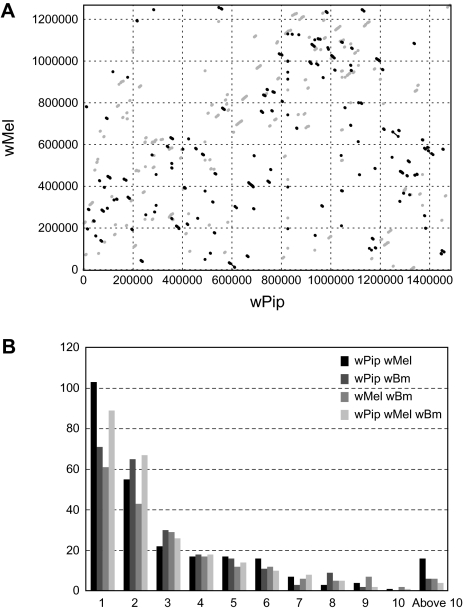
Synteny in Wolbachia between-genome comparisons. (A) Dot plot of the wPip genome sequence versus the wMel genome sequence. Coordinates were generated using nucmer with parameters—maxgap = 500—mincluster = 100, and the plot was generated by mummerplot. Gray dots represent forward matches, and black dots represent reverse matches. (B) Sizes (in number of genes) of blocks of genes found in synteny between the 3 different Wolbachia genomes. The x axis shows the number of genes in a block, and the y axis shows the number of blocks with a certain size. The bars correspond to comparisons between wPip–wMel, wPip–wBm, wMel–wBm–wPip, and wMel–wBm, respectively. All comparisons were based on reciprocal best Blast hits from BlastP searches (see Materials and Methods).
F<sc>IG</sc>. 3.—
FIG. 3.—
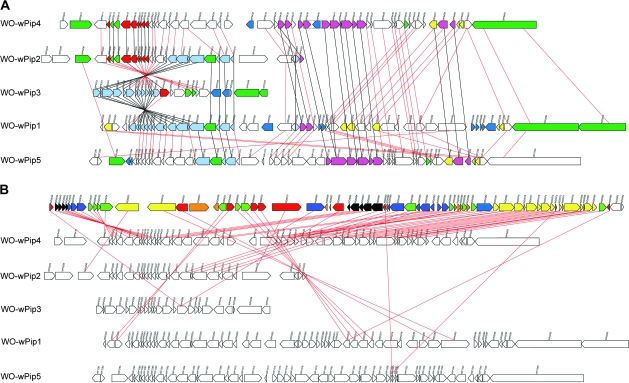
WO phage in wPip. (A) The 5 prophage copies in the genome of wPip. The colors of the boxes represent: green, ANK genes; dark blue, transposases; and yellow, putative transcriptional regulators. Other colors represent identical genes, that is, red genes are identical to other red genes. Black lines connect genes that are identical, and red lines connect genes that are homologous but not identical. (B) WO phage comparing wPip copies with wMel: number of homologues in wPip to genes in the WO-B prophage region in the wMel genome. The top row represents the genes in the WO-B prophage region in the wMel genome, and the next 5 rows depict the 5 prophage regions in wPip. The genes in wMel are colored according to the number of homologues found in the different copies of the wPip prophages. Black, 5 homologues; blue, 4 homologues; green, 3 homologues; yellow, 2 homologues; red, 1 homologues; and orange, 0 homologues. Lines connect the WO-B gene to one of the homologues.
F<sc>IG</sc>. 4.—
FIG. 4.—
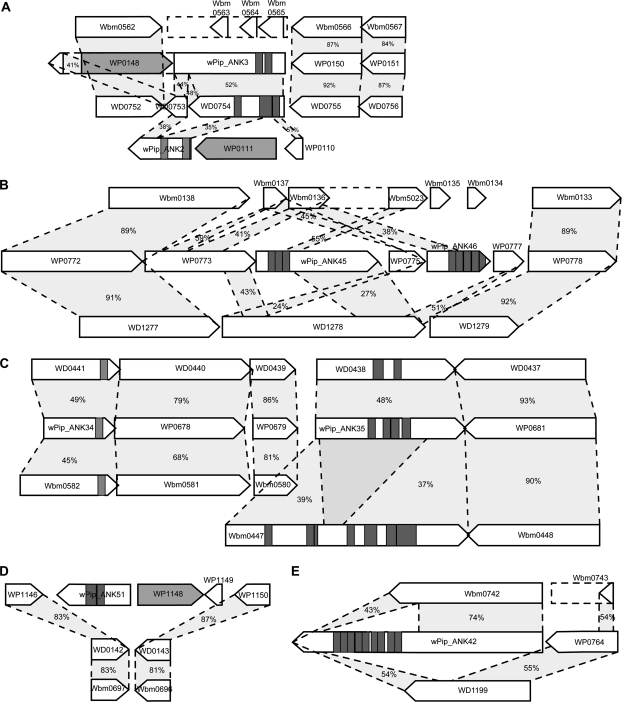
ANK gene evolution: 5 examples of different evolutionary scenarios of ANK genes in wPip. Gray rectangles show the position of ANK domains, and dark gray genes represent transposons. Dotted lines are drawn between homologous genes, and the number represents percent identity on the amino acid level. (A) Example of a possible duplication event in the wPip genome of wPip_ANK2 and wPip_ANK3 with comparison to wMel and wBm. (B) Possible deletions of ANK domains in wMel and wBm, putative duplication in wPip and wPip ANK is homologous to non-ANK genes. (C) Conserved gene order of ANKs between wPip, wMel, and wBm. (D) Example of a wPip ANK gene inserted in a region of local synteny with wMel and wBm. (E) Possible deletions of ANK domains in wMel and wBm, wPip ANK homologies are found to non-ANK genes.
F<sc>IG</sc>. 5.—
FIG. 5.—
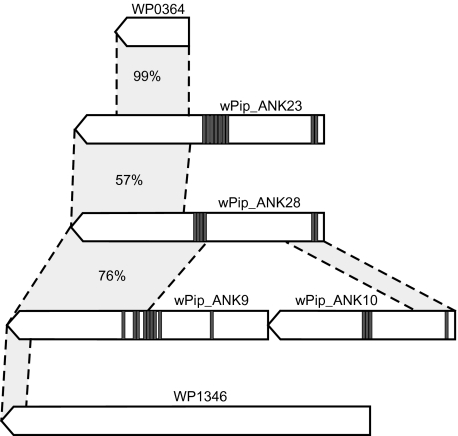
Schematic figure of the large ANK genes found in close proximity of the WO prophages in wPip. Gray rectangles show the position of ANK domains, dotted lines are drawn between similar regions, and the number percent represents percent identity on the amino acid level.

References

    1. Baldo L, Werren JH. Revisiting Wolbachia supergroup typing based on WSP: spurious lineages and discordance with MLST. Curr Microbiol. 2007;55:81–87. - PubMed
    1. Bandi C, McCall JW, Genchi C, Corona S, Venco L, Sacchi L. Effects of tetracycline on the filarial worms Brugia pahangi and Dirofilaria immitis and their bacterial endosymbionts Wolbachia. Int J Parasitol. 1999;29:357–364. - PubMed
    1. Barr AR. Cytoplasmic incompatibility in natural populations of a mosquito, Culex pipiens L. Nature. 1980;283:71–72. - PubMed
    1. Bordenstein SR, Wernegreen JJ. Bacteriophage flux in endosymbionts (Wolbachia): infection frequency, lateral transfer, and recombination rates. Mol Biol Evol. 2004;21:1981–1991. - PubMed
    1. Brownlie JC, O'Neill SL. Wolbachia genomics: accelerating our understanding of a pervasive symbiosis. In: Bourtzis K, Miller TA, editors. Insect symbiosis. Boca Raton (FL): CRC Press; 2006. pp. 175–183.

Publication types

Associated data

LinkOut - more resources