. 2008 Sep;3(5):1548-54.
doi: 10.2215/CJN.01350308. Epub 2008 Jun 11.

Vitamin D and sunlight: strategies for cancer prevention and other health benefits

Affiliations

Vitamin D and sunlight: strategies for cancer prevention and other health benefits

Michael F Holick. Clin J Am Soc Nephrol. 2008 Sep.

Abstract

Vitamin D deficiency is a worldwide health problem. The major source of vitamin D for most humans is sensible sun exposure. Factors that influence cutaneous vitamin D production include sunscreen use, skin pigmentation, time of day, season of the year, latitude, and aging. Serum 25-hydroxyvitamin D [25(OH)D] is the measure for vitamin D status. A total of 100 IU of vitamin D raises blood level of 25(OH)D by 1 ng/ml. Thus, children and adults who do not receive adequate vitamin D from sun exposure need at least 1000 IU/d vitamin D. Lack of sun exposure and vitamin D deficiency have been linked to many serious chronic diseases, including autoimmune diseases, infectious diseases, cardiovascular disease, and deadly cancers. It is estimated that there is a 30 to 50% reduction in risk for developing colorectal, breast, and prostate cancer by either increasing vitamin D intake to least 1000 IU/d vitamin D or increasing sun exposure to raise blood levels of 25(OH)D >30 ng/ml. Most tissues in the body have a vitamin D receptor. The active form of vitamin D, 1,25-dihydroxyvitamin D, is made in many different tissues, including colon, prostate, and breast. It is believed that the local production of 1,25(OH)(2)D may be responsible for the anticancer benefit of vitamin D. Recent studies suggested that women who are vitamin D deficient have a 253% increased risk for developing colorectal cancer, and women who ingested 1500 mg/d calcium and 1100 IU/d vitamin D(3) for 4 yr reduced risk for developing cancer by >60%.


Figures
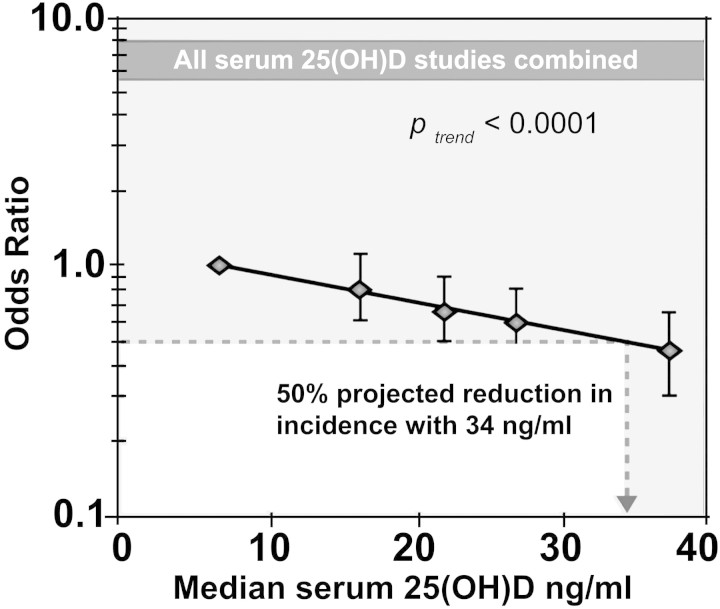
Figure 1.
Figure 1.
Dosage-response gradient for colorectal cancer according to serum 25-hydroxyvitamin D [25(OH)D] concentration of five studies combined. The five points are the odds ratios for each quintile of 25(OH)D on the basis of the combined data from the five studies. Reprinted from reference (8), with permission.
Figure 2.
Figure 2.
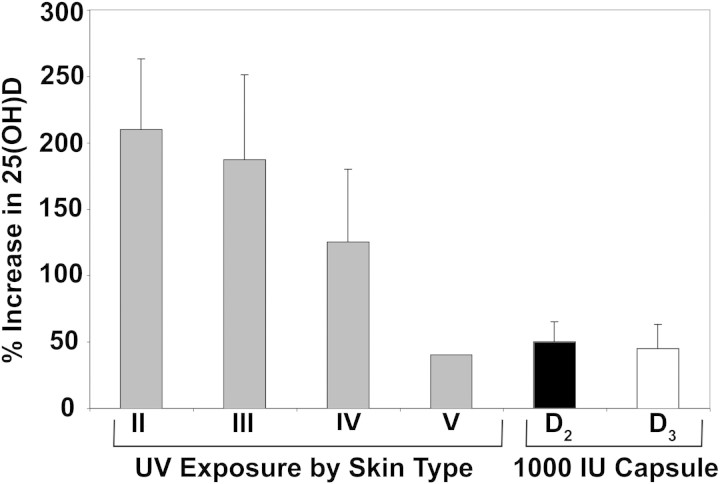
Comparison of the percentage increase in serum 25(OH)D levels of healthy adults who were in a bathing suit and exposed to suberythemal doses (0.5 MED) of ultraviolet B radiation once a week for 3 mo with healthy adults who received either 1000 IU of vitamin D2 or 1000 IU of vitamin D3 daily during the winter and early spring for a period of 11 wk. Fifty percent increase represented approximately 10 ng/ml from baseline 18 ± 3 to 28 ± 4 ng/ml. Skin type is based on the Fitzpatrick scale: Type II always burns, sometimes tans; type III always burns, always tans; type IV sometimes burns, always tans; type V never burns, always tans. Data are means ± SEM. Reprinted with permission, copyright Michael F. Holick, 2008.
Figure 3.
Figure 3.
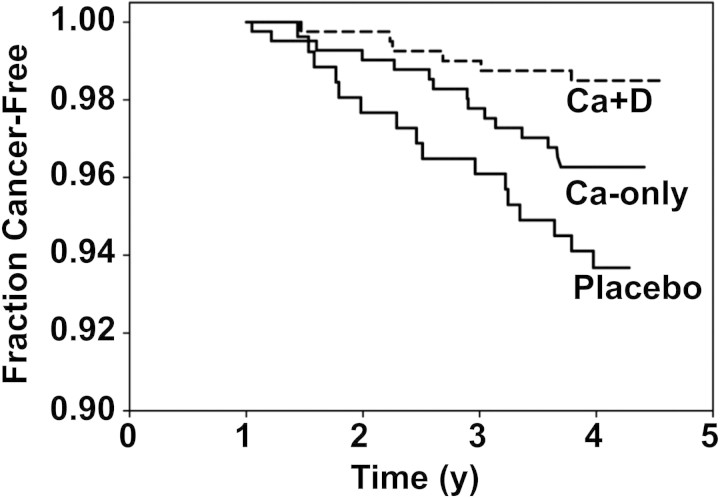
Kaplan-Meier survival curves (i.e., free of cancer) for the three treatment groups randomly assigned in the cohort of women who were free of cancer at 1 yr of intervention (n = 1085). Sample sizes are 266 for the placebo group, 416 for the calcium-only (Ca-only) group, and 403 for the calcium plus vitamin D (Ca+D) group. The survival at the end of study for the Ca+D group is significantly higher than that for the placebo group, by logistic regression. Reprinted with permission from Dr. Robert Heaney, 2007.
Figure 4.
Figure 4.
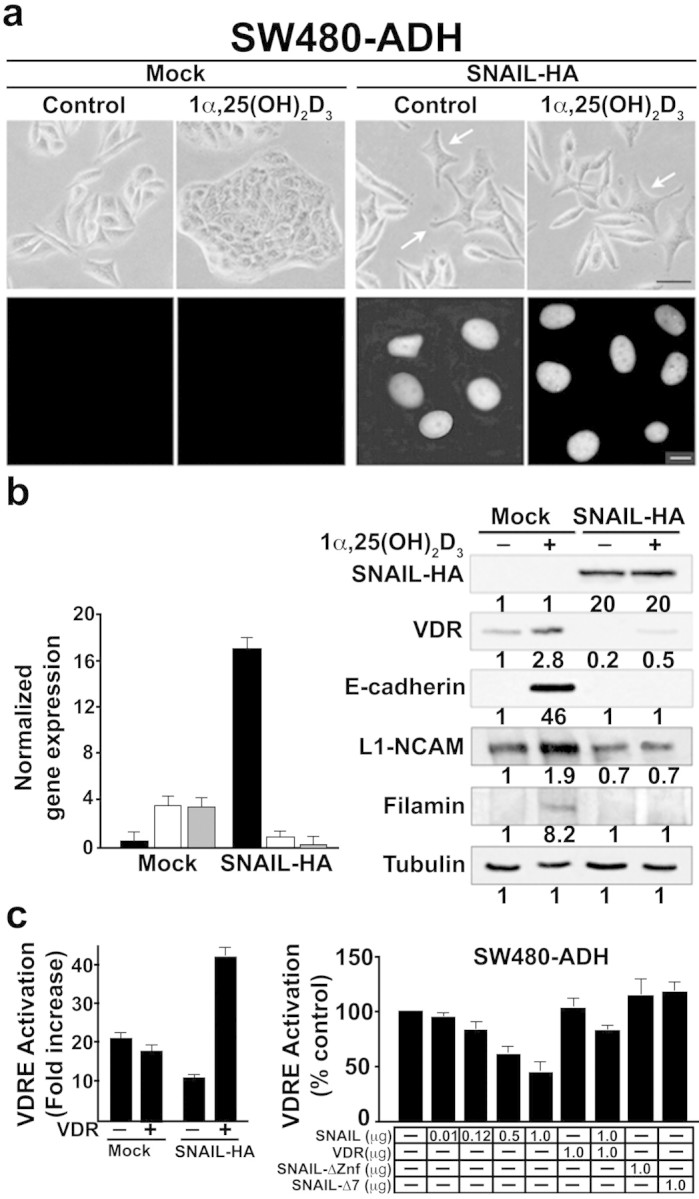
(Top) Micrographs of SNAIL-HA and mock-infected cells. Arrows indicate the phenotypic change induced by SNAIL. Bar = 50 μm. (Bottom) Immunostaining of ectopic SNAIL expression using an antibody to HA. Bar = 10 μm. (Left) Normalized SNAIL. Vitamin D receptor (VDR) and E-cadherin mRNA levels were measured by real-time reverse transcriptase–PCR. (Right) Protein expression was estimated by Western blot. Numbers refer to fold increase over untreated mock-infected cells. SNAIL inhibits the induction of L1-NCAM and filamin by 1,25(OH)D2D3. Wild-type (left) but not mutant (right) SNAIL proteins inhibit VDR transcriptional activity (4XVDRE-tk-luciferase). Reprinted from reference (50), with permission.

References

    1. Holick MF: Vitamin D: A millennium perspective. J Cell Biochem 88 :296– 307,2003 - PubMed
    1. Holick M: F: Resurrection of vitamin D deficiency and rickets. J Clin Invest 116 :2062– 2072,2006 - PMC - PubMed
    1. Hess AF, Unger LJ: The cure of infantile rickets by sunlight. JAMA 77 :39– 41,1921
    1. Hoffman FL: The Mortality of Cancer throughout the World, New York, Prudential Press,1915. , Appendix E
    1. Peller S, Stephenson CS: Skin irritation and cancer in the United States Navy. Am J Med Sci 194 :326– 333,1937

Publication types

MeSH terms