. 2008 Aug;19(8):3477-87.
doi: 10.1091/mbc.e08-03-0236. Epub 2008 Jun 11.

Molecular mechanisms controlling GLUT4 intracellular retention

Affiliations

Molecular mechanisms controlling GLUT4 intracellular retention

Vincent Blot et al. Mol Biol Cell. 2008 Aug.

Abstract

In basal adipocytes, glucose transporter 4 (GLUT4) is sequestered intracellularly by an insulin-reversible retention mechanism. Here, we analyze the roles of three GLUT4 trafficking motifs (FQQI, TELEY, and LL), providing molecular links between insulin signaling, cellular trafficking machinery, and the motifs in the specialized trafficking of GLUT4. Our results support a GLUT4 retention model that involves two linked intracellular cycles: one between endosomes and a retention compartment, and the other between endosomes and specialized GLUT4 transport vesicles. Targeting of GLUT4 to the former is dependent on the FQQI motif and its targeting to the latter is dependent on the TELEY motif. These two motifs act independently in retention, with the TELEY-dependent step being under the control of signaling downstream of the AS160 rab GTPase activating protein. Segregation of GLUT4 from endosomes, although positively correlated with the degree of basal retention, does not completely account for GLUT4 retention or insulin-responsiveness. Mutation of the LL motif slows return to basal intracellular retention after insulin withdrawal. Knockdown of clathrin adaptin protein complex-1 (AP-1) causes a delay in the return to intracellular retention after insulin withdrawal. The effects of mutating the LL motif and knockdown of AP-1 were not additive, establishing that AP-1 regulation of GLUT4 trafficking requires the LL motif.


Figures
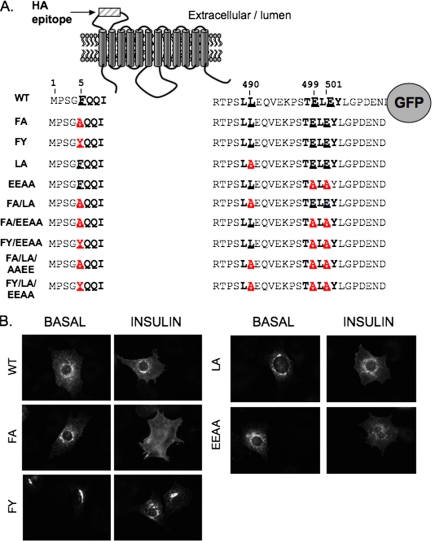
Figure 1.
Figure 1.
GLUT4 mutants used in this study. (A) Schematic representation of HA-GLUT4-GFP. The positions of the amino acids from the N terminus (position 1) are indicated. The mutated amino acids are underlined and the changes in red type. (B) HA-GLUT4-GFP mutants in the basal or the insulin-stimulated adipocytes detected by GFP fluorescence in epifluorescence microscopy. The images were collected with the same exposure times and scaled identically so that they are comparable.
Figure 2.
Figure 2.
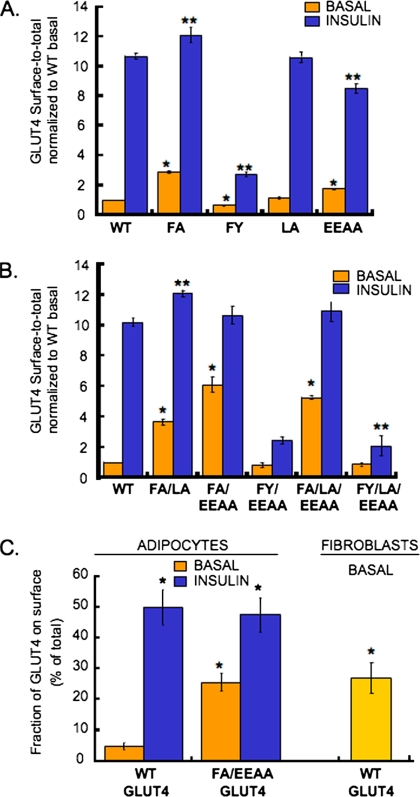
The FQQI and TELEY motifs constitute the basal retention signal. (A) Surface-to-total distribution of HA-GLUT4-GFP mutants in basal or insulin-stimulated adipocytes. For insulin stimulation, cells were incubated with 170 nM insulin for 30 min at 37°C. Results are averages ± SEM from 9 to 16 experiments. The data from the individual experiments are normalized to WT GLUT4 basal surface-to-total ratio measured in the individual experiments (*p < 0.001 compared with WT basal, **p < 0.005 compared with WT insulin. Paired Student's t test). (B) The surface-to-total distribution of the HA-GLUT4-GFP double or triple mutants in basal or insulin-stimulated adipocytes. Results are averages ± SD from two to nine independent experiments. The data from the individual experiments are normalized to WT GLUT4 basal surface-to-total ratio measured in the individual experiments (*p < 0.001 compared with WT basal, **p < 0.05 compared with WT insulin, paired Student's t test). (C) Fraction of total WT or FA/EEAA HA-GLUT4-GFP present in the plasma membrane of basal or insulin-stimulated adipocytes, and of HA-GLUT4 in the plasma membrane of 3T3-L1 fibroblasts. Results are average ± SD of three to four independent experiments (*p = 0.006 compared with WT basal, unpaired Student's t test).
Figure 3.
Figure 3.
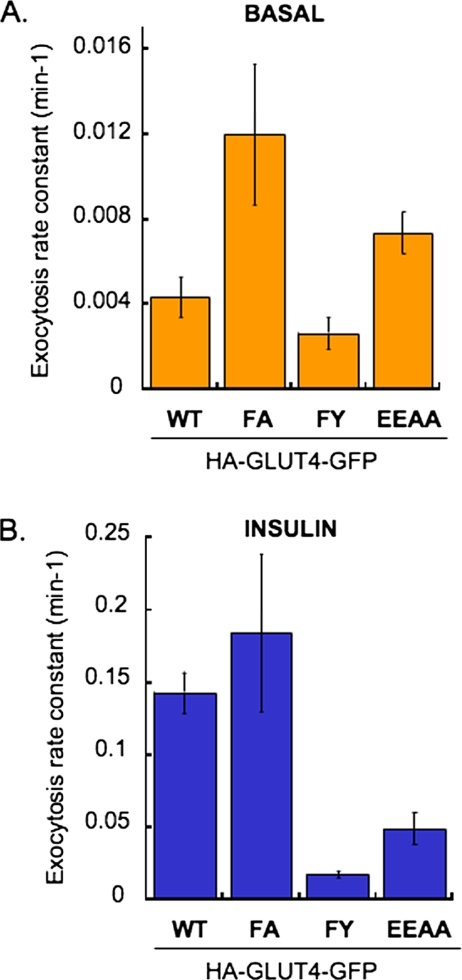
Effects of different mutations in GLUT4 trafficking motifs on HA-GLUT4-GFP exocytosis rate constant in basal (A) and insulin-stimulated (B) adipocytes. Data from at least three different experiments were averaged and a plot of CY3/GFP ratio versus time were fit to a single exponential described by the equation: (Cy3/GFP)t = (Cy3/GFP)plateau − (Cy3/GFP)t = 0 X exp(−kext), where (Cy3/GFP)t is the Cy3/GFP ratio measured at time t, (Cy3/GFP)plateau is the Cy3/GFP ratio measured (Karylowski et al., 2004). The r value for each fit was equal or greater than 0.98, and the χ2 for the lines were WT, 0.003; FA, 0.02; FY, 0.007; and EEAA, 0.003. The exocytosis rate constants (Kex) are determined from nonlinear curve fit to the above-mentioned equation using Kaleidagraph software (Synergy Software, Reading, PA). The rate constants are presented ± SE.
Figure 4.
Figure 4.
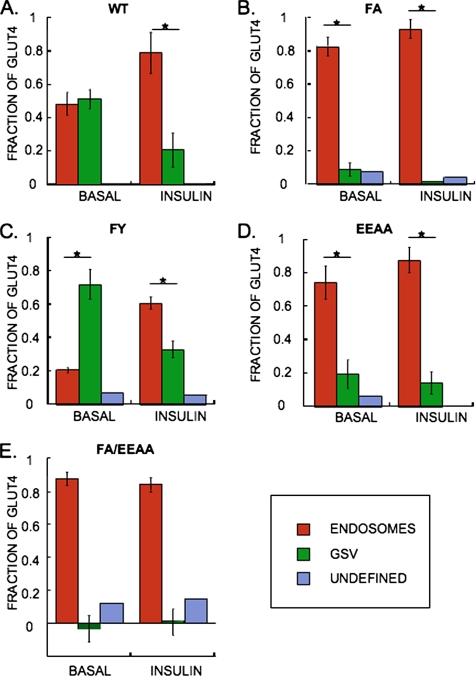
Mutations in GLUT4 motifs alter HA-GLUT4-GFP intracellular distribution between endosomes and GSV. (A) WT GLUT4, (B) FA GLUT4, (C) FY GLUT4, (D) EEAA GLUT4, and (E) FA/EEAA double mutant GLUT4. The distribution of HA-GLUT4-GFP between endosomes and GSV is determined by compartment specific HRP-induced DAB polymerization-mediated ablation of the anti-HA epitopes. HRP taken up by IRAP-TR resulted in 85% ablation of WT GLUT4, which is the maximal ablation expected for two proteins colocalized (Zeigerer et al., 2002). The results presented are corrected for this factor, and nonablated GLUT4 above this 15% threshold are subsequently categorized as being localized in an “undefined” intracellular compartment. Importantly, mutations in GLUT4 resulted in only 0–8% maximum delocalization of HA-GLUT4-GFP in undefined compartments, indicating that the mutations did not result in aberrant delocalization of GLUT4. Results are the average ± SD from three experiments (*p < 0.007, unpaired Student's t test) except for the FA/EEAA mutant, which are the results from a representative experiment plotted as the average ± SEM of at least 20 cells per condition.
Figure 5.
Figure 5.
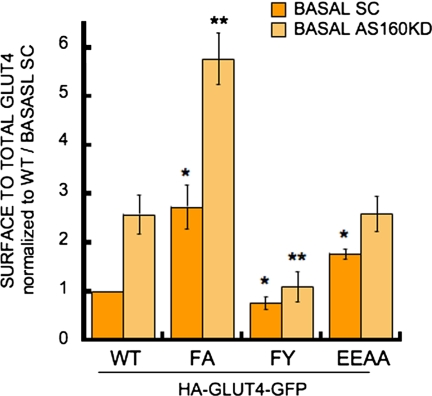
AS160 knockdown in adipocytes and FA mutation have additive affects on GLUT4 basal levels. AS160 knockdown (KD) adipocytes and control cells expressing a scramble shRNA (SC) were described in Eguez et al. (2005). Results are average ± SD of HA-GLUT4-GFP surface to total distributions in either basal SC or AS160 KD adipocytes from four to seven experiments and are normalized to WT GLUT4 in control SC cells (*p < 0.05 compared with WT GLUT4 in control cells (SC). **p <0.01 compared with WT GLUT4 in AS160 KD adipocytes, paired Student's t test).
Figure 6.
Figure 6.
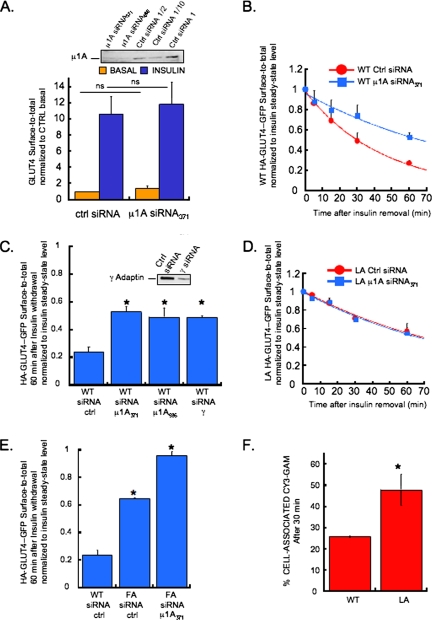
Clathrin adaptor AP-1 and the LL490 motif work at the same step to control GLUT4 return to basal levels after insulin removal. (A) Knockdown of μ1A using two different siRNA (371 and 585) as determined by western blotting (top inset) and effects of μ1A siRNA371 on GLUT4 basal and insulin-stimulated steady- state surface-to-total distributions. The graph is the average ± SD from six independent experiments. ns, nonsignificant, unpaired Student's t test. (B) Effects of μ1A siRNA371 on WT HA-GLUT4-GFP surface-to-total distribution at increasing times after insulin removal. Plots are average ± SD from two independent experiments fitted to an exponential decrease. (C) Effects of μ1A siRNA371, μ1A siRNA585, or γ-adaptin siRNA on the surface-to-total distribution of WT HA-GLUT4-GFP 60 min after insulin removal. The results are the average ± SD from two to three independent experiments. *p < 0.005 compared with WT siRNA ctrl, unpaired Student's t test. The top inset shows the siRNA-mediated knockdown of γ-adaptin as determined by Western blotting. (D) Effects of μ1A siRNA371 on LA HA-GLUT4-GFP surface-to-total distribution at increasing times after insulin removal. Plots are average ± SD from two independent experiments fitted to an exponential decrease. (E) Effects of μ1A siRNA371 on the surface-to-total distribution of FA HA-GLUT4-GFP 60 min after insulin removal. The results are the average ± SD from two independent experiments. *p ≤ 0.01 compared with WT siRNA ctrl, unpaired Student's t test. (F) The LL490 motif determines the fraction of GLUT4 in the rapid recycling pathway. HA-GLUT4-GFP (WT or LA mutant)-expressing cells were pulsed for 5 min with a saturated concentration of HA.11 antibody. Cy3-conjugated secondary antibodies were then added to the medium for 30 min. The increase in cell-associated Cy3 fluorescence compared with time 0 is a measure of GLUT4 return to the PM during the 30-min incubation. At the beginning of the 30 min incubation, ∼15% of WT and LA mutant HA.11 bound GLUT4 (GLUT4 labeled during the 5-min pulse) were in the PM. The values shown are the total cell-associated at the end of the 30-min incubation with Cy3-GAM and therefore are the initial 15% plus what ever returned to the surface during the incubation. The results are average ± SD from two (WT GLUT4) and three (LA mutant) experiments (*p = 0.077, unpaired Student's t test).
Figure 7.
Figure 7.
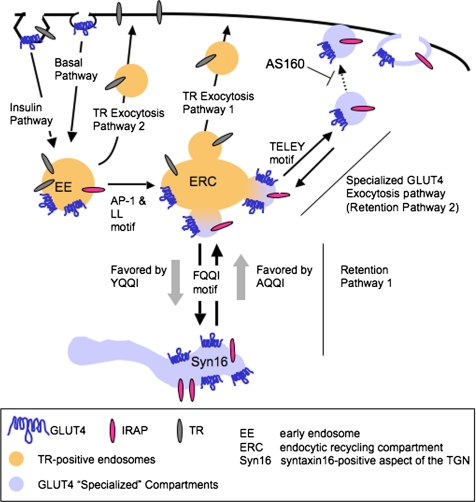
GLUT4 trafficking in adipocytes. For discussion of the intracellular pathways, see the text. We have shown previously, as noted in the figure, that GLUT4 is internalized by different mechanism in basal and insulin-stimulated conditions (Blot and McGraw, 2006). However in both cases GLUT4 is delivered to TR-containing endosomes.

References

    1. Al-Hasani H., Kunamneni R. K., Dawson K., Hinck C. S., Muller-Wieland D., Cushman S. W. Roles of the N- and C-termini of GLUT4 in endocytosis. J. Cell Sci. 2002;115:131–140. - PubMed
    1. Blot V., McGraw T. E. GLUT4 is internalized by a cholesterol-dependent nystatin-sensitive mechanism inhibited by insulin. EMBO J. 2006;25:5648–5658. - PMC - PubMed
    1. Bonifacino J. S., Traub L. M. Signals for sorting of transmembrane proteins to endosomes and lysosomes. Annu. Rev. Biochem. 2003;72:395–447. - PubMed
    1. Bryant N., Govers R., James D. Regulated transport of the glucose transporter GLUT4. Nat. Rev. 2002;3:267–277. - PubMed
    1. Capilla E., Suzuki N., Pessin J. E., Hou J. C. The glucose transporter 4 FQQI motif is necessary for Akt substrate of 160-kilodalton-dependent plasma membrane translocation but not Golgi-localized (gamma)-ear-containing Arf-binding protein-dependent entry into the insulin-responsive storage compartment. Mol. Endocrinol. 2007;21:3087–3099. - PubMed

Publication types

LinkOut - more resources