. 2008 Jun 17;105(24):8428-33.
doi: 10.1073/pnas.0712219105. Epub 2008 Jun 12.

Two distinct activity patterns of fast-spiking interneurons during neocortical UP states

Affiliations

Two distinct activity patterns of fast-spiking interneurons during neocortical UP states

Maria Victoria Puig et al. Proc Natl Acad Sci U S A. .

Abstract

During sleep, neocortical neuronal networks oscillate slowly (<1 Hz) between periods of activity (UP states) and silence (DOWN states). UP states favor the interaction between thalamic-generated spindles (7-14 Hz) and cortically generated gamma (30-80 Hz) waves. We studied how these three nested oscillations modulate fast-spiking interneuron (FSi) activity in vivo in VGAT-Venus transgenic rats. Our data describe a population of FSi that discharge "early" within UP states and another population that discharge "late." Early FSi tended to be silent during epochs of desynchronization, whereas late FSi were active. We hypothesize that late FSi may be responsible for generating the gamma oscillations associated with cognitive processing during wakefulness. Remarkably, FSi populations were differently modulated by spindle and gamma rhythms. Early FSi were robustly coupled to spindles and always discharged earlier than late FSi within spindle and gamma cycles. The preferred firing phase during spindle and gamma waves was strongly correlated in each cell, suggesting a cross-frequency coupling between oscillations. Our results suggest a precise spatiotemporal pattern of FSi activity during UP states, whereby information rapidly flows between early and late cells, initially promoted by spindles and efficiently extended by local gamma oscillations.


Conflict of interest statement

The authors declare no conflict of interest.

Figures
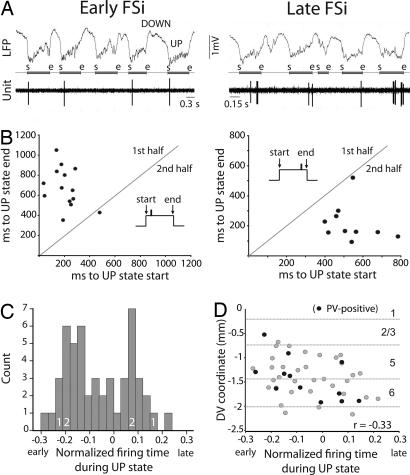
Fig. 1.
Fig. 1.
FSi consistently discharge early or late during UP states. (A) Examples of early- and late-FSis. The start (s) and end (e) of each UP state have been marked between the LFP and unit traces. (B) Scatter plots of averaged distances (in milliseconds) of all spikes within a UP state relative to the start and end of 20 consecutive UP states (same cells as in A). (C) Frequency distribution of normalized times to the start of UP states (−0.5–0.5) of all FSi recorded (n = 50). Zero indicates the center of UP state. 1 and 2 depict the location of example cells in Figs. 1 and 2, respectively. (D) Early units were located more superficially in the dorsoventral (DV) axis than were late units. Only cells recorded in the secondary motor area are shown (n = 46). Dashed lines depict standard layer boundaries. r correlation coefficient in all figures.
Fig. 2.
Fig. 2.
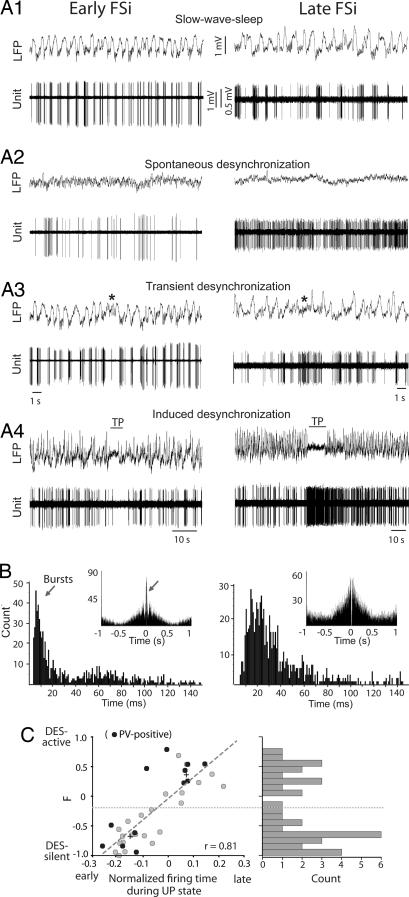
Opposing shifts in discharge frequency between early and late FSi. (A) Examples of spontaneous firing of an early neuron and a late neuron during SWS (A1), DES (A2), transient DES occurring during SWS (A3), and tail pinching-induced DES (TP; A4) delivered during SWS. (B) Interspike interval histograms (ISIHs) of the cells shown in A during SWS epochs. Bursting units showed a bimodal distribution where the first peak contained the brief interspike intervals occurring within bursts (arrow). All bursting FSi belonged to the early FSi population (Left). Most FSi were regular-spiking, with ISIHs exhibiting a unimodal distribution (Right). (Insets) Autocorrelograms show high correlation for bursting cells (arrow). (C) Distribution of the firing index F during UP states. F index = FR(DES)-FR(SWS)/FR(DES)+FR(SWS), where FR is the mean firing rate. Plus marks represent the centers of the two clusters determined by two-means cluster analysis. The boundary is shown by a dotted line. Best-fit regression line is shown.
Fig. 3.
Fig. 3.
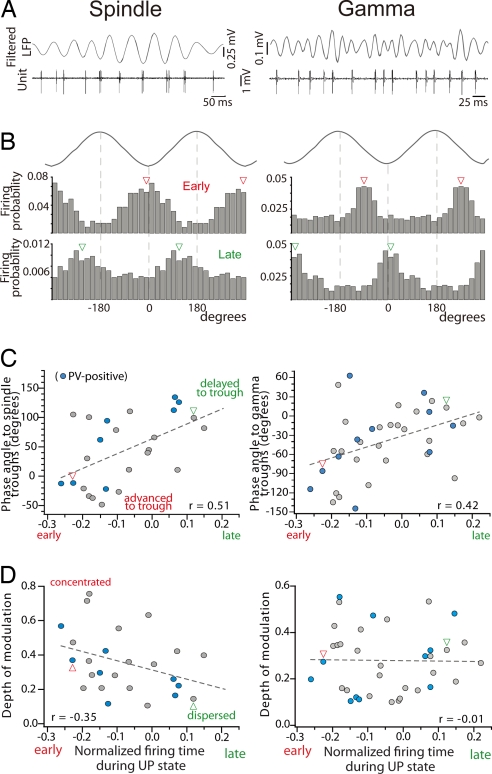
Early FSi fire earlier than late FSi within spindle and gamma cycles. (A) Example of an early cell firing rhythmically with spindle and gamma bands (digitally filtered from the LFP). Note different time scales. (B) Firing probability distributions of the unit shown in A (Middle) and a late FSi (Bottom) during spindle and gamma cycles (Top). Arrowheads point to mean phase angles. Note the smaller scale for the late unit in Left, depicting a weak coupling to spindles. Cycles are shown twice for clarity. (C) Correlation of mean phase angles during spindle and gamma cycles with firing time during the UP states. Firing of early units precedes that of late units around spindle and gamma troughs. Arrowheads point to the examples shown in B. (D) Distribution of the depth of modulation during UP states. Best-fit regression lines are shown.
Fig. 4.
Fig. 4.
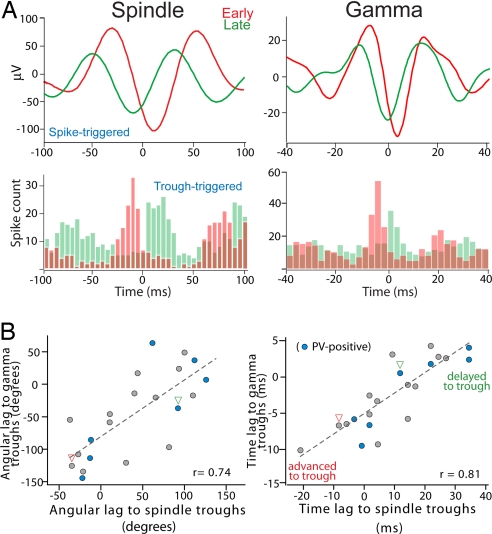
Correlation between phase preferences to spindle and gamma waves. (A Upper) Spike-triggered averages of LFPs filtered at spindle and gamma bands. Examples of an early (red) and a late (green) FSi are shown. (Lower) Firing distributions of the same units around spindle and gamma troughs. Bin size, 2.5 ms. (B) Mean angular (Left) and time (Right) lags from spikes to spindle and gamma troughs are highly correlated. Best-fit regression lines are shown (P < 0.001 for both). Arrowheads point to the examples shown in A.

References

    1. Kawaguchi Y, Kubota Y. GABAergic cell subtypes and their synaptic connections in rat frontal cortex. Cereb Cortex. 1997;7:476–486. - PubMed
    1. Uematsu M, et al. Quantitative chemical composition of cortical GABAergic neurons revealed in transgenic Venus-expressing rats. Cereb Cortex. 2008;18:315–330. - PubMed
    1. Gibson JR, Beierlein M, Connors BW. Two networks of electrically coupled inhibitory neurons in neocortex. Nature. 1999;402:75–79. - PubMed
    1. Hestrin S, Galarreta M. Electrical synapses define networks of neocortical GABAergic neurons. Trends Neurosci. 2005;28:304–309. - PubMed
    1. Bartos M, Vida I, Jonas P. Synaptic mechanisms of synchronized gamma oscillations in inhibitory interneuron networks. Nat Rev Neurosci. 2007;8:45–56. - PubMed

Publication types