


"Inside-out" signaling of sphingosine-1-phosphate: therapeutic targets
- PMID: 18552276
- PMCID: PMC2695666
- DOI: 10.1124/pr.107.07113
"Inside-out" signaling of sphingosine-1-phosphate: therapeutic targets
Abstract
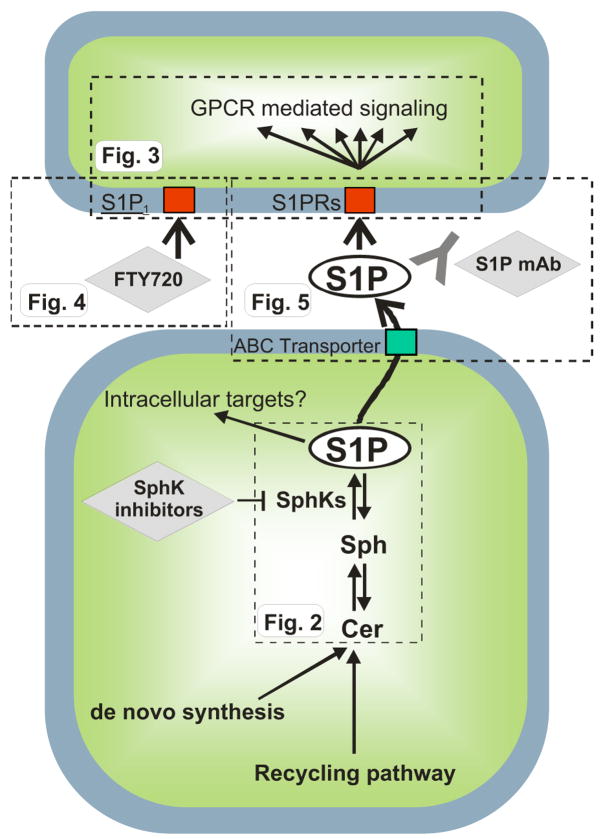
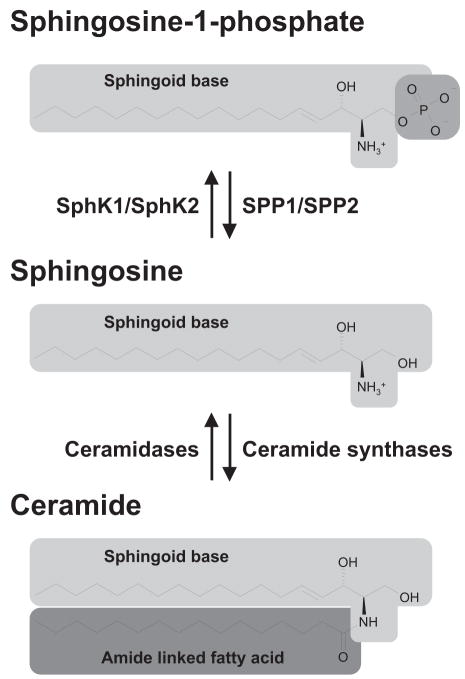
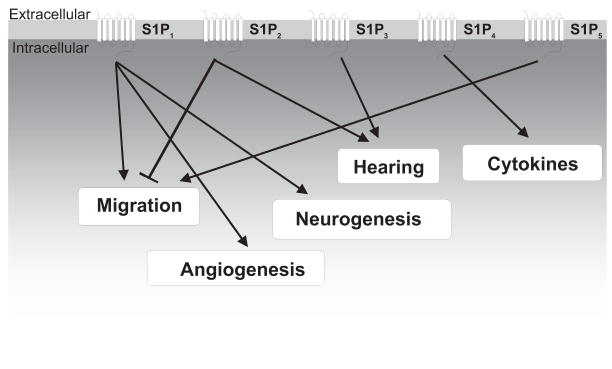
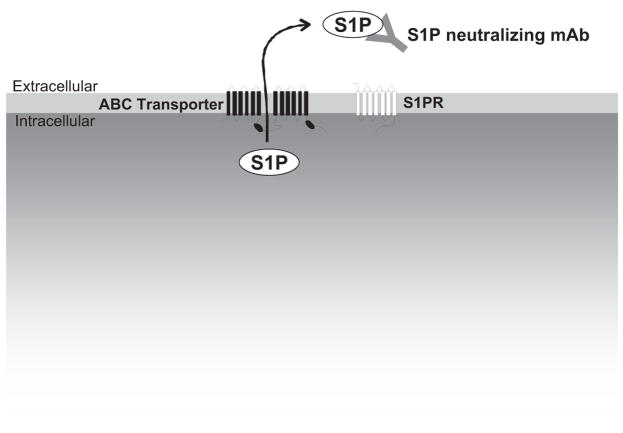
Sphingosine 1-phosphate (S1P) is a bioactive sphingolipid metabolite involved in many critical cellular processes including proliferation, survival, and migration, as well as angiogenesis and allergic responses. S1P levels inside cells are tightly regulated by the balance between its synthesis by sphingosine kinases and degradation. S1P is interconvertible with ceramide, which is a critical mediator of apoptosis. It has been postulated that the ratio between S1P and ceramide determines cell fate. Activation of sphingosine kinase by a variety of agonists increases intracellular S1P, which in turn can function intracellularly as a second messenger or be secreted out of the cell and act extracellularly by binding to and signaling through S1P receptors in autocrine and/or paracrine manners. Recent studies suggest that this "inside-out" signaling by S1P may play a role in many human diseases, including cancer, atherosclerosis, inflammation, and autoimmune disorders such as multiple sclerosis. In this review we summarize metabolism of S1P, mechanisms of sphingosine kinase activation, and S1P receptors and their downstream signaling pathways and examine relationships to multiple disease processes. In particular, we describe recent preclinical and clinical trials of therapies targeting S1P signaling, including 2-amino-2-propane-1,3-diol hydrochloride (FTY720, fingolimod), S1P receptor agonists, sphingosine kinase inhibitors, and anti-S1P monoclonal antibody.
Figures
References
-
- Alemany R, van Koppen CJ, Danneberg K, Ter Braak M, Meyer zu Heringdorf D. Regulation and functional roles of sphingosine kinases. Naunyn Schmiedebergs Arch Pharmacol. 2007;374:413–428. - PubMed
-
- Allende ML, Sasaki T, Kawai H, Olivera A, Mi Y, van Echten-Deckert G, Hajdu R, Rosenbach M, Keohane CA, Mandala S, et al. Mice deficient in sphingosine kinase 1 are rendered lymphopenic by FTY720. J Biol Chem. 2004;279:52487–52492. - PubMed
-
- Alvarez SE, Milstien S, Spiegel S. Autocrine and paracrine roles of sphingosine-1-phosphate. Trends Endocrinol Metab. 2007;18:300–307. - PubMed
-
- Ammit AJ, Hastie AT, Edsall LC, Hoffman RK, Amrani Y, Krymskaya VP, Kane SA, Peters SP, Penn RB, Spiegel S, et al. Sphingosine 1-phosphate modulates human airway smooth muscle cell functions that promote inflammation and airway remodeling in asthma. FASEB J. 2001;15:1212–1214. - PubMed
Publication types
MeSH terms
Substances
Grants and funding
- R37GM043880/GM/NIGMS NIH HHS/United States
- R01CA61774/CA/NCI NIH HHS/United States
- T32 GM008695/GM/NIGMS NIH HHS/United States
- 5T32GM008695-08/GM/NIGMS NIH HHS/United States
- R01 AI050094/AI/NIAID NIH HHS/United States
- K12 HD055881/HD/NICHD NIH HHS/United States
- T32 AI007407/AI/NIAID NIH HHS/United States
- 1K12HD055881-01/HD/NICHD NIH HHS/United States
- R01 CA061774/CA/NCI NIH HHS/United States
- R37 GM043880/GM/NIGMS NIH HHS/United States
- T32AI007407/AI/NIAID NIH HHS/United States
- R01AI50094/AI/NIAID NIH HHS/United States
- ImNIH/Intramural NIH HHS/United States
LinkOut - more resources
Full Text Sources
Other Literature Sources
Molecular Biology Databases
