


Prediction of clinical response based on pharmacokinetic/pharmacodynamic models of 5-hydroxytryptamine reuptake inhibitors in mice
- PMID: 18552871
- PMCID: PMC2538695
- DOI: 10.1038/bjp.2008.243
Prediction of clinical response based on pharmacokinetic/pharmacodynamic models of 5-hydroxytryptamine reuptake inhibitors in mice
Abstract
Background and purpose: Bridging the gap between preclinical research and clinical trials is vital for drug development. Predicting clinically relevant steady-state drug concentrations (Css) in serum from preclinical animal models may facilitate this transition. Here we used a pharmacokinetic/pharmacodynamic (PK/PD) modelling approach to evaluate the predictive validity of 5-hydroxytryptamine (5-HT; serotonin) transporter (SERT) occupancy and 5-hydroxytryptophan (5-HTP)-potentiated behavioral syndrome induced by 5-HT reuptake inhibitor (SRI) antidepressants in mice.
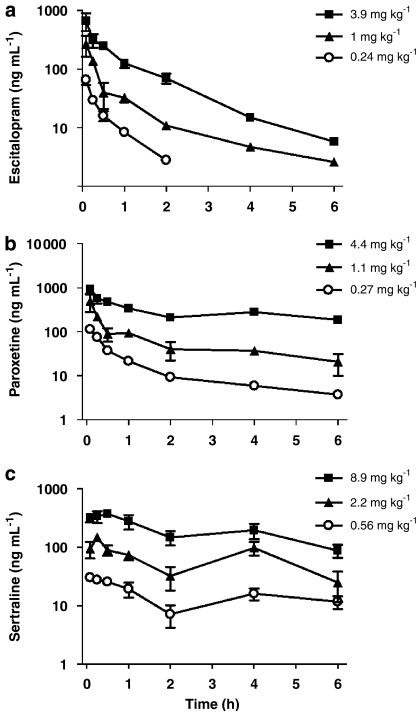
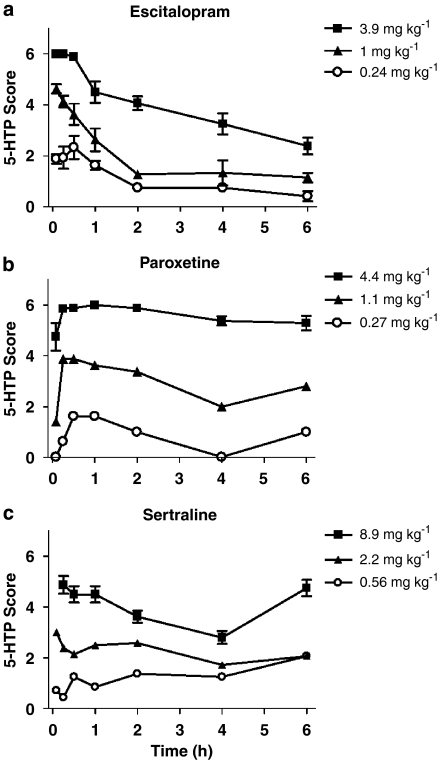
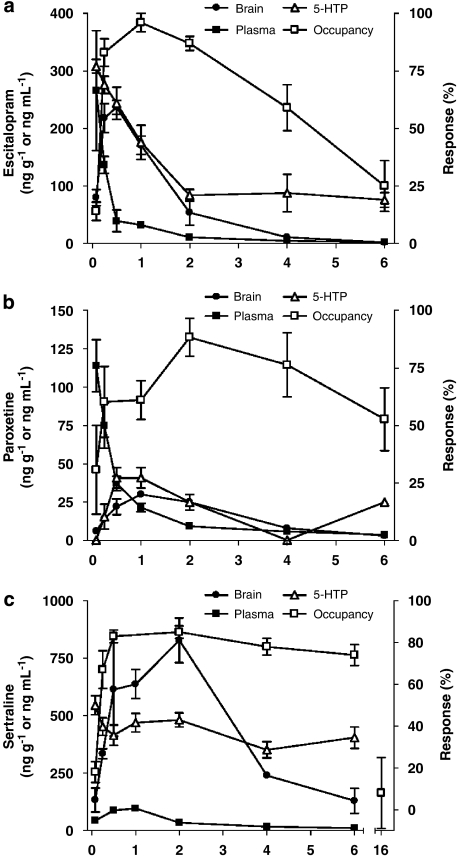
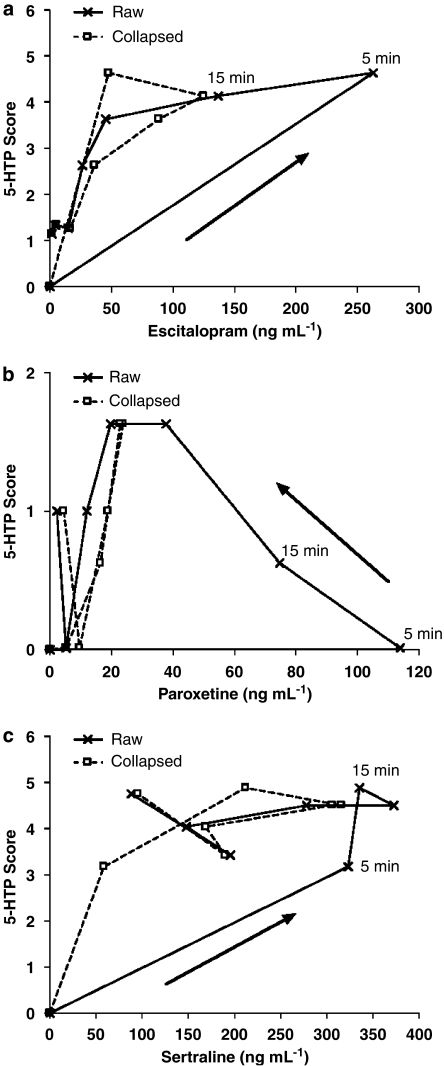
Experimental approach: Serum and whole brain drug concentrations, cortical SERT occupancy and 5-HTP-potentiated behavioral syndrome were measured over 6 h after a single subcutaneous injection of escitalopram, paroxetine or sertraline. [(3)H]2-(2-dimethylaminomethylphenylsulphanyl)-5-methyl-phenylamine ([(3)H]MADAM) was used to assess SERT occupancy. For PK/PD modelling, an effect-compartment model was applied to collapse the hysteresis and predict the steady-state relationship between drug exposure and PD response.
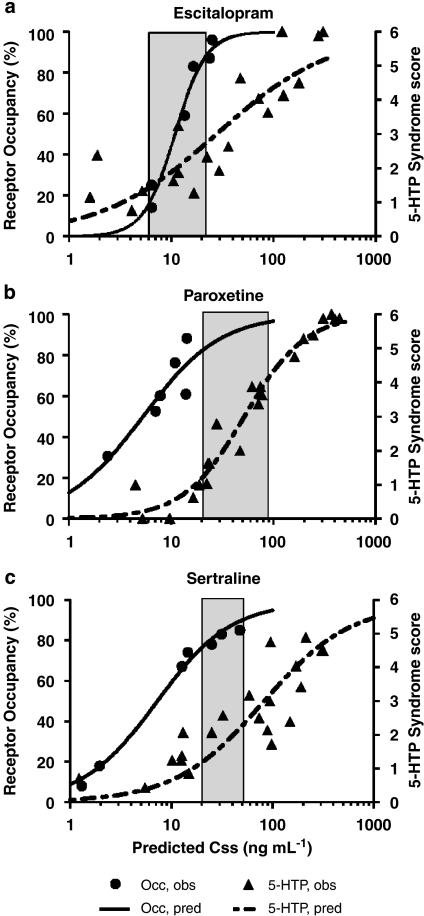
Key results: The predicted Css for escitalopram, paroxetine and sertraline at 80% SERT occupancy in mice are 18 ng mL(-1), 18 ng mL(-1) and 24 ng mL(-1), respectively, with corresponding responses in the 5-HTP behavioral model being between 20-40% of the maximum.
Conclusions and implications: Therapeutically effective SERT occupancy for SRIs in depressed patients is approximately 80%, and the corresponding plasma Css are 6-21 ng mL(-1), 21-95 ng mL(-1) and 20-48 ng mL(-1) for escitalopram, paroxetine and sertraline, respectively. Thus, PK/PD modelling using SERT occupancy and 5-HTP-potentiated behavioral syndrome as response markers in mice may be a useful tool to predict clinically relevant plasma Css values.
Figures
References
-
- American Psychiatric Association Diagnostic and Statistical Manual of Mental Disorders 2000. 4th edn, American Psychiatric Press, Inc: Washington
-
- Asberg M, Eriksson B, Martensson B, Traskman-Bendz L, Wagner A. Therapeutic effects of serotonin uptake inhibitors in depression. J Clin Psychiatry. 1986;47:23–35. - PubMed
-
- Baumann P. Pharmacokinetic–pharmacodynamic relationship of the selective serotonin reuptake inhibitors. Clin Pharmacokinet. 1996;31:444–469. - PubMed
-
- Bech P, Tanghoj P, Andersen HF, Overo K. Citalopram dose–response revisited using an alternative psychometric approach to evaluate clinical effects of four fixed citalopram doses compared to placebo in patients with major depression. Psychopharmacology (Berl) 2002;163:20–25. - PubMed
-
- Bech P, Tanghoj P, Cialdella P, Andersen HF, Pedersen AG. Escitalopram dose–response revisited: an alternative psychometric approach to evaluate clinical effects of escitalopram compared to citalopram and placebo in patients with major depression. Int J Neuropsychopharmacol. 2004;7:283–290. - PubMed
MeSH terms
Substances
LinkOut - more resources
Full Text Sources
Miscellaneous
