


Racial/ethnic disparities in time to follow-up after an abnormal mammogram
- PMID: 18554094
- PMCID: PMC2942754
- DOI: 10.1089/jwh.2007.0402
Racial/ethnic disparities in time to follow-up after an abnormal mammogram
Abstract
Background: Although non-Hispanic white women have an increased risk of developing breast cancer, the disease-specific survival is lower for African American and Hispanic women. Little is known about disparities in follow-up after an abnormal mammogram. The goal of this study was to investigate potential disparities in follow-up after an abnormal mammogram.
Methods: A retrospective cohort study of 6722 women with an abnormal mammogram and documented follow-up from January 2000 through December 2002 was performed at an academic medical center in New York City. The outcome was the number of days between the abnormal mammogram and follow-up imaging or biopsy. Cox proportional hazards models were used to assess the effect of race/ethnicity and other potential covariates.
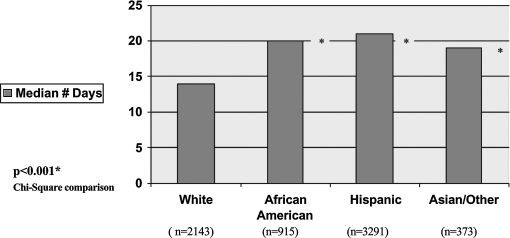
Results: The median number of days to diagnostic follow-up after an abnormal mammogram was greater for African American (20 days) and Hispanic (21 days) women compared with non-Hispanic white (14 days) women (p < 0.001). Racial/ethnic disparities remained significant in a multivariable model controlling for age, Breast Imaging Reporting and Data System (BIRADS) category, insurance status, provider practice location, and median household income.
Conclusions: After an abnormal mammogram, African American and Hispanic women had longer times to diagnostic follow-up compared with non-Hispanic white women. Future efforts will focus on identifying the barriers to follow-up so that effective interventions may be implemented.
Figures
References
-
- Surveillance, Epidemiology, End Results (SEER) [Nov;2002 ]. www.cancer.org. www.cancer.org
-
- Bradley CJ. Given CW. Roberts C. Disparities in cancer diagnosis and survival. Cancer. 2001;91:178–188. - PubMed
-
- Li CI. Malone KE. Daling JR. Differences in breast cancer stage, treatment, and survival by race and ethnicity. Arch Intern Med. 2003;163:49–56. - PubMed
-
- Freeman HP. Reuben SH. Presidents Cancer Panel Report of the chairman, 2000–2001. Bethesda, MD: National Cancer Program National Cancer Institute; 2001. Voices of a broken system. Real problems, real people.
-
- Zapka JG. Taplin SH. Solberg LI. Manos MM. A framework for improving the quality of cancer care: The case of breast and cervical cancer screening. Cancer Epidemiol Biomarkers Prev. 2003;12:4–13. - PubMed
Publication types
MeSH terms
LinkOut - more resources
Full Text Sources
Medical
