


Attentional deficits in cocaine-dependent patients: converging behavioral and electrophysiological evidence
- PMID: 18555537
- PMCID: PMC2546507
- DOI: 10.1016/j.psychres.2007.11.019
Attentional deficits in cocaine-dependent patients: converging behavioral and electrophysiological evidence
Abstract
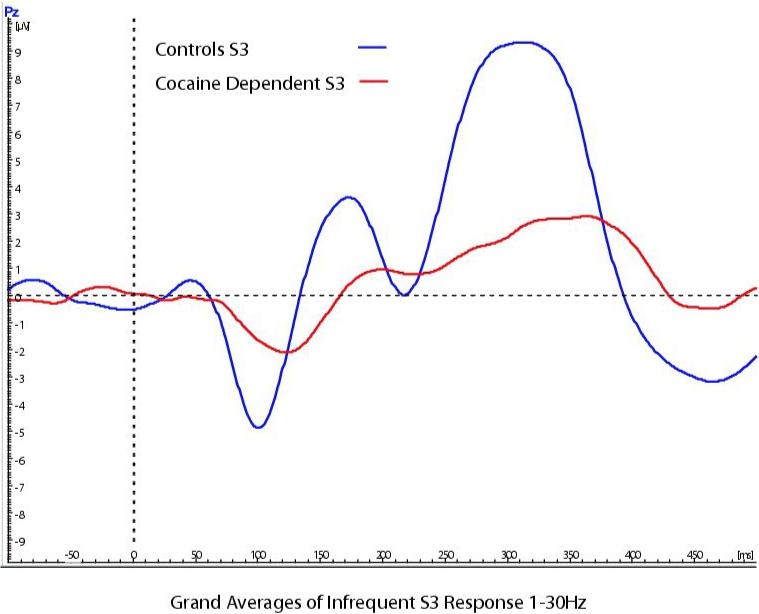
Although there are several reports of patients with cocaine dependence displaying cognitive deficits, the nature of their information processing deficits is not well characterized. In the present study, the attentional performance of cocaine-dependent patients (n=14) was examined and compared with that of healthy control individuals (n=15). Attention was assessed using an auditory oddball event-related task as well as the Continuous Performance Test (CPT, Identical Pairs version). The cocaine-dependent group displayed P300 amplitude reduction compared to controls. The group difference in P300 response latency did not reach significance. On the CPT, the cocaine-dependent patients displayed significantly poorer discriminability and greater errors of commission than the controls. There was a positive correlation between performance on the oddball event-related task and performance on the CPT. This investigation provides converging behavioral and electrophysiological evidence of attentional deficits in cocaine-dependent patients.
Figures
References
-
- Amass L, Lukas SE, Weiss RD, Mendelson J. Evaluation of cognitive skills in ethanol- and cocaine-dependent patients during detoxification using P300 evoked response potentials. NIDA Research monograph. 1989;95:353–354. - PubMed
-
- American Psychiatric Association . Diagnostic and statistical manual of mental disorders. 4th ed. Washington, DC: 1994. Author.
-
- Bauer LO. Psychomotor and electroencephalographic sequelae of cocaine dependence. NIDA Research Monograph. 1996;163:66–93. - PubMed
-
- Bauer LO. Frontal P300 decrements, childhood conduct disorder, family history, and the prediction of relapse among abstinent cocaine abusers. Drug and Alcohol Dependence. 1997;44:1–10. - PubMed
-
- Bauer LO. CNS recovery from cocaine, cocaine and alcohol, or opiod dependence: a P300 study. Clinical Neurophysiology. 2001;112:1508–1515. - PubMed
Publication types
MeSH terms
Grants and funding
LinkOut - more resources
Full Text Sources
Medical
Miscellaneous
