


Longitudinal changes in patients with traumatic brain injury assessed with diffusion-tensor and volumetric imaging
- PMID: 18556217
- PMCID: PMC2613482
- DOI: 10.1016/j.neuroimage.2008.04.254
Longitudinal changes in patients with traumatic brain injury assessed with diffusion-tensor and volumetric imaging
Abstract
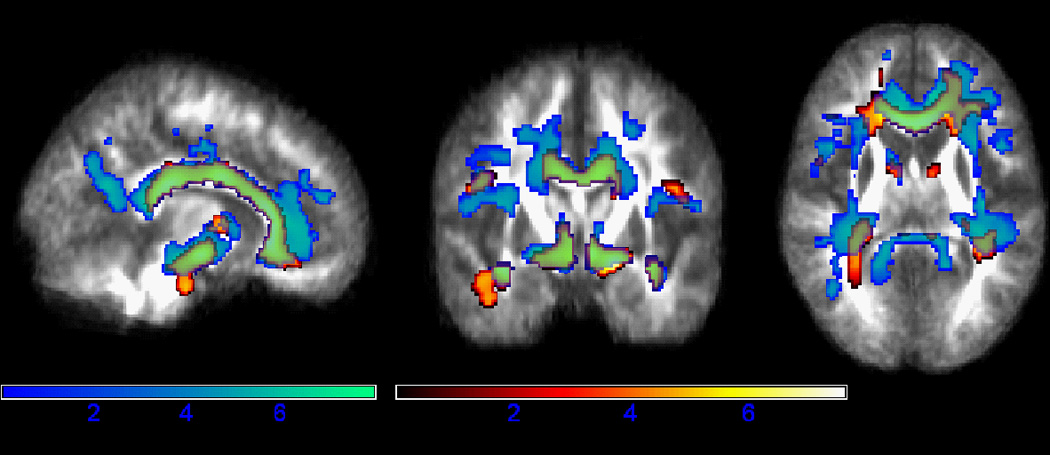
Traumatic brain injury (TBI) is associated with brain volume loss, but there is little information on the regional gray matter (GM) and white matter (WM) changes that contribute to overall loss. Since axonal injury is a common occurrence in TBI, imaging methods that are sensitive to WM damage such as diffusion-tensor imaging (DTI) may be useful for characterizing microstructural brain injury contributing to regional WM loss in TBI. High-resolution T1-weighted imaging and DTI were used to evaluate regional changes in TBI patients compared to matched controls. Patients received neuropsychological testing and were imaged approximately 2 months and 12.7 months post-injury. Paradoxically, neuropsychological function improved from Visit 1 to Visit 2, while voxel-based analyses of fractional anisotropy (FA), and mean diffusivity (MD) from the DTI images, and voxel-based analyses of the GM and WM probability maps from the T1-weighted images, mainly revealed significantly greater deleterious GM and WM change over time in patients compared to controls. Cross-sectional comparisons of the DTI measures indicated that patients have decreased FA and increased MD compared to controls over large regions of the brain. TBI affected virtually all of the major fiber bundles in the brain including the corpus callosum, cingulum, the superior and inferior longitudinal fascicules, the uncinate fasciculus, and brain stem fiber tracts. The results indicate that both GM and WM degeneration are significant contributors to brain volume loss in the months following brain injury, and also suggest that DTI measures may be more useful than high-resolution anatomical images in assessment of group differences.
Figures


References
-
- Anderson CV, Bigler ED, Blatter DD. Frontal lobe lesions, diffuse damage, and neuropsychological functioning in traumatic brain-injured patients. J Clin Exp Neuropsychol. 1995;17:900–908. - PubMed
-
- Ariza M, Junque C, Mataro M, Poca MA, Bargallo N, Olondo M, Sahuquillo J. Neuropsychological correlates of basal ganglia and medial temporal lobe NAA/Cho reductions in traumatic brain injury. Arch Neurol. 2004;61:541–544. - PubMed
-
- Ariza M, Serra-Grabulosa JM, Junque C, Ramirez B, Mataro M, Poca A, Bargallo N, Sahuquillo J. Hippocampal head atrophy after traumatic brain injury. Neuropsychologia. 2006;44:1956–1961. - PubMed
-
- Bergeson AG, Lundin R, Parkinson RB, Tate DF, Victoroff J, Hopkins RO, Bigler ED. Clinical rating of cortical atrophy and cognitive correlates following traumatic brain injury. Clin Neuropsychol. 2004;18:509–520. - PubMed
Publication types
MeSH terms
Grants and funding
LinkOut - more resources
Full Text Sources
Medical
