


Social recovery model: an 8-year investigation of adolescent 12-step group involvement following inpatient treatment
- PMID: 18557829
- PMCID: PMC3759822
- DOI: 10.1111/j.1530-0277.2008.00712.x
Social recovery model: an 8-year investigation of adolescent 12-step group involvement following inpatient treatment
Abstract
Background: Despite widespread use of 12-step treatment approaches and referrals to Alcoholics Anonymous (AA) and Narcotics Anonymous (NA) by youth providers, little is known about the significance of these organizations in youth addiction recovery. Furthermore, existing evidence is based mostly on short-term follow-up and is limited methodologically.
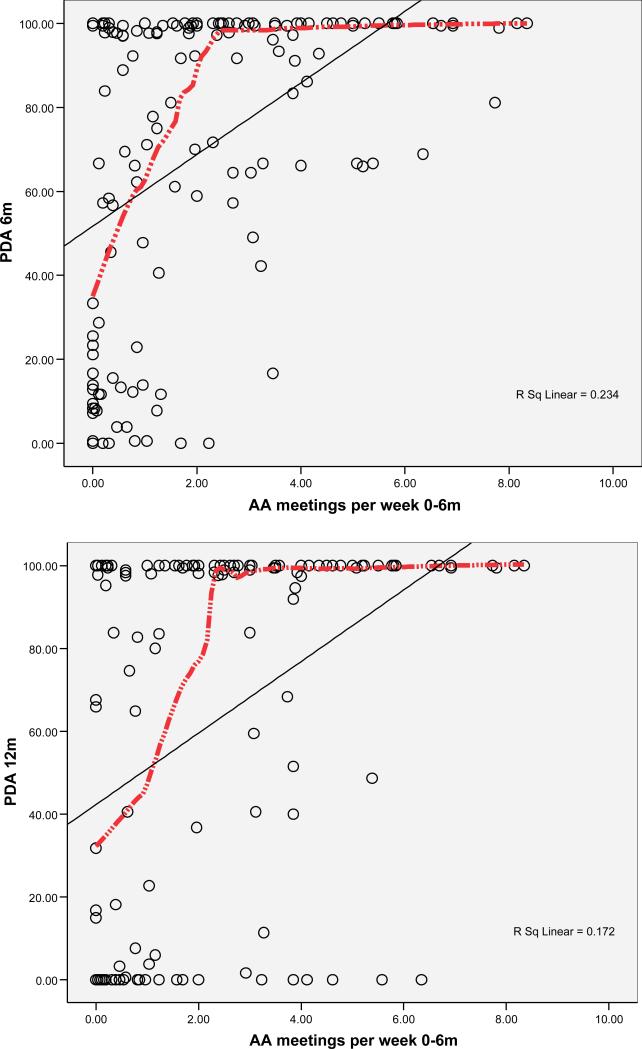
Methods: Adolescent inpatients (n = 160; mean age = 16, 40% female) were followed at 6-months, and at 1, 2, 4, 6, and 8 years posttreatment. Time-lagged, generalized estimating equations modeled treatment outcome in relation to AA/NA attendance controlling for static and time-varying covariates. Robust regression (locally weighted scatterplot smoothing) explored dose-response thresholds of AA/NA attendance on outcome.
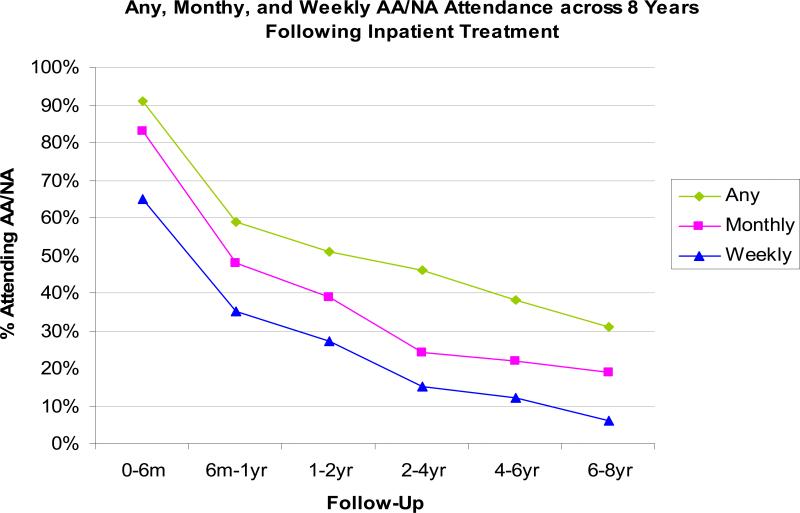
Results: The AA/NA attendance was common and intensive early posttreatment, but declined sharply and steadily over the 8-year period. Patients with greater addiction severity and those who believed that they could not use substances in moderation were more likely to attend. Despite declining attendance, the effects related to AA/NA remained significant and consistent. Greater early participation was associated with better long-term outcomes.
Conclusions: Even though many youth discontinue AA/NA over time, attendees appear to benefit, and more severely substance-involved youth attend most. Successful early posttreatment engagement of youth in abstinence-supportive social contexts, such as AA/NA, may have long-term implications for alcohol and drug involvement into young adulthood.
Figures
References
-
- Alcoholics Anonymous . Twelve Steps and Twelve Traditions. Alcoholics Anonymous World Services; New York: 1953.
-
- Alcoholics Anonymous . Alcoholics Anonymous: The Story of How Thousands of Men and Women Have Recovered from Alcoholism. 4th ed. Alcoholics Anonymous World Services; New York: 2001.
-
- Alcoholics Anonymous . 2004 Membership Survey. Alcoholics Anonymous World Services; New York: 2005.
-
- Alford GS, Koehler RA, Leonard J. Alcoholics Anonymous-Narcotics Anonymous model inpatient treatment of chemically dependent adolescents: a 2-year outcome study. J Stud Alcohol. 1991;52:118–126. - PubMed
-
- American Psychiatric Association . Diagnostic and Statistical Manual of Mental Disorders. 3rd ed., rev. Author; Washington, D.C.: 1987.
Publication types
MeSH terms
Grants and funding
LinkOut - more resources
Full Text Sources
Medical
