


Chloroplast DNA sequence of the green alga Oedogonium cardiacum (Chlorophyceae): unique genome architecture, derived characters shared with the Chaetophorales and novel genes acquired through horizontal transfer
- PMID: 18558012
- PMCID: PMC2442088
- DOI: 10.1186/1471-2164-9-290
Chloroplast DNA sequence of the green alga Oedogonium cardiacum (Chlorophyceae): unique genome architecture, derived characters shared with the Chaetophorales and novel genes acquired through horizontal transfer
Abstract
Background: To gain insight into the branching order of the five main lineages currently recognized in the green algal class Chlorophyceae and to expand our understanding of chloroplast genome evolution, we have undertaken the sequencing of chloroplast DNA (cpDNA) from representative taxa. The complete cpDNA sequences previously reported for Chlamydomonas (Chlamydomonadales), Scenedesmus (Sphaeropleales), and Stigeoclonium (Chaetophorales) revealed tremendous variability in their architecture, the retention of only few ancestral gene clusters, and derived clusters shared by Chlamydomonas and Scenedesmus. Unexpectedly, our recent phylogenies inferred from these cpDNAs and the partial sequences of three other chlorophycean cpDNAs disclosed two major clades, one uniting the Chlamydomonadales and Sphaeropleales (CS clade) and the other uniting the Oedogoniales, Chaetophorales and Chaetopeltidales (OCC clade). Although molecular signatures provided strong support for this dichotomy and for the branching of the Oedogoniales as the earliest-diverging lineage of the OCC clade, more data are required to validate these phylogenies. We describe here the complete cpDNA sequence of Oedogonium cardiacum (Oedogoniales).
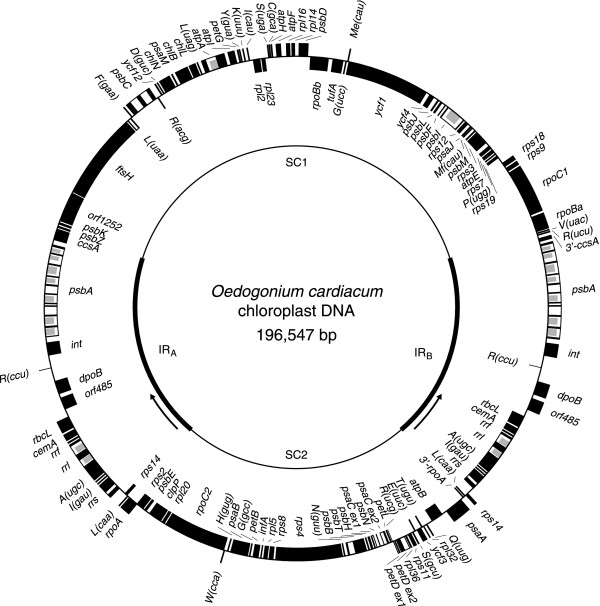
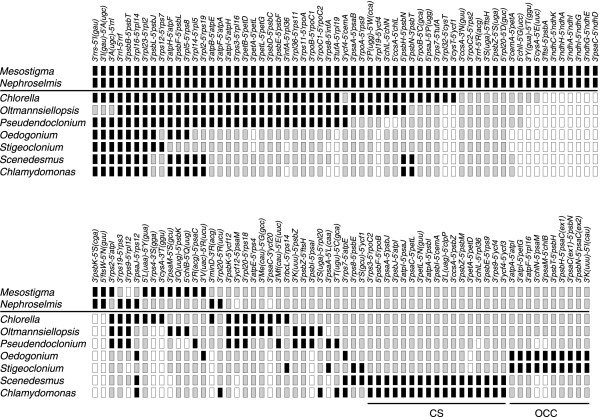
Results: Like its three chlorophycean homologues, the 196,547-bp Oedogonium chloroplast genome displays a distinctive architecture. This genome is one of the most compact among photosynthetic chlorophytes. It has an atypical quadripartite structure, is intron-rich (17 group I and 4 group II introns), and displays 99 different conserved genes and four long open reading frames (ORFs), three of which are clustered in the spacious inverted repeat of 35,493 bp. Intriguingly, two of these ORFs (int and dpoB) revealed high similarities to genes not usually found in cpDNA. At the gene content and gene order levels, the Oedogonium genome most closely resembles its Stigeoclonium counterpart. Characters shared by these chlorophyceans but missing in members of the CS clade include the retention of psaM, rpl32 and trnL(caa), the loss of petA, the disruption of three ancestral clusters and the presence of five derived gene clusters.
Conclusion: The Oedogonium chloroplast genome disclosed additional characters that bolster the evidence for a close alliance between the Oedogoniales and Chaetophorales. Our unprecedented finding of int and dpoB in this cpDNA provides a clear example that novel genes were acquired by the chloroplast genome through horizontal transfers, possibly from a mitochondrial genome donor.
Figures
References
-
- Bremer K, Humphries CJ, Mishler BD, Churchill SP. On cladistic relationships in green plants. Taxon. 1987;36:339–349.
-
- Friedl T. The evolution of the green algae. Pl Syst Evol (Suppl) 1997;11:87–101.
-
- Lewis LA, McCourt RM. Green algae and the origin of land plants. Am J Bot. 2004;91:1535–1556. - PubMed
-
- O'Kelly CJ, Floyd GL. Flagellar apparatus absolute orientations and the phylogeny of the green algae. BioSystems. 1984;16:227–251. - PubMed
-
- Pickett-Heaps J. Green Algae: Structure, Reproduction and Evolution in Selected Genera. Sunderland, Massachusetts: Sinauer Associates, Inc; 1975.
Publication types
MeSH terms
Substances
LinkOut - more resources
Full Text Sources
Molecular Biology Databases
