. 2008 Jul;9(7):1787-94.
doi: 10.1021/bm800012x. Epub 2008 Jun 18.

Deformation responses of a physically cross-linked high molecular weight elastin-like protein polymer

Affiliations

Deformation responses of a physically cross-linked high molecular weight elastin-like protein polymer

Xiaoyi Wu et al. Biomacromolecules. 2008 Jul.

Abstract

Recombinant protein polymers were synthesized and examined under various loading conditions to assess the mechanical stability and deformation responses of physically cross-linked, hydrated, protein polymer networks designed as triblock copolymers with central elastomeric and flanking plastic-like blocks. Uniaxial stress-strain properties, creep and stress relaxation behavior, as well as the effect of various mechanical preconditioning protocols on these responses were characterized. Significantly, we demonstrate for the first time that ABA triblock protein copolymers when redesigned with substantially larger endblock segments can withstand significantly greater loads. Furthermore, the presence of three distinct phases of deformation behavior was revealed upon subjecting physically cross-linked protein networks to step and cyclic loading protocols in which the magnitude of the imposed stress was incrementally increased over time. We speculate that these phases correspond to the stretch of polypeptide bonds, the conformational changes of polypeptide chains, and the disruption of physical cross-links. The capacity to select a genetically engineered protein polymer that is suitable for its intended application requires an appreciation of its viscoelastic characteristics and the capacity of both molecular structure and conditioning protocols to influence these properties.


Figures

Scheme 1
Scheme 1
Amino Acid Sequence of Protein-Based Block Copolymer B10.
Figure 1
Figure 1
Sodium dodecyl sulfate-polyacrylamide gel electrophoresis (SDS-PAGE) analysis of B10 copolymer. B10 was run on a 5% SDS-PAGE and stained with Coomassie G250 (BioRad). Molecular weight markers were Precision Plus Protein Kaleidoscope (BioRad).
Figure 2
Figure 2
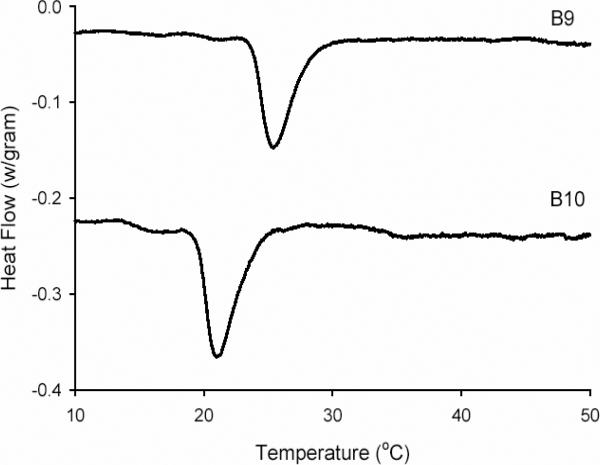
Differential scanning microcalorimetry of B9 and B10. Signals are shifted along Y-axis for clarity.
Figure 3
Figure 3
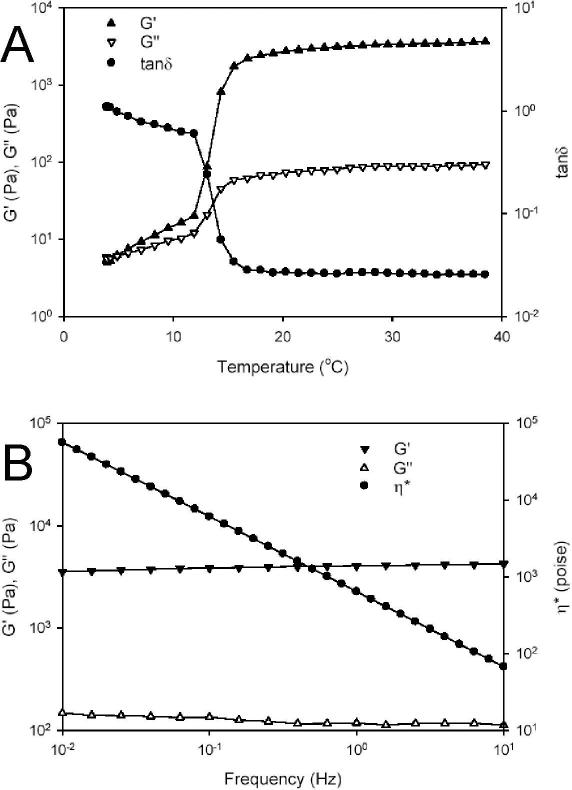
Rheological behavior of B10 in water. (A) Dynamic shear storage (G′), loss modulus (G″), and tanδ are plotted as a function of temperature (γ 2%, ω 1Hz). (B) Dynamic shear storage (G′), loss modulus (G″), and complex viscosity (η*) are plotted as a function of frequency (γ 2%, 37 °C).
Figure 4
Figure 4
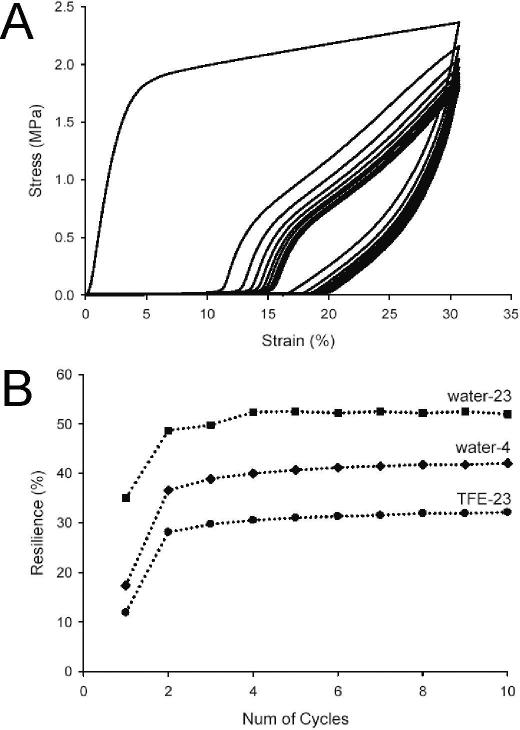
Uniaxial stress-strain analysis. The Young's modulus was 87 ± 9MPa for TFE-23 and 60 ± 8MPa for water-4 measured from the first linear range, and was 0.71 ± 0.12MPa for water-23 film measured from the first 10% of deformation.
Figure 5
Figure 5
Creep analysis of B10 films. (A) Creep of TFE-23 film. From top to bottom, creep was examined as tensile stress was maintained at 1.0MPa, 0.8MPa and 0.6MPa, respectively. (B) Creep of water-4 film. From top to bottom, creep was examined as tensile stress was maintained at 0.8MPa, 0.6MPa and 0.4MPa, respectively. (C) Creep of water-23 films. From top to bottom, creep was examined as tensile stress was maintained at 60KPa, 40KPa and 30KPa, respectively. Under 60KPa stress, creep reached the maximum strain that was allowed on the current testing facility within 12 hours. (D) Comparison of the creep behaviors of water-4 films derived from B10 and B9. The short-term creep behaviors demonstrated that films derived from B10 are more stable under mechanical loading.
Figure 6
Figure 6
(A) The influence of preconditioning on resilience of water-4 film. A water-4 sample was cyclically stretched to 30% strain, with an off-loading period of 5 minutes between cycles. Plotted are the stress-strain curves from the first ten cycles of stretches, because stress-strain responses were stabilized after the eight cycles of stretch. Similar responses were also observed for TFE-23 and water-23 samples. (B) The dependence of resilience on the number of preconditioning cycles. Samples cast in different conditions are cyclically stretched to 30% strain, with an off-loading period of 5 minutes between cycles. Plotted is resilience after each cycle against the number of the preconditioning cycles.
Figure 7
Figure 7
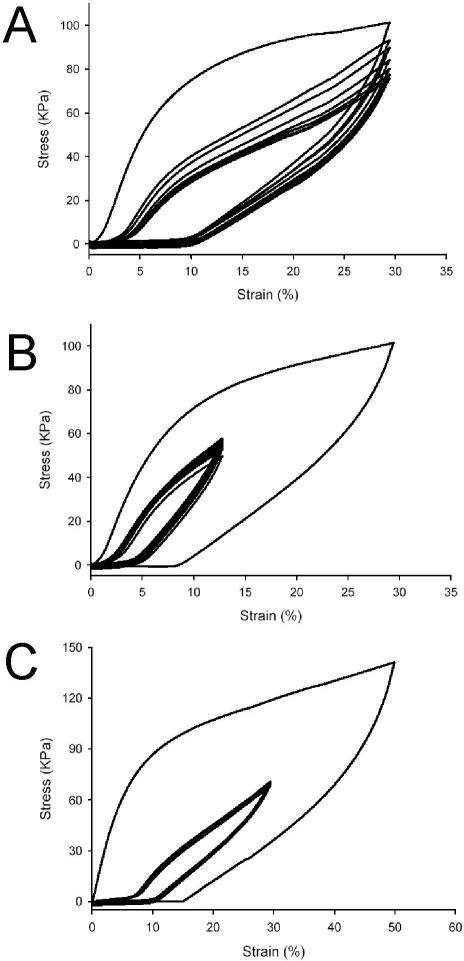
The influence of preconditioning on the resilience of water-23 films. (A) A water-23 sample was cyclically stretched to 30% strain for 21 cycles, with an off-loading period of 5 minutes between cycles. Plotted are the stress-strain curves from the first 10 cycles, because the material response to the external loading is stabilized after 8 cycles of stretch. (B) A water-23 sample was cyclically stretched to 30% strain and then to 12% strain for 20 cycles, with an off-loading period of 5 minutes between cycles. (C) A water-23 sample was cyclically stretched to 50% strain and then to 30% strain for 20 cycles, with an off-loading period of 5 minutes between cycles.
Figure 8
Figure 8
Deformation behaviors of preconditioned water-4 films under cyclic stress of increasing magnitude. (A) A water-4 sample was subjected to cyclic stress of increasing magnitudes (shown in inset), and the deformation history was recorded. Reproducibility was examined on three replicate samples, which were preconditioned at 30% strain for 20 cycles with an off-loading period of 5 minutes between cycles and a two hour recovery time. (B) Deformation at the end of each loading (filled circles) and off-loading (open circles) period were plotted against the magnitude of cyclic stress.
Figure 9
Figure 9
Deformation behavior of preconditioned water-4 films subjected to a step loading protocol. A water-4 sample was subjected to step stress (shown in inset), and strains at the end of each loading step represented by open circles in water-4 films and by crosses in TFE-23 films were plotted against the magnitude of stress. Reproducibility was examined on three replicate samples, which were preconditioned at 30% strain for 20 cycles with an off-loading period of 5 minutes between cycles.

References

    1. Petka WA, Harden JL, McGrath KP, Wirtz D, Tirrell DA. Science. 1998;281:389–92. - PubMed
    1. Rodriguez-Cabellio JC, Reguera J, Girotti A, Arias FJ, Alonso M. Adv Polym Sci. 2006;200:119–167.
    1. Haider M, Megeed Z, Ghandehari H. J Control Release. 2004;95:1–26. - PubMed
    1. Cappello J, Crissman J, Dorman M, Mikolajczak M, Textor G, Marquet M, Ferrari F. Biotechnol Prog. 1990;6:198–202. - PubMed
    1. Nagarsekar A, Crissman J, Crissman M, Ferrari F, Cappello J, Ghandehari H. J Biomed Mater Res. 2002;62:195–203. - PubMed

Publication types