


Neostigmine but not sugammadex impairs upper airway dilator muscle activity and breathing
- PMID: 18559352
- PMCID: PMC4994812
- DOI: 10.1093/bja/aen176
Neostigmine but not sugammadex impairs upper airway dilator muscle activity and breathing
Abstract
Background: Cholinesterase inhibitor-based reversal agents, given in the absence of neuromuscular block, evoke a partial upper airway obstruction by decreasing skeletal upper airway muscle function. Sugammadex reverses neuromuscular block by encapsulating rocuronium. However, its effects on upper airway integrity and breathing are unknown.
Methods: Fifty-one adult male rats were anaesthetized with isoflurane, tracheostomized, and a femoral artery and vein were cannulated. First, we compared the efficacy of sugammadex 15 mg kg(-1) and neostigmine 0.06 mg kg(-1) to reverse respiratory effects of rocuronium-induced partial paralysis [train-of-four ratio (T4/T1)=0.5]. Subsequently, we compared the safety of sugammadex and neostigmine given after recovery of the T4/T1 to 1, by measuring phasic genioglossus activity and breathing.
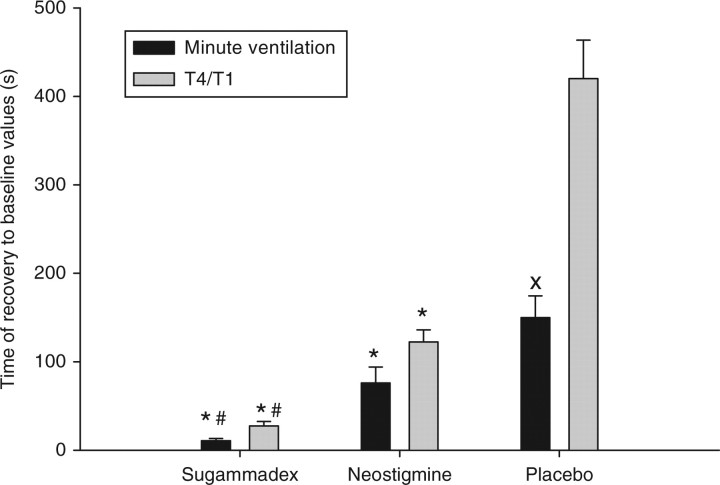
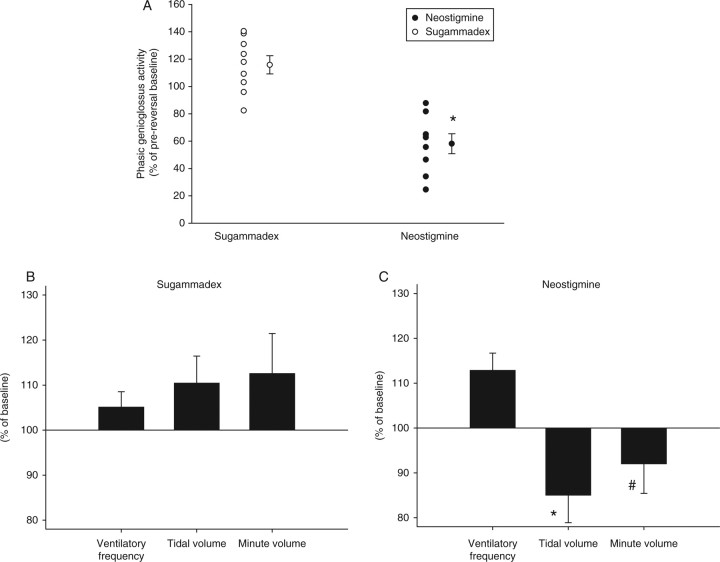
Results: During partial paralysis (T4/T1=0.5), time to recovery of minute volume to baseline values was 10.9 (2), 75.8 (18), and 153 (54) s with sugammadex, neostigmine, and placebo, respectively (sugammadex was significantly faster than neostigmine and placebo, P<0.05). Recovery of T4/T1 was also faster for sugammadex than neostigmine and placebo. Neostigmine administration after complete recovery of T4/T1 decreased upper airway dilator muscle activity to 64 (30)% of baseline and decreased tidal volume (P<0.05 for both variables), whereas sugammadex had no effect on either variable.
Conclusions: In contrast to neostigmine, which significantly impairs upper airway dilator muscle activity when given after recovery from neuromuscular block, a reversal dose of sugammadex given under the same conditions does not affect genioglossus muscle activity and normal breathing. Human studies will be required to evaluate the clinical relevance of our findings.
Figures
References
-
- Sundman E, Witt H, Olsson R, Ekberg O, Kuylenstierna R, Eriksson LI. The incidence and mechanisms of pharyngeal and upper esophageal dysfunction in partially paralyzed humans: pharyngeal videoradiography and simultaneous manometry after atracurium. Anesthesiology. 2000;92:977–84. - PubMed
-
- Eikermann M, Vogt FM, Herbstreit F, et al. The predisposition to inspiratory upper airway collapse during partial neuromuscular blockade. Am J Respir Crit Care Med. 2007;175:9–15. - PubMed
-
- Berg H. Is residual neuromuscular block following pancuronium a risk factor for postoperative pulmonary complications? Acta Anaesthesiol Scand Suppl. 1997;110:156–8. - PubMed
-
- Viby-Mogensen J. Postoperative residual curarization and evidence-based anaesthesia. Br J Anaesth. 2000;84:301–3. - PubMed
-
- Eriksson LI. Evidence-based practice and neuromuscular monitoring: it’s time for routine quantitative assessment. Anesthesiology. 2003;98:1037–9. - PubMed
Publication types
MeSH terms
Substances
Grants and funding
LinkOut - more resources
Full Text Sources
Medical
