


Relational pathways between socioeconomic position and cardiovascular risk in a multiethnic urban sample: complexities and their implications for improving health in economically disadvantaged populations
- PMID: 18559448
- PMCID: PMC2668209
- DOI: 10.1136/jech.2007.063222
Relational pathways between socioeconomic position and cardiovascular risk in a multiethnic urban sample: complexities and their implications for improving health in economically disadvantaged populations
Abstract
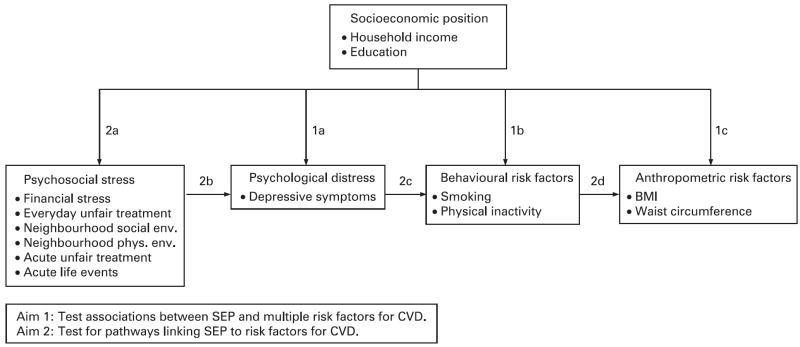
Background: The study was designed to provide evidence of a cascade effect linking socioeconomic position to anthropometric indicators of cardiovascular disease (CVD) risk through effects on psychosocial stress, psychological distress and health-related behaviours, and consider implications for disease prevention and health promotion.
Methods: A cross-sectional stratified two-stage probability sample of occupied housing units in three areas of Detroit, Michigan, was used in the study. 919 adults aged > or =25 years completed the survey (mean age 46.3; 53% annual household income <$20 000; 57% non-Hispanic black, 22% Latino, 19% non-Hispanic white). Variables included self-report (eg, psychosocial stress, depressive symptoms, health behaviours) and anthropometric measurements (eg, waist circumference, height, weight). The main outcome variables were depressive symptoms, smoking status, physical activity, body mass index and waist circumference.
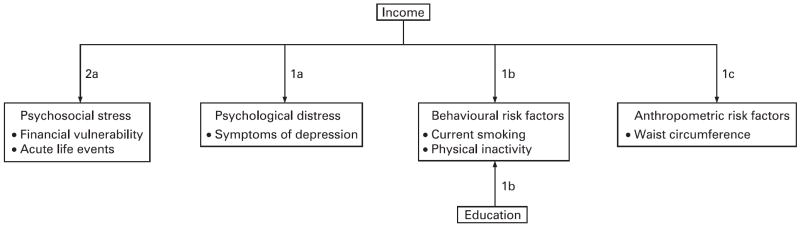
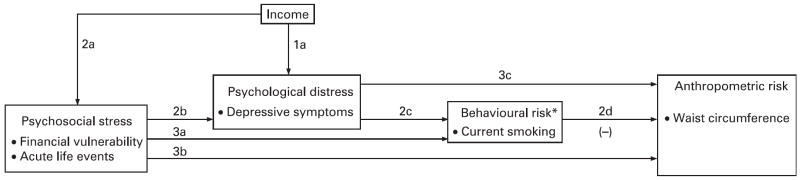
Results: Income was inversely associated with depressive symptoms, likelihood of current smoking, physical inactivity and waist circumference. These relationships were partly or fully mediated by psychosocial stress. A suppressor effect of current smoking on the relationship between depressive symptoms and waist circumference was found. Independent effects of psychosocial stress and psychological distress on current smoking and waist circumference were found, above and beyond the mediated pathways.
Conclusions: The results suggest that relatively modest improvements in the income of economically disadvantaged people can set in motion a cascade of effects, simultaneously reducing exposure to stressful life conditions, improving mental well-being, increasing health-promoting behaviours and reducing anthropometric risks associated with CVD. Such interventions offer important opportunities to improve population health and reduce health disparities.
Figures
References
-
- Cooper R, Cutler JA, Desvigne-Nickens P, et al. Trends and disparities in coronary heart disease, stroke and other cardiovascular diseases in the United States: findings of the national conference on cardiovascular disease prevention. Circulation. 2000;102:3137–47. - PubMed
-
- Williams DR. Race, socioeconomic status and health. Ann N Y Acad Sci. 1999;896:173–88. - PubMed
-
- House JS, Williams DR. Understanding and reducing socioeconomic and racial/ ethnic disparities in health. In: Smedley BD, Syme SL, editors. Promoting health: intervention strategies from social and behavioral research. Vol. 81. Washington, DC: National Academy Press; 2000. pp. 1–4. - PubMed
-
- Link BG, Phelan J. Social conditions as fundamental causes of disease. J Health Social Behav. 1995;36(Special issue):80–94. - PubMed
-
- Marmot MG, Bosma H, Hemingway H, et al. Contribution of job control and other risk factors to social variations in coronary heart disease incidence. Lancet. 1997;350:235–9. - PubMed
Publication types
MeSH terms
Grants and funding
LinkOut - more resources
Full Text Sources
Medical
