


Primary central nervous system lymphoma in Japan: changes in clinical features, treatment, and prognosis during 1985-2004
- PMID: 18559969
- PMCID: PMC2666229
- DOI: 10.1215/15228517-2008-028
Primary central nervous system lymphoma in Japan: changes in clinical features, treatment, and prognosis during 1985-2004
Abstract
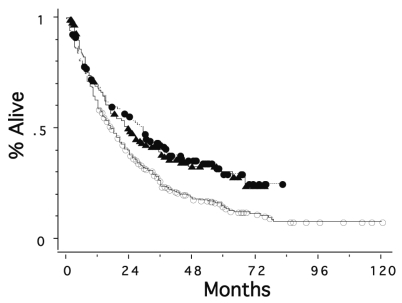
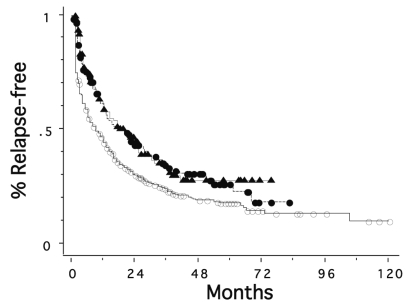
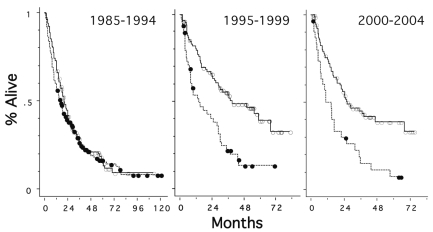
We have conducted nationwide surveys of primary central nervous system lymphoma (PCNSL) treated since 1985. In the present study, we newly collected data between 2000 and 2004 and investigated changes in clinical features and outcome over time. A total of 739 patients with histologically proven PCNSL under going radiotherapy were analyzed. Seventeen institutions were surveyed, and data on 131 patients were collected. These data were compared with updated data that were previously obtained for 466 patients treated during 1985-1994 and 142 patients treated during 1995-1999. Recent trends toward decrease in male/female ratio, increase in aged patients, and increase in patients with multiple lesions were seen. Regarding treatment, decrease in attempts at surgical tumor removal and increases in use of systemic chemotherapy and methotrexate (MTX)-containing regimens were observed. The median survival time was 18, 29, and 24 months for patients seen during 1985-1994, 1995-1999, and 2000-2004, respectively, and the respective 5-year survival rates were 15%, 30%, and 30%. In groups seen during 1995-1999 and during 2000-2004, patients who received systemic or MTX-containing chemotherapy had better prognosis than those who did not. Multivariate analysis of all patients seen during 1985-2004 suggested the usefulness of MTX-containing chemotherapy as well as the importance of age, lactate dehydrogenase level, and tumor multiplicity as prognostic factors. Thus, this study revealed several notable changes in clinical features of PCNSL patients. The prognosis improved during the last 10 years. Advantage of radiation plus chemotherapy, especially MTX-containing chemotherapy, over radiation alone was suggested.
Figures


References
-
- Panageas KS, Elkin EB, DeAngelis LM, Ben-Porat L, Abrey LE. Trends in survival from primary central nervous system lymphoma, 1975–1999: a population-based analysis. Cancer. 2005;104:2466–2472. - PubMed
-
- DeAngelis LM. Primary central nervous system lymphoma: a curable brain tumor. J Clin Oncol. 2003;21:4471–4473. - PubMed
-
- Batchelor T, Loeffler JS. Primary CNS lymphoma. J Clin Oncol. 2006;24:1281–1288. - PubMed
-
- Nelson DF. Radiotherapy in the treatment of primary central nervous system lymphoma (PCNSL) J Neurooncol. 1999;43:241–247. - PubMed
-
- Bessell EM, Hoang-Xuan K, Ferreri AJ, Reni M. Primary central nervous system lymphoma: biological aspects and controversies in management. Eur J Cancer. 2007;43:1141–1152. - PubMed
Publication types
MeSH terms
Substances
LinkOut - more resources
Full Text Sources
Medical
