


Sleep loss activates cellular inflammatory signaling
- PMID: 18561896
- PMCID: PMC2547406
- DOI: 10.1016/j.biopsych.2008.05.004
Sleep loss activates cellular inflammatory signaling
Abstract
Background: Accumulating evidence suggests that sleep disturbance is associated with inflammation and related disorders including cardiovascular disease, arthritis, and diabetes mellitus. This study was undertaken to test the effects of sleep loss on activation of nuclear factor (NF)-kappaB, a transcription factor that serves a critical role in the inflammatory signaling cascade.
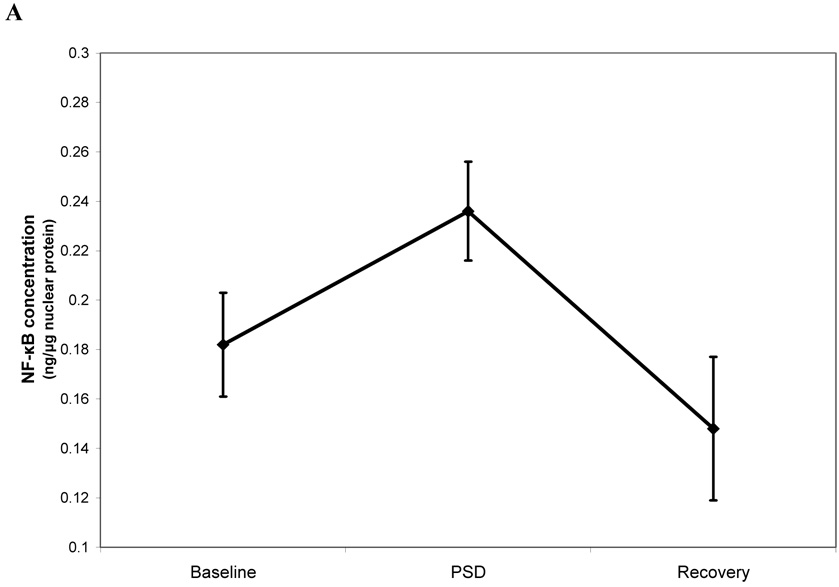
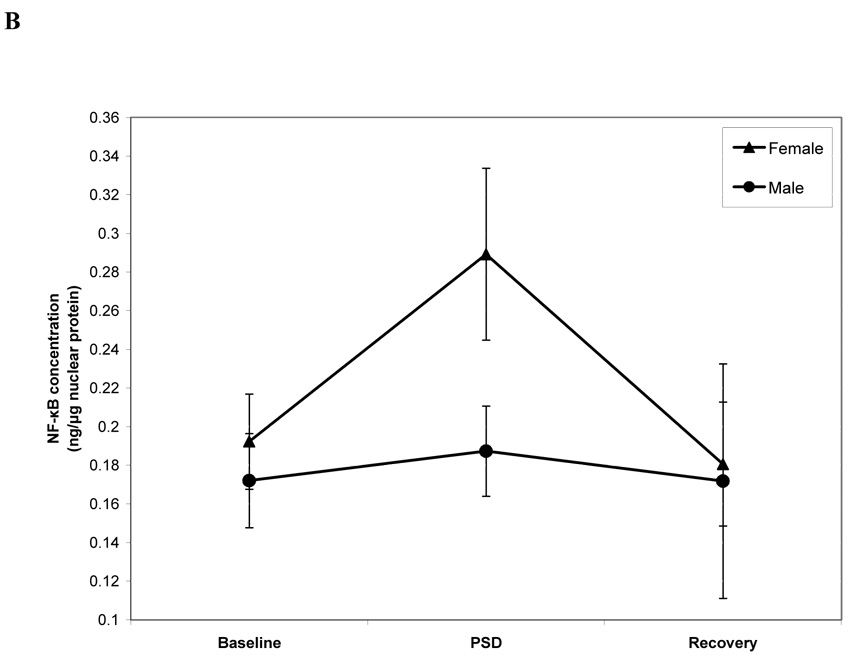
Methods: In 14 healthy adults (seven women; seven men), peripheral blood mononuclear cell NF-kappaB was repeatedly assessed, along with enumeration of lymphocyte subpopulations, in the morning after baseline sleep, partial sleep deprivation (awake from 11 pm to 3:00 am), and recovery sleep.
Results: In the morning after a night of sleep loss, mononuclear cell NF-kappaB activation was significantly greater compared with morning levels following uninterrupted baseline or recovery sleep, in which the response was found in female but not in male subjects.
Conclusions: These results identify NF-kappaB activation as a molecular pathway by which sleep disturbance may influence leukocyte inflammatory gene expression and the risk of inflammation-related disease.
Figures
References
-
- Dew MA, Hoch CC, Buysse DJ, Monk TH, Begely AE, Houck PR, et al. Healthy older adults' sleep predicts all-cause mortality at 4 to 19 years of follow-up. Psychosom Medicine. 2003;65:63–73. - PubMed
-
- Phillips B, Mannino DM. Does insomnia kill? Sleep. 2005;28:965–971. - PubMed
-
- Volpato S, Guralnik JM, Ferrucci L, Balfour J, Chaves P, Fried LP, et al. Cardiovascular disease, interleukin-6, and risk of mortality in older women: the women's health and aging study. Circulation. 2001;103:947–953. - PubMed
-
- Karin M, Greten FR. NF-kappaB: linking inflammation and immunity to cancer development and progression. Nat Rev Immunol. 2005;5:749–759. - PubMed
Publication types
MeSH terms
Substances
Grants and funding
- P30-AG028748/AG/NIA NIH HHS/United States
- M01 RR000865/RR/NCRR NIH HHS/United States
- AG 026364/AG/NIA NIH HHS/United States
- CA 10014152/CA/NCI NIH HHS/United States
- P30 AG028748/AG/NIA NIH HHS/United States
- R01 HL079955/HL/NHLBI NIH HHS/United States
- R01 AA013239/AA/NIAAA NIH HHS/United States
- R01 CA119159/CA/NCI NIH HHS/United States
- T32 MH018399/MH/NIMH NIH HHS/United States
- CA116778/CA/NCI NIH HHS/United States
- R01 CA116778/CA/NCI NIH HHS/United States
- T32-MH18399/MH/NIMH NIH HHS/United States
- HL 079955/HL/NHLBI NIH HHS/United States
- RR00827/RR/NCRR NIH HHS/United States
- T32 MH019925/MH/NIMH NIH HHS/United States
- M01 RR000827/RR/NCRR NIH HHS/United States
- R01 AG026364/AG/NIA NIH HHS/United States
LinkOut - more resources
Full Text Sources
Medical
