. 2008 Aug;102(2):207-20.
doi: 10.1093/aob/mcn076. Epub 2008 Jun 18.

Characterization and expression analysis of genes directing galactomannan synthesis in coffee

Affiliations

Characterization and expression analysis of genes directing galactomannan synthesis in coffee

Martial Pré et al. Ann Bot. 2008 Aug.

Abstract

Background and aims: Galactomannans act as storage reserves for the seeds in some plants, such as guar (Cyamopsis tetragonoloba) and coffee (Coffea arabica and Coffea canephora). In coffee, the galactomannans can represent up to 25 % of the mass of the mature green coffee grain, and they exert a significant influence on the production of different types of coffee products. The objective of the current work was to isolate and characterize cDNA encoding proteins responsible for galactomannan synthesis in coffee and to study the expression of the corresponding transcripts in the developing coffee grain from C. arabica and C. canephora, which potentially exhibit slight galactomannan variations. Comparative gene expression analysis was also carried out for several other tissues of C. arabica and C. canephora.

Methods: cDNA banks, RACE-PCR and genome walking were used to generate full-length cDNA for two putative coffee mannan synthases (ManS) and two galactomannan galactosyl transferases (GMGT). Gene-specific probe-primer sets were then generated and used to carry out comparative expression analysis of the corresponding genes in different coffee tissues using quantitative RT-PCR.

Key results: Two of the putative galactomannan biosynthetic genes, ManS1 and GMGT1, were demonstrated to have very high expression in the developing coffee grain of both Coffea species during endosperm development, consistent with our proposal that these two genes are responsible for the production of the majority of the galactomannans found in the grain. In contrast, the expression data presented indicates that the ManS2 gene product is probably involved in the synthesis of the galactomannans found in green tissue.

Conclusions: The identification of genes implicated in galactomannan synthesis in coffee are presented. The data obtained will enable more detailed studies on the biosynthesis of this important component of coffee grain and contribute to a better understanding of some functional differences between grain from C. arabica and C. canephora.


Figures

F<sc>ig</sc>. 1.
Fig. 1.
Phylogenetic analysis of coffee ManS sequences with several cellulose synthase and cellulose-like synthase sequences. A parsimony phylogram that corresponds to the majority consensus of 1000 bootstrap replicates for full-length CesA and Csl sequences of Coffea canephora (Cc), Arabidopsis thaliana (At), Solanum tuberosum (St), Ipomoea trifida (It) and Cyamopsis tetragonolobus (Ct) was done using CLUSTALW (Lasergene package, DNASTAR) followed by a manual optimization step. Accession numbers are as follows: CcManS1 (EU568115), CcManS2 (EU716311), AtCesA1 (At4g32410), AtCesA2 (At4g39350), AtCesA3 (At5g05170), AtCslA1 (At1g24070), AtCslA2 (At5g22740), AtCslA7 (At5g35650), AtCslA9 (At5g03760), AtCslB2 (At2g32620), AtCslB3 (At2g32530), AtCslC4 (At3g28180), AtCslC6 (At3g07330), AtCslD1 (At2g33100), AtCslD2 (At5g16910), AtCslE1 (At1g55850), StCesA3 (AAP97495), ItManS (AAQ62572), CtManS (AAR23313).
F<sc>ig</sc>. 2.
Fig. 2.
Expression of ManS1 and ManS2 in different tissues of robusta ‘BP409’. The expression of each gene was measured in the root, branch and leaf tissues, plus in different stages of developing pericarp and grain of cherries, using quantitative RT-PCR. The value indicates the expression level of the gene of interest relative to that of the constitutively expressed gene RPL39. (A) ManS1, (B) ManS2. Abbreviations: SG, small green stage grain; LG, large green stage grain; YG, yellow stage grain; RG, red stage grain; SP, small green pericarp; LP, large green pericarp; YP, yellow pericarp; RP, red pericarp; Rt, root; Br, branch; Le, leaf. Mean values ± s.e. were calculated from triplicate measurements.
F<sc>ig</sc>. 3.
Fig. 3.
Phylogenetic analysis of several glycosyl transferase sequences. A parsimony phylogram that corresponds to the majority consensus of 1000 bootstrap replicates for full-length galactosyl- and xylosyl-transferase (Tase) sequences of Coffea arabica (Ca), Coffea canephora (Cc), Arabidopsis thaliana (At), Solanum tuberosum (St), Senna occidentalis (So), Lotus japonicus (Lj), Trigonella foenum-graecum (Tf) and Cyamopsis tetragonolobus (Ct) was done using CLUSTALW (Lasergene package, DNASTAR) followed by a manual optimization step. A partial sequence corresponding to the first 232 amino acids at the N-terminus of CcGT1 was used for the alignment. Accession numbers that are not provided in the figure are as follows: CaGMGT1 (EU568117), CcGMGT2 (EU716313), CcXT1 (in silico sequence, this work), CcGT1 (SGN- U354294; EU716312), StGTase (CAI11452), SoGTase (CAI79403), CtGMGT (CAI79402), LjGTase (CAD98924), TfGTase (CAB52246), AtXT1 (At3g62720), AtXT2 (At4g02500).
F<sc>ig</sc>. 4.
Fig. 4.
Expression of coffee GTases in different tissues of robusta ‘BP409’. The expression of each gene was measured in the root, branch and leaf tissues, plus in different stages of developing pericarp and grain of cherries, using quantitative RT-PCR. The value indicates the expression level of the gene of interest relative to that of the constitutively expressed gene RPL39. (A) GMGT1, (B) GMGT2, (C) XT1, (D) GT1. Abbreviations: G, small green stage grain; LG, large green stage grain; YG, yellow stage grain; RG, red stage grain; SP, small green pericarp; LP, large green pericarp; YP, yellow pericarp; RP, red pericarp; Rt, root; Br, branch; Le, leaf. Mean values ± s.e. calculated from triplicate measurements.
F<sc>ig</sc>. 5.
Fig. 5.
Comparison of expression of ManS1 and GMGT1 in the grain of arabica and robusta. The expression of each gene was measured at different stages of grain development using quantitative RT-PCR. The vertical axis has the RQ value of the gene of interest relative to that of the RPL39 gene. For arabica ‘T2308’ GH denotes greenhouse and Fld denotes field. Abbreviations: SG, small green stage grain; LG, large green stage grain; Y, yellow stage grain; R, red stage grain. Mean values ± s.e. were calculated from triplicate measurments.
F<sc>ig</sc>. 6.
Fig. 6.
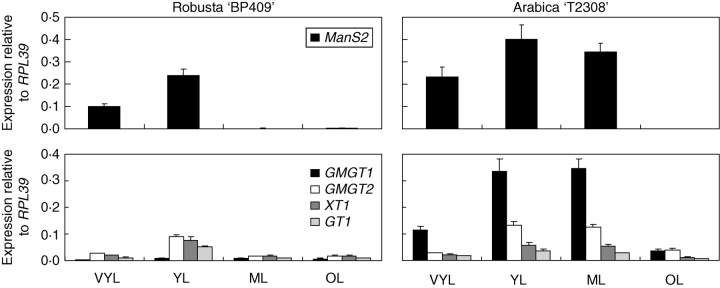
Expression of mannan synthase and glycosyl transferase genes in leaves of arabica and robusta. Relative expression of (Top Panels) ManS2 and (Bottom Panels) the four GTases at different stages of developing leaves. Abbreviations: VYL, very young leaves; YL, young leaves; ML, mature leaves; OL, old leaves. The value indicates the expression level of the gene of interest relative to that of the constitutively expressed gene RPL39. Mean values ± s.e. were calculated from triplicate measurements.

References

    1. Bailey RW. Polysaccharides in the leguminosae. In: Harborne JB, Boulter D, Turner BL, editors. Chemotaxonomy of the Leguminosae. London: Academic Press; 1971. pp. 503–541.
    1. Bradbury AGW, Halliday DJ. Chemical structures of green coffee bean polysaccharides. Journal of Agricultural and Food Chemistry. 1990;38:389–392.
    1. Cavalier DM, Keegstra K. Two xyloglucan xylosyltransferases catalyze the addition of multiple xylosyl residues to cellohexaose. Journal of Biological Chemistry. 2006;281:34197–34207. - PubMed
    1. Clifford MN. Chemical and physical aspects of green coffee and coffee products. In: Clifford MN, Willson KC, editors. Coffee, botany, biochemistry and production of beans and beverage. London: Croom Helm; 1985. pp. 305–374.
    1. Cocuron JC, Lerouxel O, Drakakaki G, Alonso AP, Liepman AH, Keegstra K, Raikhel N, Wilkerson CG. A gene from the cellulose synthase-like C family encodes a beta-1,4 glucan synthase. Proceedings of the National Academy of Science of the USA. 2007;104:8550–8555. - PMC - PubMed

MeSH terms