Pervasive positive selection on duplicated and nonduplicated vertebrate protein coding genes
- PMID: 18562677
- PMCID: PMC2527703
- DOI: 10.1101/gr.076992.108
Pervasive positive selection on duplicated and nonduplicated vertebrate protein coding genes
Abstract
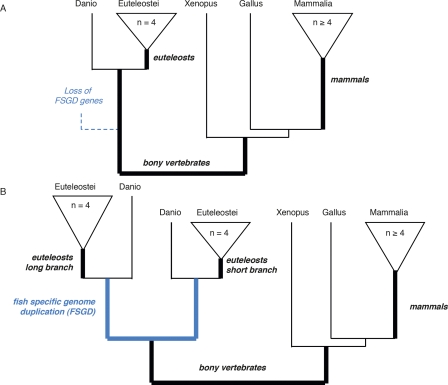
A stringent branch-site codon model was used to detect positive selection in vertebrate evolution. We show that the test is robust to the large evolutionary distances involved. Positive selection was detected in 77% of 884 genes studied. Most positive selection concerns a few sites on a single branch of the phylogenetic tree: Between 0.9% and 4.7% of sites are affected by positive selection depending on the branches. No functional category was overrepresented among genes under positive selection. Surprisingly, whole genome duplication had no effect on the prevalence of positive selection, whether the fish-specific genome duplication or the two rounds at the origin of vertebrates. Thus positive selection has not been limited to a few gene classes, or to specific evolutionary events such as duplication, but has been pervasive during vertebrate evolution.
Figures
References
-
- Al-Shahrour F., Minguez P., Tarraga J., Medina I., Alloza E., Montaner D., Dopazo J., Minguez P., Tarraga J., Medina I., Alloza E., Montaner D., Dopazo J., Tarraga J., Medina I., Alloza E., Montaner D., Dopazo J., Medina I., Alloza E., Montaner D., Dopazo J., Alloza E., Montaner D., Dopazo J., Montaner D., Dopazo J., Dopazo J. FatiGO +: A functional profiling tool for genomic data. Integration of functional annotation, regulatory motifs and interaction data with microarray experiments. Nucleic Acids Res. 2007;35:W91–W96. - PMC - PubMed
-
- Anisimova M., Yang Z., Yang Z. Multiple hypothesis testing to detect lineages under positive selection that affects only a few sites. Mol. Biol. Evol. 2007;24:1219–1228. - PubMed
-
- Anisimova M., Bielawski J.P., Yang Z., Bielawski J.P., Yang Z., Yang Z. Accuracy and power of Bayes prediction of amino acid sites under positive selection. Mol. Biol. Evol. 2002;19:950–958. - PubMed
-
- Aparicio S., Chapman J., Stupka E., Putnam N., Chia J.-m., Dehal P., Christoffels A., Rash S., Hoon S., Smit A., Chapman J., Stupka E., Putnam N., Chia J.-m., Dehal P., Christoffels A., Rash S., Hoon S., Smit A., Stupka E., Putnam N., Chia J.-m., Dehal P., Christoffels A., Rash S., Hoon S., Smit A., Putnam N., Chia J.-m., Dehal P., Christoffels A., Rash S., Hoon S., Smit A., Chia J.-m., Dehal P., Christoffels A., Rash S., Hoon S., Smit A., Dehal P., Christoffels A., Rash S., Hoon S., Smit A., Christoffels A., Rash S., Hoon S., Smit A., Rash S., Hoon S., Smit A., Hoon S., Smit A., Smit A., et al. Whole-genome shotgun assembly and analysis of the genome of Fugu rubripes. Science. 2002;297:1301–1310. - PubMed
Publication types
MeSH terms
Substances
LinkOut - more resources
Full Text Sources