. 2008 Aug;147(4):1947-59.
doi: 10.1104/pp.108.118778. Epub 2008 Jun 18.

Mutation of the rice Narrow leaf1 gene, which encodes a novel protein, affects vein patterning and polar auxin transport

Affiliations

Mutation of the rice Narrow leaf1 gene, which encodes a novel protein, affects vein patterning and polar auxin transport

Jing Qi et al. Plant Physiol. 2008 Aug.

Abstract

The size and shape of the plant leaf is an important agronomic trait. To understand the molecular mechanism governing plant leaf shape, we characterized a classic rice (Oryza sativa) dwarf mutant named narrow leaf1 (nal1), which exhibits a characteristic phenotype of narrow leaves. In accordance with reduced leaf blade width, leaves of nal1 contain a decreased number of longitudinal veins. Anatomical investigations revealed that the culms of nal1 also show a defective vascular system, in which the number and distribution pattern of vascular bundles are altered. Map-based cloning and genetic complementation analyses demonstrated that Nal1 encodes a plant-specific protein with unknown biochemical function. We provide evidence showing that Nal1 is richly expressed in vascular tissues and that mutation of this gene leads to significantly reduced polar auxin transport capacity. These results indicate that Nal1 affects polar auxin transport as well as the vascular patterns of rice plants and plays an important role in the control of lateral leaf growth.


Figures
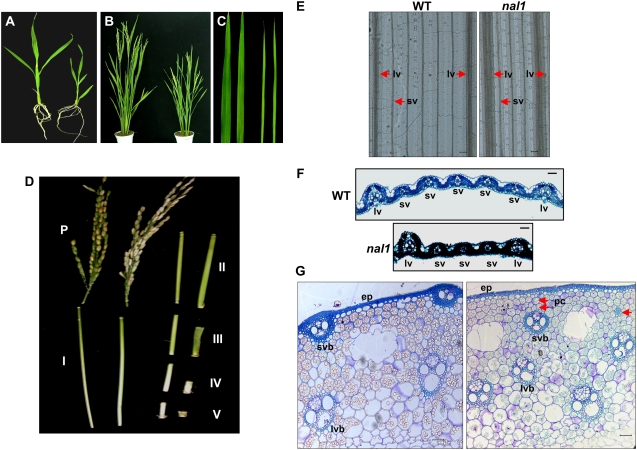
Figure 1.
Figure 1.
The nal1 mutant shows a defective vascular system in leaves and culms. A, Gross morphology of 1-month-old wild-type (left) and nal1 (right) plants. B, Gross morphology of wild-type (left) and nal1 (right) plants at the heading stage. C, Leaf morphology of wild-type (left) and nal1 (right) plants. Shown are the second leaf blades (from the top of the plant) of 3-month-old plants. D, Phenotypic exhibition of the components of rice plant height in representative wild-type (left) and nal1 (right) plants at the mature stage. P, Panicle. I to V indicate the corresponding internodes from top to bottom. E, Whole-mount clearing of the mature fifth leaves of wild-type (WT) and nal1 plants. Shown are regions between two large veins in the middle of mature leaf blades. lv, Large vein; sv, small vein. Bars = 150 μm. F, Transverse sections of the mature fifth leaves in the middle part of wild-type and nal1 plants. Bars = 20 μm. G, Transverse sections of the middle part of internode IV of wild-type (left) and nal1 (right) plants at the mature stage. ep, Epidermis; lvb, large vascular bundles; pc, parenchyma cells; svb, small vascular bundles. The single red arrow indicates an immature vascular bundle, and the double red arrows indicate parenchyma cell layers in the region between the epidermis and the outer ring of small vascular bundles. Bars = 20 μm.
Figure 2.
Figure 2.
Nal1 encodes a plant-specific protein with unknown biochemical function. A, Fine genetic and physical mapping of Nal1. The target gene was initially mapped to a genetic interval between markers RM5503 and RM3836 on rice chromosome 4. Analysis of an F2 mapping population of 2,000 plants delimited the gene to a 29-kb region between markers M3 and M4 on BAC clone AL662950. Markers and the numbers of recombination events identified are indicated. B, Schematic representation of the Nal1 gene structure. The nal1 allele contains a 30-bp deletion in the fourth exon. Black boxes indicate the coding sequence, white boxes indicate the 5′ and 3′ untranslated regions, and lines between boxes indicate introns. The start codon (ATG) and the stop codon (TGA) are indicated. C, Genetic complementation of nal1 (top) and molecular identification of transgenic plants (bottom). The wild type (left), nal1 containing an empty vector (middle), and a transgenic plant containing the 12.4-kb DNA fragment of ORF1 in the genetic background of nal1 (right) are shown. The 30-bp deletion in the nal1 was used as a PCR-based marker to distinguish the three plants. D, Deduced amino acid sequence of Nal1. The deleted 10 amino acids are underlined, and the red letters indicate the putative nuclear localization signal. E, Phylogeny of the Nal1 protein family. A neighbor-joining tree was built by MEGA3 using a Poisson correction model with gaps to complete deletion. Topological robustness was assessed by bootstrap analysis with 500 replicates. The bar is an indicator of genetic distance based on branch length. Nal1 and AK120320 are from rice; BT014552 and BT013672 are from tomato; AC191706, AC191543, AC205276, and AC208803 are from maize; and AK248497 and AK252329 are from barley. F, Confocal image (left), transmitted light image (middle), and merged image (right) of Arabidopsis cell culture protoplasts transfected with free GFP. Bar = 10 μm. G, Confocal image (left), transmitted light image (middle), and merged image (right) of Arabidopsis cell culture protoplasts transfected with Nal1-GFP fusion proteins. Bar = 10 μm. H, Steady-state nuclear protein body patterns of 35S:Nal1-GFP in root cells from a 5-d-old transgenic Arabidopsis seedling. Confocal image (left), transmitted light image (middle), and merged image (right) of root cortex cells. Bar = 20 μm.
Figure 3.
Figure 3.
Nal1 expression pattern. A, RT-PCR analysis of Nal1 expression. Total RNA was isolated from leaf sheaths (S), leaves (L), culms (C), and panicles (P) of wild-type plants. Amplification of the rice ACTIN1 gene was used as a control. B to D, Nal1 expression revealed by GUS staining in Nal1 promoter-GUS transgenic rice plants. B, Nal1 promoter-GUS expression patterns in 5-d-old dark-grown coleoptiles showing intense GUS staining in vascular tissues. C, Transverse section of the middle part of the coleoptile in B showing intense expression of GUS in the phloem. D, Transverse section of a fourth internode at the heading stage showing the expression of Nal1 promoter-GUS in the phloem of vascular bundles. ph, Phloem; v, vascular bundle. Bars = 400 μm in B, 20 μm in C, and 100 μm in D. E to I, Nal1 expression patterns revealed by RNA in situ hybridization. E, Transverse section of a 1-month-old seedling showing intense expression of Nal1 in vascular tissues of leaves and leaf sheaths. F, Magnified image of the boxed region in E showing the strong expression of Nal1 in developing vascular bundles of leaf sheath. G, Transverse section of a young culm. H, Magnified image of the boxed region in G showing the strong expression of Nal1 in vascular bundles. I, Background control. No hybridization signal was observed with the sense probe. X, Xylem. Bars = 200 μm in B, 130 μm in E, G, and I, 70 μm in F and H, 50 μm in C, and 20 μm in D.
Figure 4.
Figure 4.
The nal1 mutant shows defective PAT activity. A, Comparison of auxin uptake between wild-type (WT) and nal1 plants in dark-grown coleoptiles. Values represent means ± sd of six independent assays. B, Comparison of auxin transport between wild-type and nal1 plants in dark-grown coleoptiles. Values represent means ± sd of six independent assays. The asterisk indicates that the difference between the wild type and nal1 is significant (Student's t test, P < 0.001). C, IAA efflux of dark-grown coleoptile segments. Five coleoptile segments were used in each assay, and values are given as means ± sd of three independent assays. The difference between the wild type and nal1 is significant (Student's t test, P < 0.05). D and E, Cross sections of dark-grown wild-type (D) and nal1 (E) shoots showing that the vasculature of nal1 coleoptile is similar to that of the wild type. Bars = 50 μm. F, Magnified image of the boxed region in D. Bar = 50 μm. G, Magnified image of the boxed region in E. Bar = 50 μm. H to K, Immunohistochemical analysis of etiolated wild-type and nal1 seedlings using the anti-AtPIN1 antibodies as probe. H, Transverse section through the middle part of a 5-d-old dark-grown wild-type seedling. I, Bright-field image of K. J, Transverse section through the middle part of a 5-d-old dark-grown nal1 seedling. K, Bright-field image of J. Bars = 50 μm. L, Protein gel-blot analysis using the anti-AtPIN1 antibodies as probe. Membrane protein extracts from wild-type and nal1 coleoptiles were probed with anti-AtPIN1 antibodies. The signal (arrowhead) abundance detected in nal1 was significantly reduced from that in the wild type. The numbers at left denote the molecular masses of marker proteins in kilodaltons. Coomassie blue staining of the protein samples was used as a loading control (bottom gel). M, Quantitative real-time RT-PCR analysis comparing OsPIN1 relative expression levels in 5-d-old coleoptiles of the wild type and nal1. Values represent means ± sd of three independent assays. The difference between the wild type and nal1 is significant (Student's t test, P < 0.05).

References

    1. Aloni R (2004) The induction of vascular tissues by auxin. In PJ Davies, ed, Plant Hormones: Biosynthesis, Signal Transduction, Action! Kluwer Academic Publishers, Dordrecht, The Netherlands, pp 471–492
    1. Blakeslee JJ, Peer WA, Murphy AS (2005) Auxin transport. Curr Opin Plant Biol 8 494–500 - PubMed
    1. Chen M, Schwab R, Chory J (2003) Characterization of the requirements for localization of phytochrome B to nuclear bodies. Proc Natl Acad Sci USA 100 14493–14498 - PMC - PubMed
    1. Clough SJ, Bent AF (1998) Floral dip: a simplified method for Agrobacterium-mediated transformation of Arabidopsis thaliana. Plant J 16 735–743 - PubMed
    1. Dai Y, Wang H, Li B, Huang J, Liu X, Zhou Y, Mou Z, Li J (2006) Increased expression of MAP KINASE KINASE7 causes deficiency in polar auxin transport and leads to plant architectural abnormality in Arabidopsis. Plant Cell 18 308–320 - PMC - PubMed

Publication types

Associated data

LinkOut - more resources
