Review
. 2008 Jul;7(7):615-25.
doi: 10.1016/S1474-4422(08)70137-6.

MRI in multiple sclerosis: current status and future prospects

Affiliations
Review

MRI in multiple sclerosis: current status and future prospects

Rohit Bakshi et al. Lancet Neurol. 2008 Jul.

Abstract

Many promising MRI approaches for research or clinical management of multiple sclerosis (MS) have recently emerged, or are under development or refinement. Advanced MRI methods need to be assessed to determine whether they allow earlier diagnosis or better identification of phenotypes. Improved post-processing should allow more efficient and complete extraction of information from images. Magnetic resonance spectroscopy should improve in sensitivity and specificity with higher field strengths and should enable the detection of a wider array of metabolites. Diffusion imaging is moving closer to the goal of defining structural connectivity and, thereby, determining the functional significance of lesions at specific locations. Cell-specific imaging now seems feasible with new magnetic resonance contrast agents. The imaging of myelin water fraction brings the hope of providing a specific measure of myelin content. Ultra-high-field MRI increases sensitivity, but also presents new technical challenges. Here, we review these recent developments in MRI for MS, and also look forward to refinements in spinal-cord imaging, optic-nerve imaging, perfusion MRI, and functional MRI. Advances in MRI should improve our ability to diagnose, monitor, and understand the pathophysiology of MS.


Figures

Figure 1
Figure 1. Lesion change in MS over time by use of a subtraction method involving image normalisation, inhomogeneity correction, and co-registration
A new juxtacortical lesion (arrow) in a 44-year-old woman with relapsing-remitting MS who was scanned at baseline and after 3 years. The juxtacortical lesion is difficult to appreciate on the native spin-echo proton-density images, comparing the baseline (A) to follow-up scan (B), but is clearly visible on the subtraction image (C). In all images, the skull has been removed. Subtle artefacts are seen on the outer edge of the brain surface due to slight misregistration. Adapted with permission from the American Society of Neuroradiology.
Figure 2
Figure 2. Gain or loss in brain volume, as determined from serial MRI scans
Using registration-based software, brain volume gain (red) or loss (blue) can be determined with sub-voxel accuracy from serial MRI scans. Currently, it is difficult to predict why some patients (left) have little atrophy (0·29% brain volume loss per year), whereas others (right) have a high atrophy rate (2·2% brain volume loss per year).
Figure 3
Figure 3. Mismatch between gadolinium and ultra-small particles of iron oxide (USPIO) contrast agents in an acute lesion in a patient with MS
The lesion is hyperintense on the spin-echo T2-weighted image (A), but does not enhance with gadolinium on the T1-weighted image (B). On the post-USPIO T2-weighted image (C), the USPIO enhancement leads to a decrease in signal intensity (T2 shortening) due to iron. However, the lesion is enhanced after administration of USPIO on the T1-weighted image (D). Reproduced with permission from the American Society of Neuroradiology.
Figure 4
Figure 4. Composite image showing information from several sequential MRI scans of a patient with MS
The transparent brain surface shows the location of the lesions (red) determined from a T2-weighted image. Diffusion tensor fibre tracking was initiated in the right internal capsule, and the presence of the lesions has caused the tracts to deviate from the motor tract across the corpus callosum. Different approaches to tractography might allow tracking even in areas of severe axonal damage.
Figure 5
Figure 5. Areas of increased activation in patients with benign MS compared with healthy controls during the analysis of the Stroop interference condition
(A,B) Patients with benign MS had increased activity in several areas located in the frontal and parietal lobes, bilaterally, including the anterior cingulate cortex, superior frontal sulcus, inferior frontal gyrus, precuneus, secondary sensorimotor cortex, visual cortex, and cerebellum. (C) The analysis of functional connectivity, by use of dynamic causal modelling, showed different connectivity strengths between patients with benign MS and controls: within-group connections that were significant with a one-sample t-test are shown as black arrows in healthy controls and as dashed arrows in patients with MS. The arrows and p values resulting from the between-group t-test comparisons are shown in red in cases of increased strength of connection in patients versus controls, and in blue in cases of reduced strength of connection in patients versus controls (two p values are shown for all bi-directional associations). Reproduced with permission from John Wiley and Sons.
Figure 6
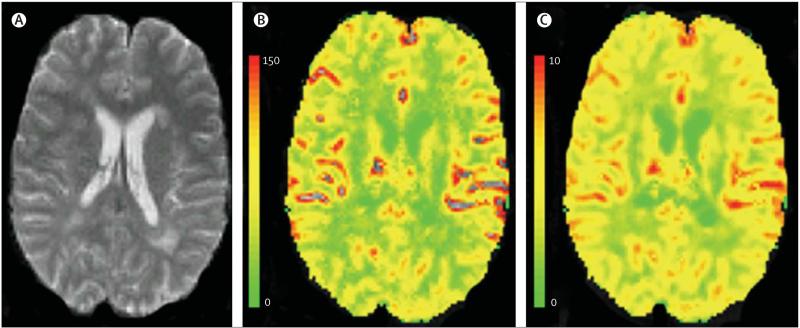
Figure 6. Axial gradient-echo echo-planar MRI showing cerebral blood flow and volume in a patient with MS
(A) Axial gradient-echo echo-planar MRI, (B) colour-coded cerebral blood flow map, and (C) colour-coded cerebral blood volume map from a patient with MS. The colour bars indicate the cerebral blood flow (mL/100 g/min) and the cerebral blood volume (mL/100 g).
Figure 7
Figure 7. Comparison of 1·5 T and 3·0 T MRI in two patients with MS
(A) 1·5 T and (B) 3·0 T MRI scans from a 48-year-old woman with secondary progressive MS, and (C) 1·5 T and (D) 3·0 T MRI scans from a 21 year-old man with relapsing-remitting MS are shown. (A) 1·5 T axial fast fluid inversion recovery (FLAIR) and (C) coronal spoiled gradient images of the brain, and 3·0 T images (B, D) of the same regions with equivalent pulse sequences on each patient display the improved sensitivity in lesion-detecting capabilities (arrows) and tissue resolution (tissue-CSF and grey-white matter differentiation) of the 3·0 T scanner. Reproduced with permission from Elsevier.

References

    1. Polman CH, Reingold SC, Edan G, et al. Diagnostic criteria for multiple sclerosis: 2005 revisions to the “McDonald Criteria”. Ann Neurol. 2005;58:840–46. - PubMed
    1. Charil A, Yousry TA, Rovaris M, et al. MRI and the diagnosis of multiple sclerosis: expanding the concept of “no better explanation”. Lancet Neurol. 2006;5:841–52. - PubMed
    1. McDonald WI, Compston A, Edan G, et al. Recommended diagnostic criteria for multiple sclerosis: guidelines from the International Panel on the Diagnosis of Multiple Sclerosis. Ann Neurol. 2001;50:121–27. - PubMed
    1. Dalton CM, Brex PA, Miszkiel KA, et al. New T2 lesions enable an earlier diagnosis of multiple sclerosis in clinically isolated syndromes. Ann Neurol. 2003;53:673–76. - PubMed
    1. Tintore M, Rovira A, Rio J, et al. New diagnostic criteria for multiple sclerosis. Application in first demyelinating episode. Neurology. 2003;60:27–30. - PubMed

Publication types

MeSH terms