


Biological impact of the fibroblast growth factor family on articular cartilage and intervertebral disc homeostasis
- PMID: 18565695
- PMCID: PMC2525607
- DOI: 10.1016/j.gene.2008.04.019
Biological impact of the fibroblast growth factor family on articular cartilage and intervertebral disc homeostasis
Abstract
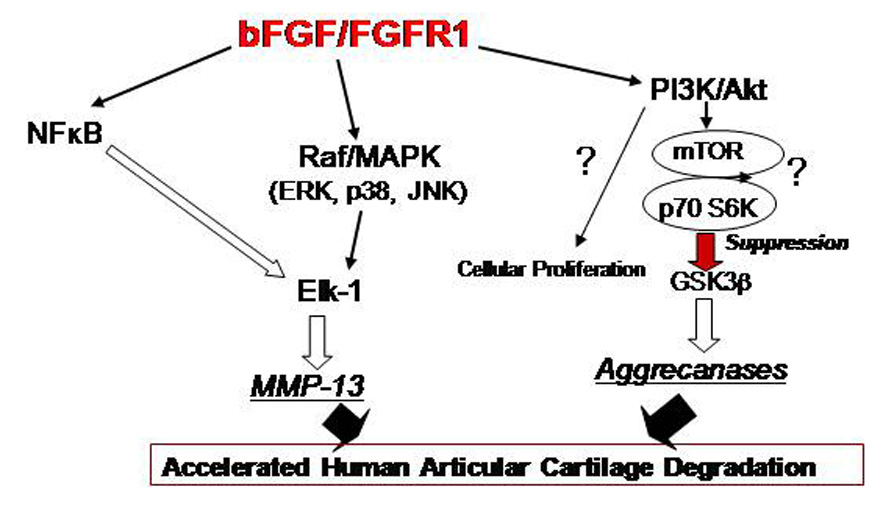
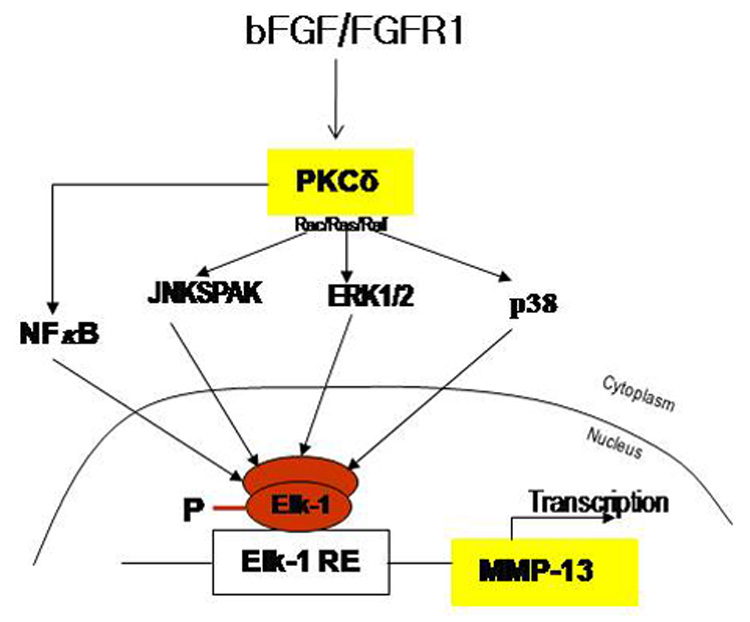
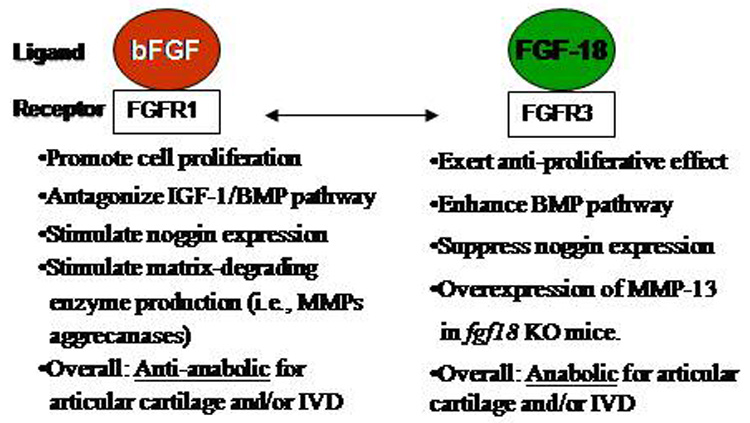
Two members of the fibroblast growth factor (FGF) family, basic FGF (bFGF) and FGF-18, have been implicated in the regulation of articular and intervertebral disc (IVD) cartilage homeostasis. Studies on bFGF from a variety of species have yielded contradictory results with regards to its precise role in cartilage matrix synthesis and degradation. In contrast, FGF-18 is a well-known anabolic growth factor involved in chondrogenesis and articular cartilage repair. In this review, we examined the biological actions of bFGF and FGF-18 in articular and IVD cartilage, the specific cell surface receptors bound by each factor, and the unique signaling cascades and molecular pathways utilized to exert their biological effects. Evidence suggests that bFGF selectively activates FGF receptor 1 (FGFR1) to exert degradative effects in both human articular chondrocytes and IVD tissue via upregulation of matrix-degrading enzyme activity, inhibition of matrix production, and increased cell proliferation resulting in clustering of cells seen in arthritic states. FGF-18, on the other hand, most likely exerts anabolic effects in human articular chondrocytes by activating FGFR3, increasing matrix formation and cell differentiation while inhibiting cell proliferation, leading to dispersed cells surrounded by abundant matrix. The results from in vitro and in vivo studies suggest the potential usefulness of bFGF and FGFR1 antagonists, as well as FGF-18 and FGFR3 agonists, as potential therapies to prevent cartilage degeneration and/or promote cartilage regeneration and repair in the future.
Figures
References
-
- Anderson DG, Izzo MW, Hall DJ, Vaccaro AR, Hilibrand A, Arnold W, Tuan RS, Albert TJ. Comparative gene expression profiling of normal and degenerative discs: analysis of a rabbit annular laceration model. Spine. 2002;27:1291–1296. - PubMed
-
- Andersson GB. Epidemiological features of chronic low-back pain. Lancet. 1999;354:581–585. - PubMed
-
- Bobick BE, Thornhill TM, Kulyk WM. Fibroblast growth factors 2, 4, and 8 exert both negative and positive effects on limb, frontonasal, and mandibular chondrogenesis via MEK-ERK activation. J Cell Physiol. 2007;211:233–243. - PubMed
-
- Bodo M, Lilli C, Aisa MC, Scapoli L, Bellucci C, Rinaldi E, Tosi L, Baroni T, Conte C, Bellocchio S, Carinci F, Stabellini G, Carinci P. Basic fibroblast growth factor: effects on matrix remodeling, receptor expression, and transduction pathway in human periosteal fibroblasts with FGFR2 gene mutation. J Interferon Cytokine Res. 2002;22:621–630. - PubMed
Publication types
MeSH terms
Substances
Grants and funding
LinkOut - more resources
Full Text Sources
Other Literature Sources
Miscellaneous
