Comparative Study
. 2008 Jun 20;4(6):e1000101.
doi: 10.1371/journal.pgen.1000101.

Plasminogen alleles influence susceptibility to invasive aspergillosis

Affiliations
Comparative Study

Plasminogen alleles influence susceptibility to invasive aspergillosis

Aimee K Zaas et al. PLoS Genet. .

Abstract

Invasive aspergillosis (IA) is a common and life-threatening infection in immunocompromised individuals. A number of environmental and epidemiologic risk factors for developing IA have been identified. However, genetic factors that affect risk for developing IA have not been clearly identified. We report that host genetic differences influence outcome following establishment of pulmonary aspergillosis in an exogenously immune suppressed mouse model. Computational haplotype-based genetic analysis indicated that genetic variation within the biologically plausible positional candidate gene plasminogen (Plg; Gene ID 18855) correlated with murine outcome. There was a single nonsynonymous coding change (Gly110Ser) where the minor allele was found in all of the susceptible strains, but not in the resistant strains. A nonsynonymous single nucleotide polymorphism (Asp472Asn) was also identified in the human homolog (PLG; Gene ID 5340). An association study within a cohort of 236 allogeneic hematopoietic stem cell transplant (HSCT) recipients revealed that alleles at this SNP significantly affected the risk of developing IA after HSCT. Furthermore, we demonstrated that plasminogen directly binds to Aspergillus fumigatus. We propose that genetic variation within the plasminogen pathway influences the pathogenesis of this invasive fungal infection.


Conflict of interest statement

Aimee K. Zaas, MD serves on the speaker's bureau for Pfizer, Inc. John R. Perfect is a consultant for the Robert Michael Educational Institute. Guochun Liao, Jonathan Usuka and Gary Peltz are employees of Roche Biosciences. All other authors declare that no conflict of interest exists.

Figures
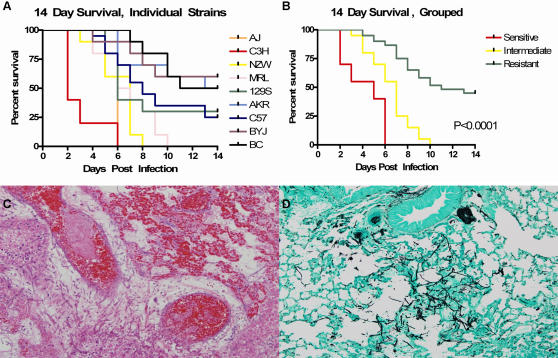
Figure 1
Figure 1. Survival following immune suppression and inhalation of A. fumigatus differs among inbred strains of mice.
(A) 14-day survival phenotype for inbred murine strains following immunosuppression and inhalation of 3.0×10⁸ AF293 conidia. Susceptible strains had death of all mice by day 6 following infection. Intermediate strains had death predominately during neutrophil recovery (days 8–11) and resistant strains had surviving mice at day 14. N = 10 mice per strain. Repetitions of the inhalation in C57Bl/6, Balb/C, A/J and C3H/HeJ yielded similar results, indicating reproducibility of phenotype and consistency of inhalational protocol. (B) Kaplan-Meier curve representing divergent outcomes of murine strains following immune suppression and inhalation of A. fumigatus. Death occurred earlier in susceptible mice as compared to intermediate and resistant mice, as well as in intermediate mice as compared to resistant mice (p<0.001, log rank). (C) Haematoxylin and eosin stain of A/J lung, taken from a moribund mouse 4 days following immune suppression and inhalation of 3.0×10e8 AF conidia, magnification 40×. 1d. Gomori-methanamine silver stain of A/J lung, showing a focus of AF hyphae, magnification 40×.
Figure 2
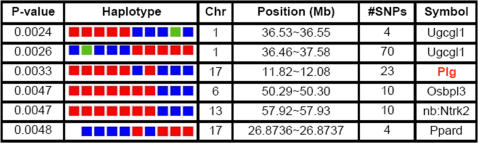
Figure 2. Computational genetic analysis identifies plasminogen (PLG) as a candidate susceptibility gene for invasive aspergillosis.
Haplotype-based computational genetic analysis was used to analyze the area under the survival curve to identify genetic factors affecting survival after AF exposure among the inbred strains. Colored blocks represent haplotype structure, with red blocks representing “resistant” murine strains (C57, 129, Balb/C, Balb/CBy and AKR) and the “intermediate” strain NZW/LacJ and blue blocks representing “susceptible” murine strains (A/J, DBA/2J and C3H/HeJ) and the “intermediate” strain MR/MpJ. The green block represents missing haplotype data.
Figure 3
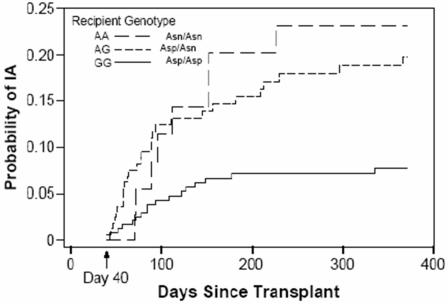
Figure 3. Kaplan-Meier curve demonstrating elevated risk of developing IA in HSCT recipients with AA or AG genotype, using GG as the reference genotype.
The data represent 59 HSCT recipients who developed IA between days 40–365 following transplantation and 135 HSCT recipients who survived >40 days following HSCT and did not develop IA (HR genotype AA 5.56, 95% CI 1.88, 16.48; HR genotype AG 3.00 95% CI 1.46, 6.14; p<0.0005). The genotypic results are reported for follow-up beyond 40 days, using a left-censored analysis.
Figure 4
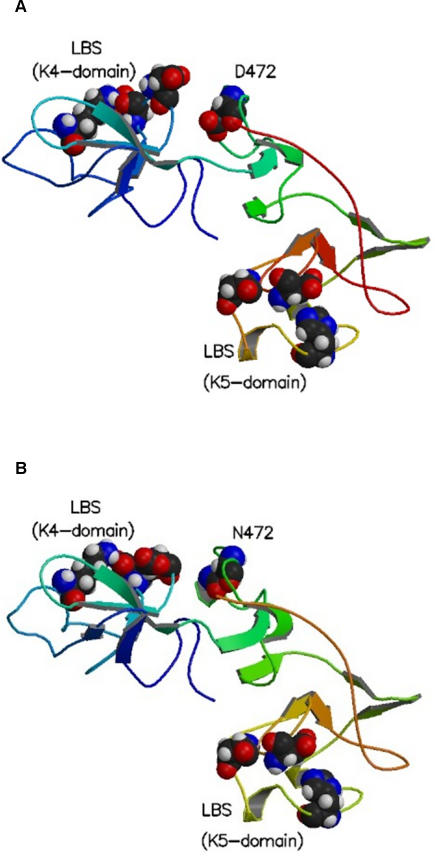
Figure 4. Ribbon diagrams of the combined kringle 4 (K4) and kringle 5 (K5) domains of human plasminogen.
(A) Ribbon diagram showing Asp472 and the relationship to a major lysine binding site (LBS) on kringle 4. (B) Asp472 in the native K4K5 structure mutated to Asn.
Figure 5
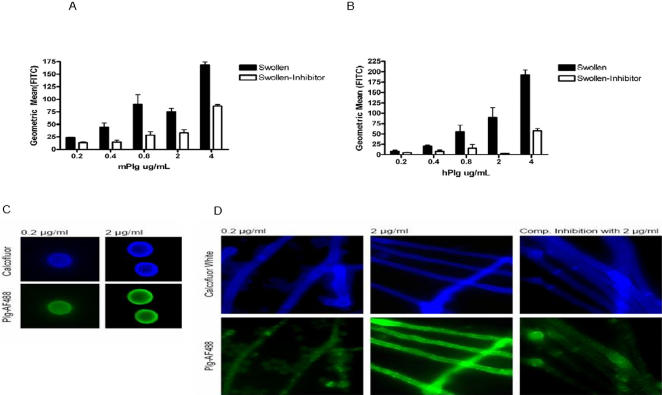
Figure 5. Murine and human plasminogen bind swollen A. fumigatus conidia and hyphae.
(A and B) A. fumigatus conidia (1×10⁶) were incubated with several concentrations of murine (A) or human (B) PLG-AF488 (FITC) for 30 minutes at 37°C. Binding was assessed by flow cytometry. There was a strong correlation between the geometric mean of the FITC channel and PLG-AF488 concentration. Results are reported as the geometric mean±the standard error of the mean of at least three experiments. Specificity of binding is demonstrated as pre-incubation with 4 ug/mL unlabeled plasminogen for 30 minutes at 37°C inhibits binding of AF488-labeled plasminogen. Results are reported as the geometric mean±the standard error of three replicates. (C.) A. fumigatus conidia (1×10⁶) were stained with murine PLG-AF488 (0.2 µg/ml) and Calcoflour White for 30 minutes at 37°C. Plasminogen binding is evident on the conidial surface. (D.) A. fumigatus hyphae were incubated with several concentrations of murine PLG-AF488 for 30 minutes at 37°C and calcofluor white and visualized with fluorescence microscopy. Preincubation (30 minutes at 37°C) of hyphae with unlabelled plasminogen inhibits binding of AF488-labeled plasminogen.

References

    1. Herbrecht R, Denning DW, Patterson TF, Bennett JE, Greene RE, et al. Voriconazole versus amphotericin B for primary therapy of invasive aspergillosis. N Engl J Med. 2002;347:408–415. - PubMed
    1. Marr KA, Carter RA, Boeckh M, Martin P, Corey L. Invasive aspergillosis in allogeneic stem cell transplant recipients: changes in epidemiology and risk factors. Blood. 2002;100:4358–4366. - PubMed
    1. Poltorak A, He X, Smirnova I, Liu MY, Van Huffel C, et al. Defective LPS signaling in C3H/HeJ and C57BL/10ScCr mice: mutations in Tlr4 gene. Science. 1998;282:2085–2088. - PubMed
    1. Grupe A, Germer S, Usuka J, Aud D, Belknap JK, et al. In silico mapping of complex disease-related traits in mice. Science. 2001;292:1915–1918. - PubMed
    1. Guo Y, Weller P, Farrell E, Cheung P, Fitch B, et al. In silico pharmacogenetics of warfarin metabolism. Nat Biotechnol. 2006;24:531–536. - PMC - PubMed

Publication types

MeSH terms