


High intraluminal pressure via H2O2 upregulates arteriolar constrictions to angiotensin II by increasing the functional availability of AT1 receptors
- PMID: 18567710
- PMCID: PMC2519219
- DOI: 10.1152/ajpheart.00205.2008
High intraluminal pressure via H2O2 upregulates arteriolar constrictions to angiotensin II by increasing the functional availability of AT1 receptors
Abstract
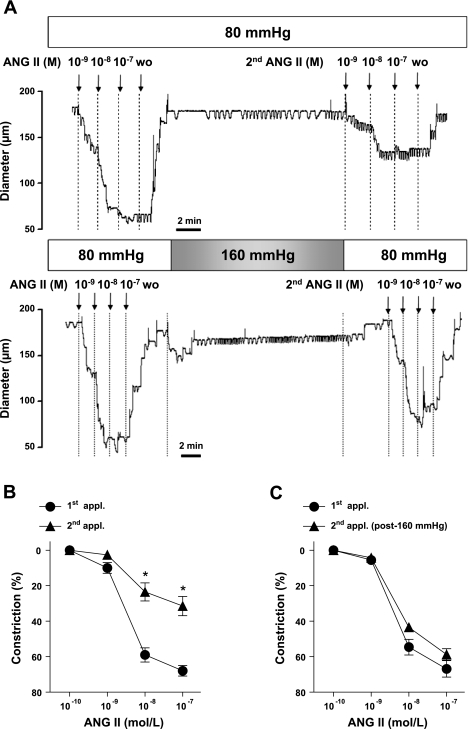
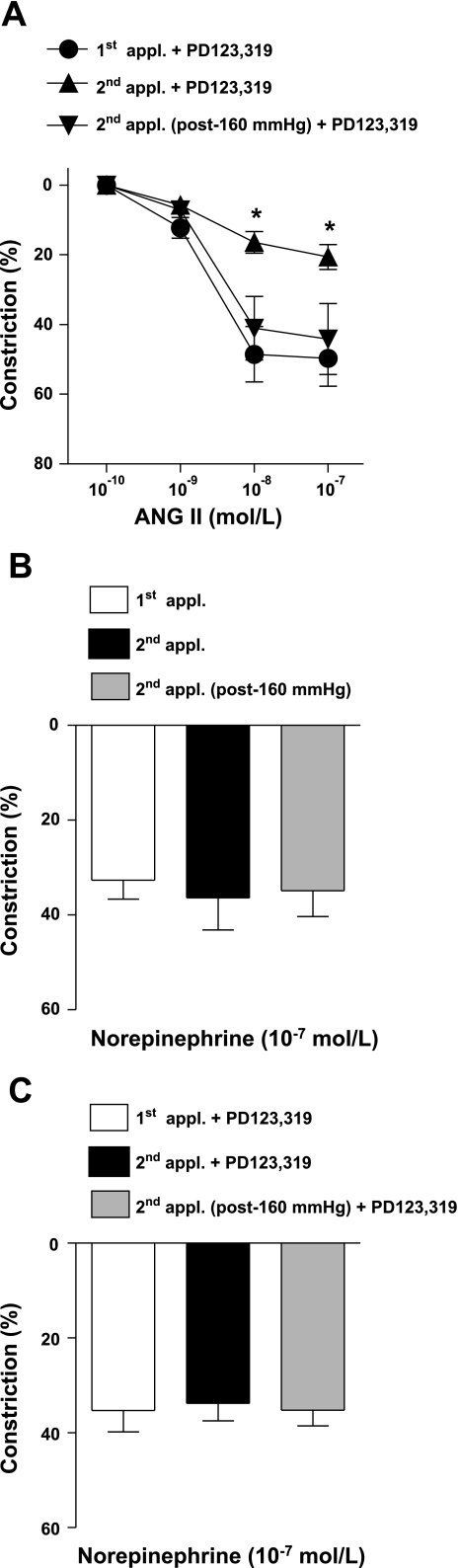
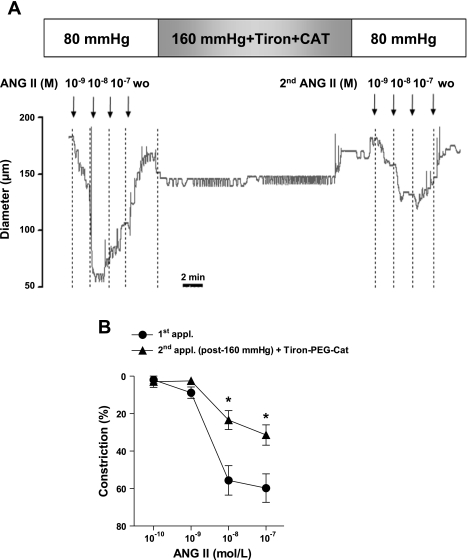
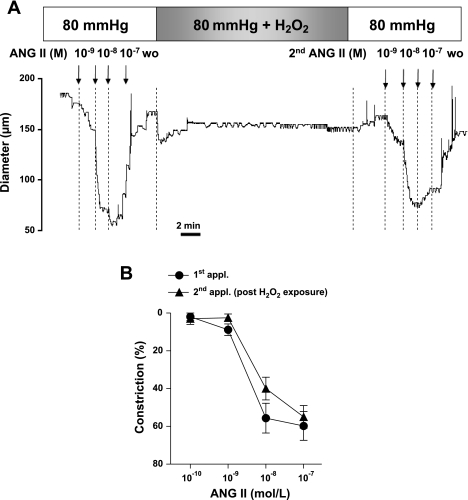
Previously, we found that high intraluminal pressure leads to production of reactive oxygen species (ROS) and also upregulates several components of the renin-angiotensin system in the wall of small arteries. We hypothesized that acute exposure of arterioles to high intraluminal pressure in vitro via increasing ROS production enhances the functional availability of type 1 angiotensin II (Ang II) receptors (AT1 receptors), resulting in sustained constrictions. In arterioles ( approximately 180 mum) isolated from rat skeletal muscle, Ang II elicited dose-dependent constrictions, which decreased significantly by the second application [maximum (max.): from 59% +/- 4% to 26% +/- 5% at 10(-8) M; P < 0.05] in the presence of 80 mmHg of intraluminal pressure. In contrast, if the arterioles were exposed to high intraluminal pressure (160 mmHg for 30 min), Ang II-induced constrictions remained substantial on the second application (max.: 51% +/- 3% at 10(-8) M). In the presence of Tiron and polyethylene glycol (PEG)-catalase, known to reduce the level of superoxide anion and hydrogen peroxide (H(2)O(2)), second applications of Ang II evoked similarly reduced constrictions, even after high-pressure exposure (29% +/- 4% at 10(-8) M). Furthermore, when arterioles were exposed to H(2)O(2) (for 30 min, 10(-7) M, at normal 80 mmHg pressure), Ang II-induced constrictions remained substantial on second applications (59% +/- 5% at 10(-8) M). These findings suggest that high pressure, likely via inducing H(2)O(2) production, increases the functional availability of AT1 receptors and thus enhances Ang II-induced arteriolar constrictions. We propose that in hypertension-regardless of etiology-high intraluminal pressure, via oxidative stress, enhances the functional availability of AT1 receptors augmenting Ang II-induced constrictions.
Figures
References
-
- Anborgh PH, Seachrist JL, Dale LB, Ferguson SS. Receptor/beta-arrestin complex formation and the differential trafficking and resensitization of beta2-adrenergic and angiotensin II type 1A receptors. Mol Endocrinol 14: 2040–2053, 2000. - PubMed
-
- Cai H, Harrison DG. Endothelial dysfunction in cardiovascular diseases: the role of oxidant stress. Circ Res 87: 840–844, 2000. - PubMed
-
- Dahlof B, Devereux RB, Kjeldsen SE, Julius S, Beevers G, de Faire U, Fyhrquist F, Ibsen H, Kristiansson K, Lederballe-Pedersen O, Lindholm LH, Nieminen MS, Omvik P, Oparil S, Wedel H. Cardiovascular morbidity and mortality in the Losartan Intervention For Endpoint reduction in hypertension study (LIFE): a randomised trial against atenolol. Lancet 359: 995–1003, 2002. - PubMed
-
- Fox KM Efficacy of perindopril in reduction of cardiovascular events among patients with stable coronary artery disease: randomised, double-blind, placebo-controlled, multicentre trial (the EUROPA study). Lancet 362: 782–788, 2003. - PubMed
Publication types
MeSH terms
Substances
Grants and funding
LinkOut - more resources
Full Text Sources
Medical
Research Materials
Miscellaneous
