. 2008 Jun;6(6):947-54.
doi: 10.1158/1541-7786.MCR-07-2079.

Mdm2 and Mdm4 loss regulates distinct p53 activities

Affiliations

Mdm2 and Mdm4 loss regulates distinct p53 activities

Juan A Barboza et al. Mol Cancer Res. 2008 Jun.

Abstract

Mutational inactivation of p53 is a hallmark of most human tumors. Loss of p53 function also occurs by overexpression of negative regulators such as MDM2 and MDM4. Deletion of Mdm2 or Mdm4 in mice results in p53-dependent embryo lethality due to constitutive p53 activity. However, Mdm2(-/-) and Mdm4(-/-) embryos display divergent phenotypes, suggesting that Mdm2 and Mdm4 exert distinct control over p53. To explore the interaction between Mdm2 and Mdm4 in p53 regulation, we first generated mice and cells that are triple null for p53, Mdm2, and Mdm4. These mice had identical survival curves and tumor spectrum as p53(-/-) mice, substantiating the principal role of Mdm2 and Mdm4 as negative p53 regulators. We next generated mouse embryo fibroblasts null for p53 with deletions of Mdm2, Mdm4, or both; introduced a retrovirus expressing a temperature-sensitive p53 mutant, p53A135V; and examined p53 stability and activity. In this system, p53 activated distinct target genes, leading to apoptosis in cells lacking Mdm2 and a cell cycle arrest in cells lacking Mdm4. Cells lacking both Mdm2 and Mdm4 had a stable p53 that initiated apoptosis similar to Mdm2-null cells. Additionally, stabilization of p53 in cells lacking Mdm4 with the Mdm2 antagonist nutlin-3 was sufficient to induce a cell death response. These data further differentiate the roles of Mdm2 and Mdm4 in the regulation of p53 activities.


Figures

FIGURE 1
FIGURE 1
A. Survival curves of p53−/− (n = 23) and p53−/−Mdm2−/− Mdm4−/− (n = 25) mice as determined by Kaplan-Meier analysis. B. Representative tumors arising in p53−/−Mdm2−/−Mdm4−/− mice. Clockwise from top left corner: lymphoma in the lung, thymic lymphoma, angiosarcoma, and a sarcoma adjacent to a lymphoma in the same mouse.
FIGURE 2
FIGURE 2
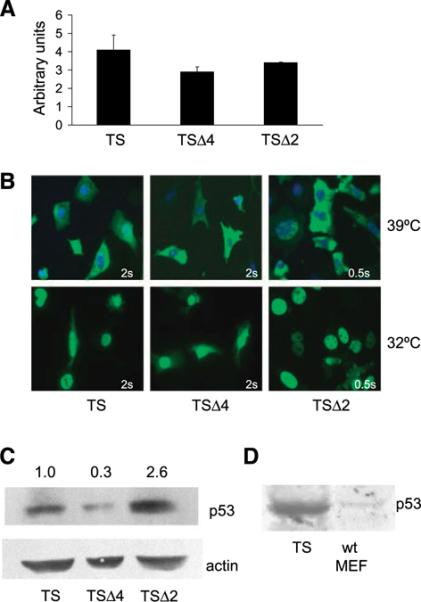
Endogenous Mdm2 and Mdm4 have distinct effects on steady-state p53 levels. A. Relative p53 mRNA levels of the temperature-sensitive mutant p53A135V were determined by real-time reverse transcription-PCR using RNA from TS, TSΔ4, and TSΔ2 cells cultured at the nonpermissive temperature of 39°C and normalized to a Gapdh internal control. SDs were determined from triplicate samples. B. TS, TSΔ4, and TSΔ2 cells were cultured at 39°C or 32°C for 6 h, fixed, and incubated with a p53 primary antibody and a FITC-conjugated secondary antibody (green). Nuclei were counterstained with 4′,6-diamidino-2-phenylindole (blue). Exposure times are indicated. C. Immunoblot of p53 from whole-cell lysates prepared from MEFs after culturing at 32°C for 6 h. β-Actin was used as a loading control. Protein levels were determined by densitometric quantification of immunoblots and relative p53 level is shown. D. A comparison of wild-type (wt) p53 protein levels in MEFs to p53A135V protein levels after retroviral infection of p53-null MEFs by Western blot analysis. Equal amounts of total protein were loaded.
FIGURE 3
FIGURE 3
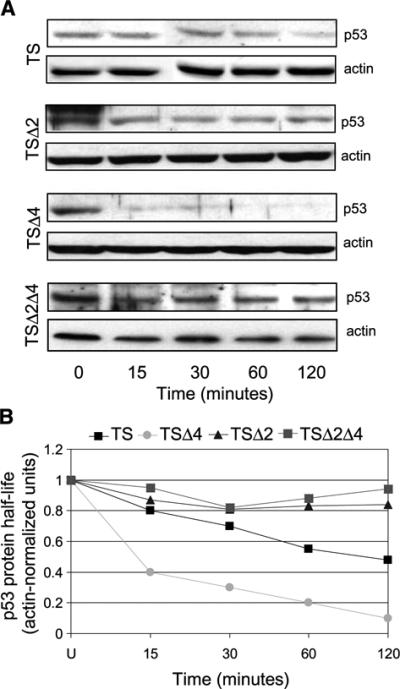
Endogenous Mdm2 and Mdm4 have distinct effects on p53 protein stability. A. TS, TSΔ2, TSΔ4, and TSΔ2Δ4 MEFs were cultured at 32°C for 6 h. Cells were then cultured in the presence of cycloheximide for the indicated times. Cell lysates were prepared and analyzed by immunoblotting with a p53 antibody. β-Actin was used as a loading control. B. p53 half-life was determined by densitometric quantification of the representative immunoblots depicted in A. Cycloheximide experiments were done at least thrice for each cell population.
FIGURE 4
FIGURE 4
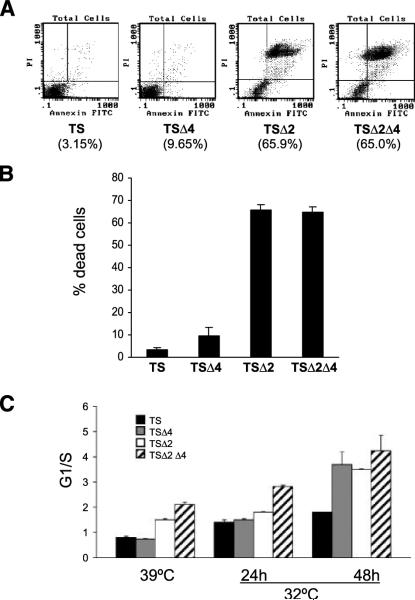
Mdm2 and Mdm4 determine p53 initiation of cell cycle arrest or apoptosis. A. MEFs were cultured at 32°C for 12 h, labeled with Annexin V-fluorescein and propidium iodide, and analyzed by flow cytometry to determine cell viability. Percentages represent apoptotic cells (Annexin V positive). B. Cell viability as determined by positive Annexin V staining described in A. C. The G1-to-S ratio was calculated from cells cultured at 39°C and 32°C and analyzed by flow cytometry. Columns, mean from at least three independent experiments done in duplicate; bars, SE.
FIGURE 5
FIGURE 5
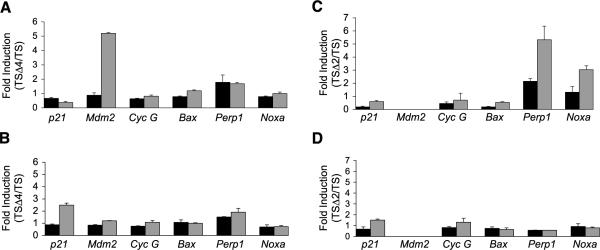
Transcriptional activation of p53 target genes in TS, TSΔ2, and TSΔ4 MEFs. Fold induction was calculated as gene expression in TSΔ4 cells over TS cells 6 h (A) and 12 h (B) after temperature shift, and in TSΔ2 cells over TS cells 6 h (C) and 12 h (D) after temperature shift. Values were normalized to expression of Gapdh in each reaction. Columns, mean from three independent experiments done in duplicate; bars, SE.
FIGURE 6
FIGURE 6
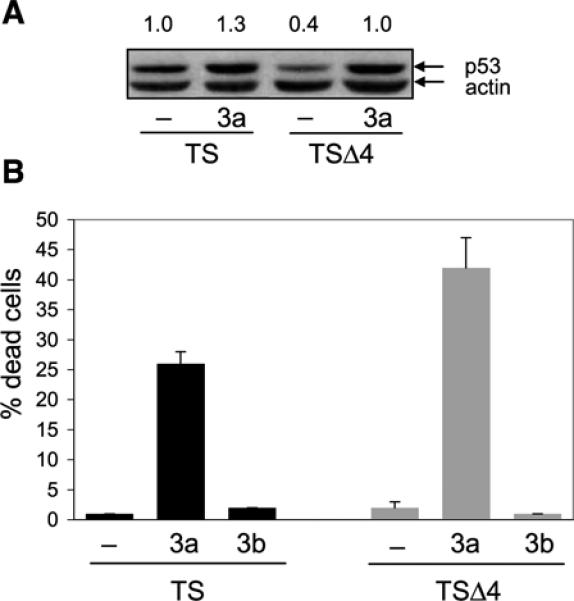
p53 stabilization induces a cell death response independent of Mdm4. A. TS and TSΔ4 MEFs were cultured at 32°C for 4 h, treated with 50 μmol/L nutlin-3a for 1 h, and analyzed for p53 expression by immunoblotting. Protein levels were determined as in Fig. 1C and relative p53 levels are shown. B. MEFs were cultured at 32°C for 4 h and then treated with 50 μmol/L of nutlin-3a or nutlin-3b for an additional 4 h. Cell viability was determined by trypan blue exclusion. At least 200 cells were counted for each treatment. Columns, mean from two independent experiments done in duplicate; bars, SE.

References

    1. Haupt Y, Maya R, Kazaz A, Oren M. Mdm2 promotes the rapid degradation of p53. Nature. 1997;387:296–9. - PubMed
    1. Honda R, Tanaka H, Yasuda H. Oncoprotein MDM2 is a ubiquitin ligase E3 for tumor suppressor p53. FEBS Lett. 1997;420:25–7. - PubMed
    1. Kubbutat MH, Jones SN, Vousden KH. Regulation of p53 stability by Mdm2. Nature. 1997;387:299–303. - PubMed
    1. Momand J, Zambetti GP, Olson DC, George D, Levine AJ. The mdm-2 oncogene product forms a complex with the p53 protein and inhibits p53-mediated transactivation. Cell. 1992;69:1237–45. - PubMed
    1. Oliner JD, Pietenpol JA, Thiagalingam S, Gyuris J, Kinzler KW, Vogelstein B. Oncoprotein MDM2 conceals the activation domain of tumour suppressor p53. Nature. 1993;362:857–60. - PubMed

Publication types

MeSH terms