


FSHB promoter polymorphism within evolutionary conserved element is associated with serum FSH level in men
- PMID: 18567894
- PMCID: PMC2517155
- DOI: 10.1093/humrep/den216
FSHB promoter polymorphism within evolutionary conserved element is associated with serum FSH level in men
Abstract
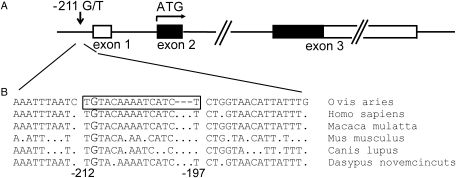
Background: No polymorphisms affecting serum FSH levels have been described in the human FSHB gene. We have identified a potential regulatory single nucleotide polymorphism (SNP, rs10835638; G/T) 211 bp upstream from the FSHB mRNA transcription start-site, located within a highly conserved region among placental mammals. We aimed to determine the correlation of carrier status of rs10835638 alternative alleles with serum FSH level in men, and testicular and hormonal parameters.
Methods: A quantitative genetic association study using a cohort of healthy men (n = 554; age 19.2 +/- 1.7 years) visiting the Centre of Andrology, Tartu University Hospital, Estonia.
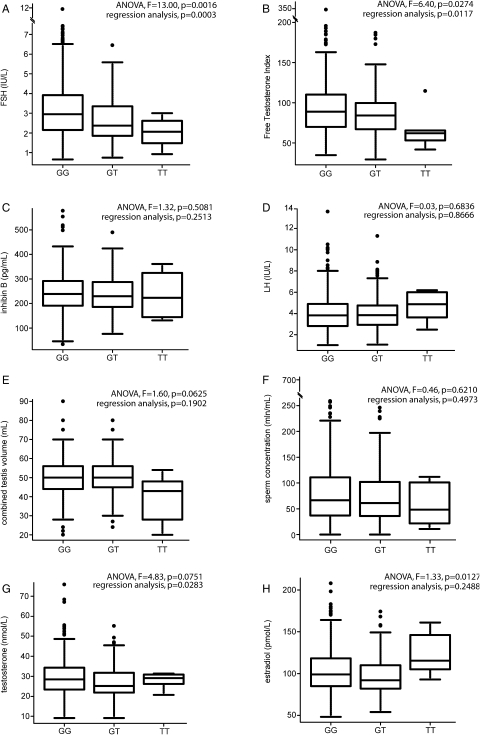
Results: Rs10835638 (allele frequencies: G 87.6%, T 12.4%) was significantly associated with serum FSH level (analysis of variance: F = 13.0, P = 0.0016, df = 1; regression testing for a linear trend: P = 0.0003). Subjects with the GG genotype exhibited higher FSH levels (3.37 +/- 1.79 IU/l, n = 423) compared with heterozygotes (2.84 +/- 1.54 IU/l, n = 125) (P = 0.0005), the group of T-allele carriers (GT+TT, 2.78 +/- 1.51 IU/l, n = 131) (P = 0.0005) and TT-homozygotes (2.02 +/- 0.81 IU/L, n = 6) (P = 0.031). Rs10835638 was also associated with significant (P < 0.05) reduction in free testosterone index and testes volume, but increased semen volume, sex hormone-binding globulin, serum testosterone and estradiol. LH and inhibin-B levels did not differ significantly between groups.
Conclusions: The identification of a regulatory SNP in FSHB promoter paves the way to study the effect of constitutively low FSH on male health and fertility. As FSH contributes to follicular development and sex steroid production in women, the role of this FSHB variant in female reproductive success is still to be addressed.
Figures
References
-
- An B-S, Choi J-H, Choi K-C, Leung PCK. Differential role of progesterone receptor isoforms in the transcriptional regulation of human gonadotropin-releasing hormone I (GnRH I) receptor, GnRH I, and GnRH II. J Clin Endocrinol Metab. 2005;90:1106–1113. - PubMed
-
- Arslan M, Weinbauer GF, Schlatt S, Shahab M, Nieschlag E. FSH and testosterone, alone or in combination, initiate testicular growth and increase the number of spermatogonia and Sertoli cells in a juvenile non-human primate (Macaca mulatta) J Endocrinol. 1993;136:235–243. - PubMed
-
- Berger K, Souza H, Brito VN, d’Alva CB, Mendonca BB, Latronico AC. Clinical and hormonal features of selective follicle-stimulating hormone (FSH) deficiency due to FSH beta-subunit gene mutations in both sexes. Fertil Steril. 2005;83:466–470. - PubMed
Publication types
MeSH terms
Substances
Grants and funding
LinkOut - more resources
Full Text Sources
Research Materials
Miscellaneous
