


doi: 10.1111/j.0963-7214.2006.00395.x.
The Automaticity of Social Life
Affiliations
- PMID: 18568084
- PMCID: PMC2435044
- DOI: 10.1111/j.0963-7214.2006.00395.x
Item in Clipboard
The Automaticity of Social Life
Curr Dir Psychol Sci.
2006 Feb.
Abstract
Much of social life is experienced through mental processes that are not intended and about which one is fairly oblivious. These processes are automatically triggered by features of the immediate social environment, such as the group memberships of other people, the qualities of their behavior, and features of social situations (e.g., norms, one's relative power). Recent research has shown these nonconscious influences to extend beyond the perception and interpretation of the social world to the actual guidance, over extended time periods, of one's important goal pursuits and social interactions.
Figures
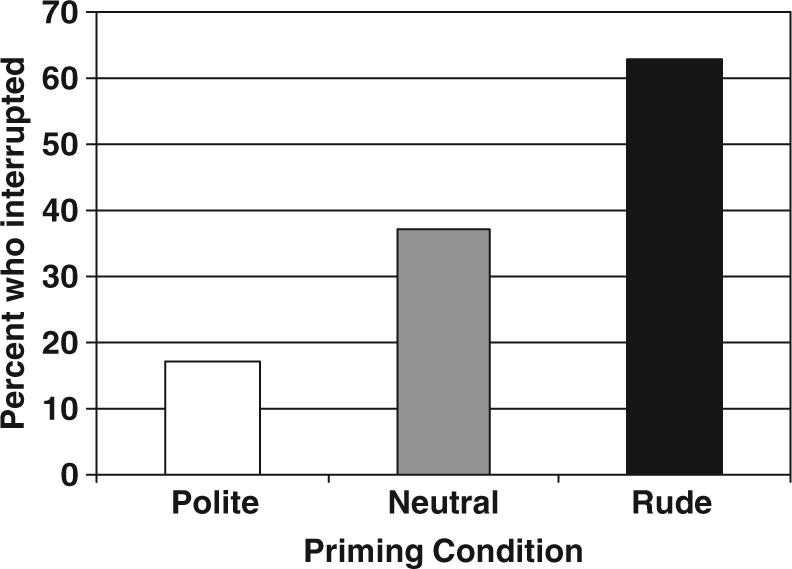
Percentage of participants primed with the concept ‘‘polite,’’ the concept ‘‘rude,’’ or a neutral concept who interrupted a conversation between the experimenter and a confederate (Bargh, Chen, & Burrows, 1996, Experiment 1). From ‘‘Automaticity of Social Behavior: Direct Effects of Trait Construct and Stereotype Priming on Action,’’ by J.A. Bargh, M. Chen, & L. Burrows, 1996, Journal of Personality and Social Psychology, 71, page 235. Copyright 1996 American Psychological Association. Reprinted with permission.
References
-
- Aarts H, Dijksterhuis A. The silence of the library: Environment, situational norms, and social behavior. Journal of Personality and Social Psychology. 2003;84:18–28. - PubMed
-
- Bargh JA. The automaticity of everyday life. In: Wyer RS, editor. Advances in social cognition. X. Erlbaum; Mahwah, NJ: 1997. pp. 1–61.
-
- Bargh JA, Chen M, Burrows L. Automaticity of social behavior: Direct effects of trait construct and stereotype priming on action. Journal of Personality and Social Psychology. 1996;71:230–244. - PubMed
-
- Chen S, Lee-Chai AY, Bargh JA. Relationship orientation as a moderator of the effects of social power. Journal of Personality and Social Psychology. 2001;80:173–187. - PubMed
Grants and funding
LinkOut - more resources
Full Text Sources