


Review
doi: 10.1039/b703021p.
Epub 2008 Jun 2.
Expanding dialogues: from natural autoinducers to non-natural analogues that modulate quorum sensing in Gram-negative bacteria
Affiliations
- PMID: 18568169
- PMCID: PMC2590586
- DOI: 10.1039/b703021p
Item in Clipboard
Review
Expanding dialogues: from natural autoinducers to non-natural analogues that modulate quorum sensing in Gram-negative bacteria
Chem Soc Rev.
2008 Jul.
Abstract
Bacteria are capable of "communicating" their local population densities via a process termed quorum sensing (QS). Gram-negative bacteria use N-acylated l-homoserine lactones (AHLs), in conjunction with their cognate LuxR-type receptors, as their primary signalling circuit for QS. In this critical review, we examine AHL signalling in Gram-negative bacteria with a primary focus on the design of non-natural AHLs, their structure-activity relationships, and their application in chemical biological approaches to study QS (72 references).
Figures
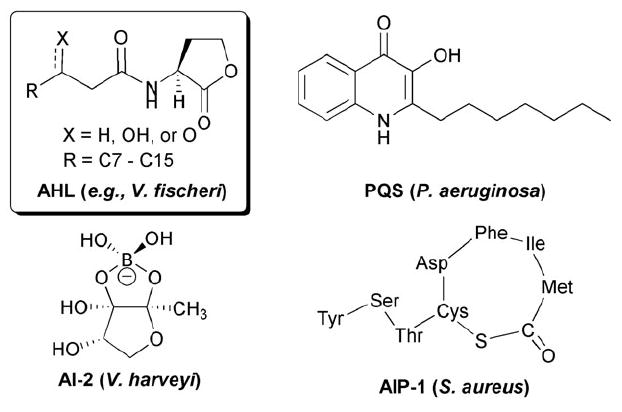
Selected QS signals listed with their corresponding bacterial species. AHL = N-acylated l -homoserine lactone; AI-2 = autoinducer 2; PQS = Pseudomonas quinolone signal; AIP-1 = autoinducing peptide 1.
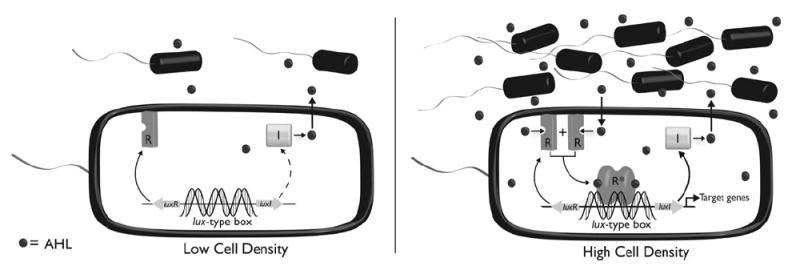
Simplified AHL signalling circuit in Gram-negative bacterial QS. R: LuxR-type receptor protein; I: LuxI-type autoinducer synthase protein; AHL: N-acylated l -homoserine lactone.
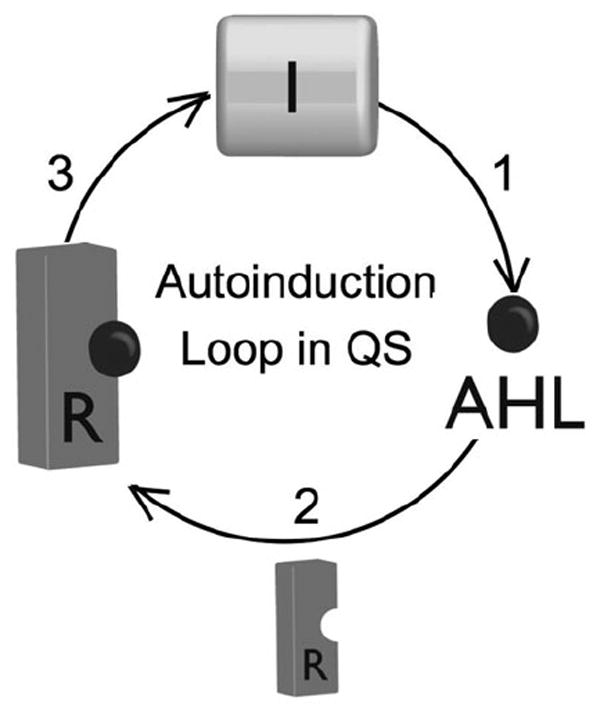
Autoinduction loop in QS: (1) AHLs are produced by LuxI-type synthase proteins (I); (2) above a critical concentration they bind to a LuxR-type receptor (R), (3) following dimerization, this receptor:ligand complex acts as a transcription factor to produce more I protein and control other essential functions of QS.
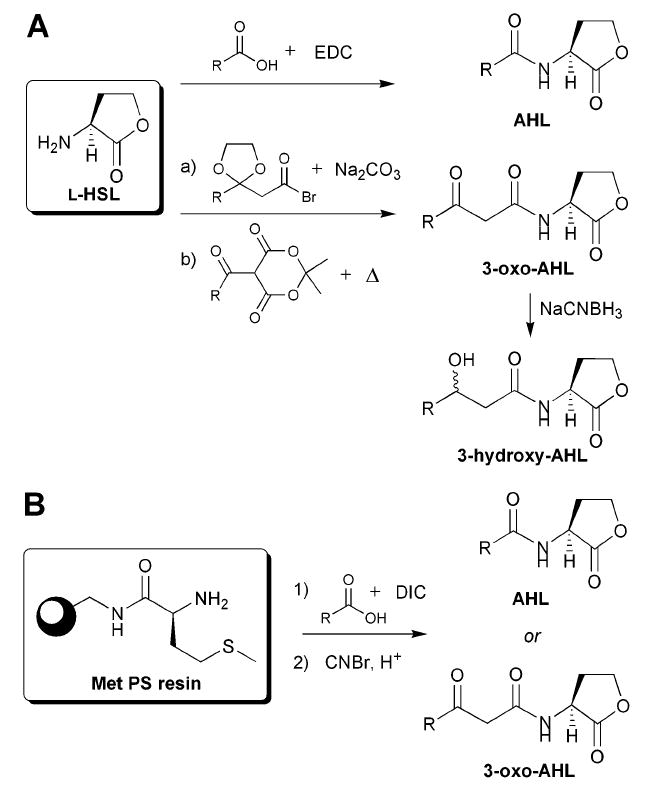
Common synthetic routes to natural AHLs. A: Solution-phase amide coupling conditions. HSL = homoserine lactone. EDC = 1-ethyl-3-(3-dimethylaminopropyl) carbodiimide hydrochloride. B: Solid-phase synthetic route for the generation of AHLs from l -methionine-loaded amino-polystyrene (Met-PS) resin. DIC = N,N′-diisopropylcarbodiimide.
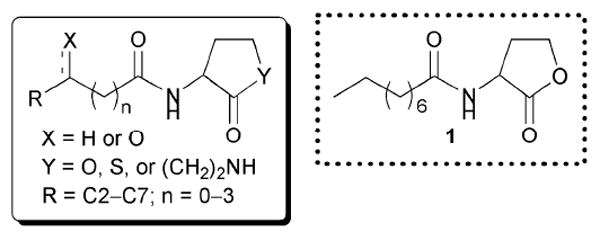
Structural features of AHLs tested against LuxR by Eberhard and co-workers summarized in shaded box; compounds were synthesized and tested as racemates. Their best antagonist is shown.
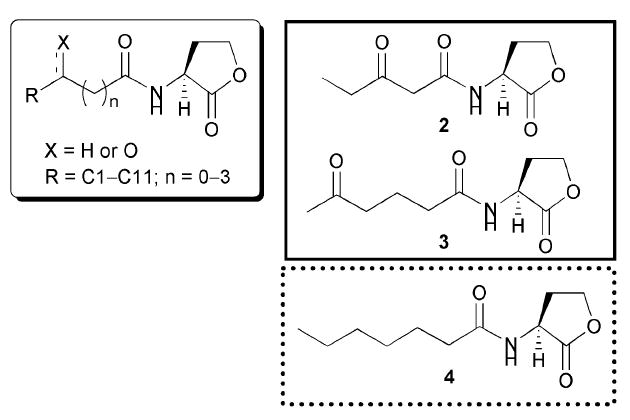
Structural features of AHLs tested against LuxR by Greenberg and co-workers summarized in shaded box; identified agonists and antagonist are outlined in solid and dashed lines, respectively.
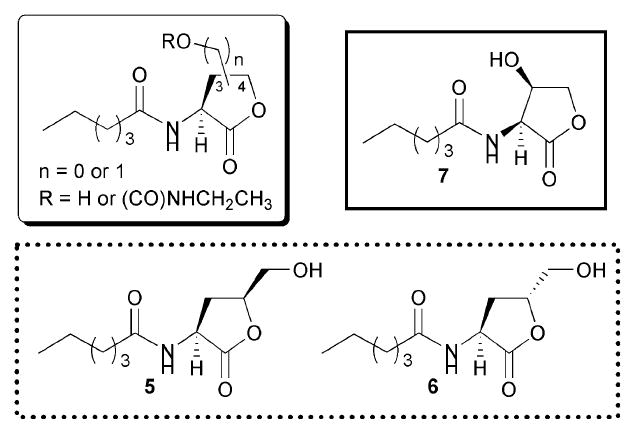
Structural features of AHLs tested against LuxR by Nielsen and co-workers summarized in shaded box; identified agonist and antagonists are outlined in solid and dashed lines, respectively.
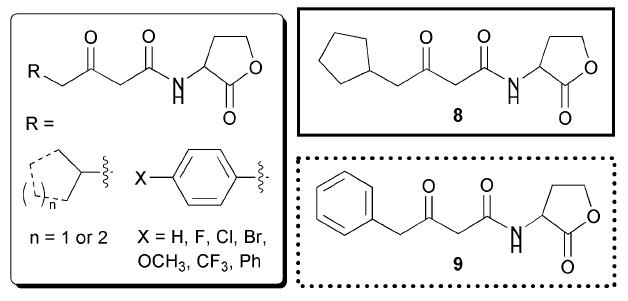
Structural features of AHLs tested against LuxR by Doutheau and co-workers summarized in shaded box; compounds were synthesized and tested as racemates. Their most active agonist and antagonist are outlined in solid and dashed lines, respectively.
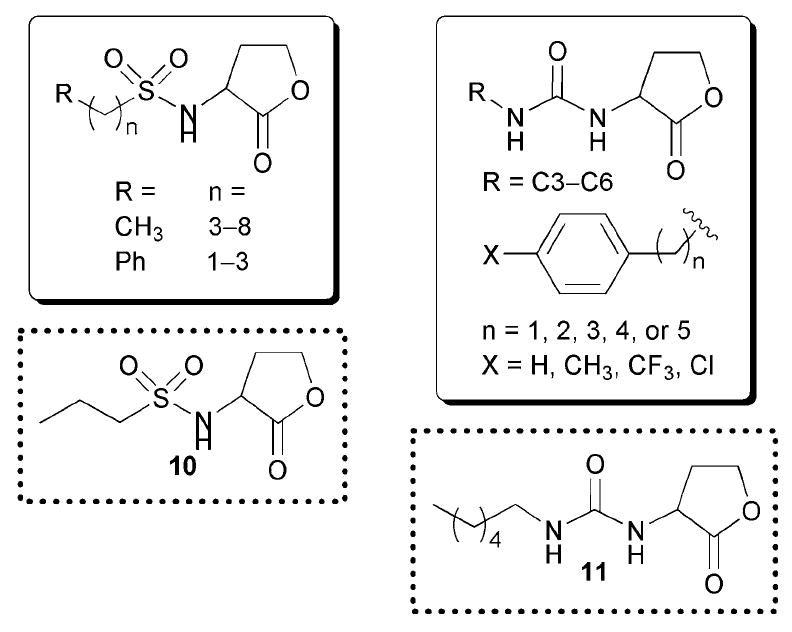
Structural features of AHLs tested against LuxR by Doutheau and co-workers summarized in shaded boxes. Compounds were synthesized and tested as racemates; antagonists are outline in dashed lines.
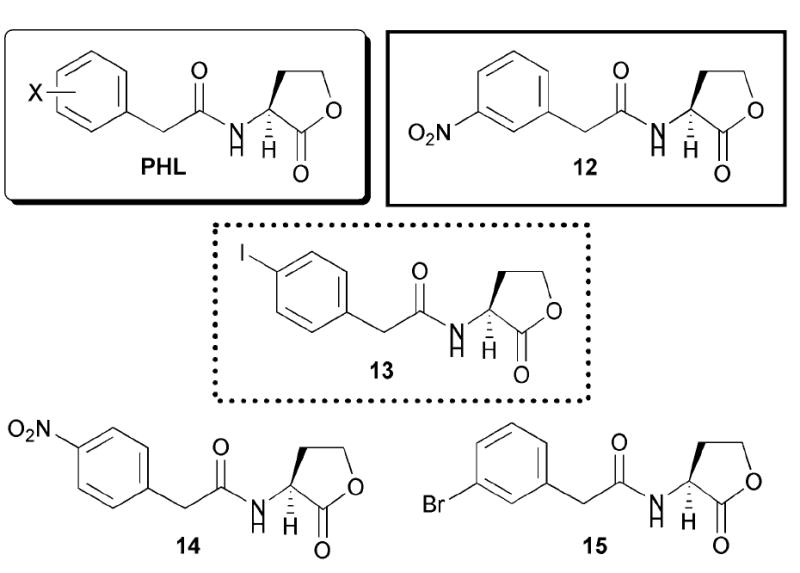
Structural features of AHLs tested against LuxR by Blackwell and co-workers summarized in shaded box. The most active agonist and antagonist are outlined in solid and dashed lines, respectively. Note, AHLs 14 and 15 behave as partial agonists.
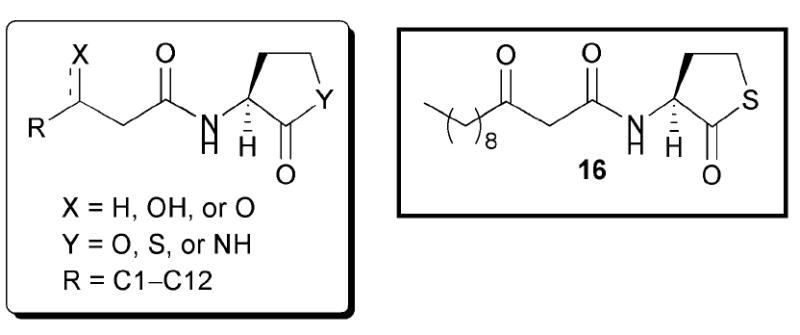
Structural features of AHLs tested against LasR by Iglewski and co-workers summarized in shaded box. AHL 16, the thiolactone analogue of OdDHL, acts as an agonist of LasR.
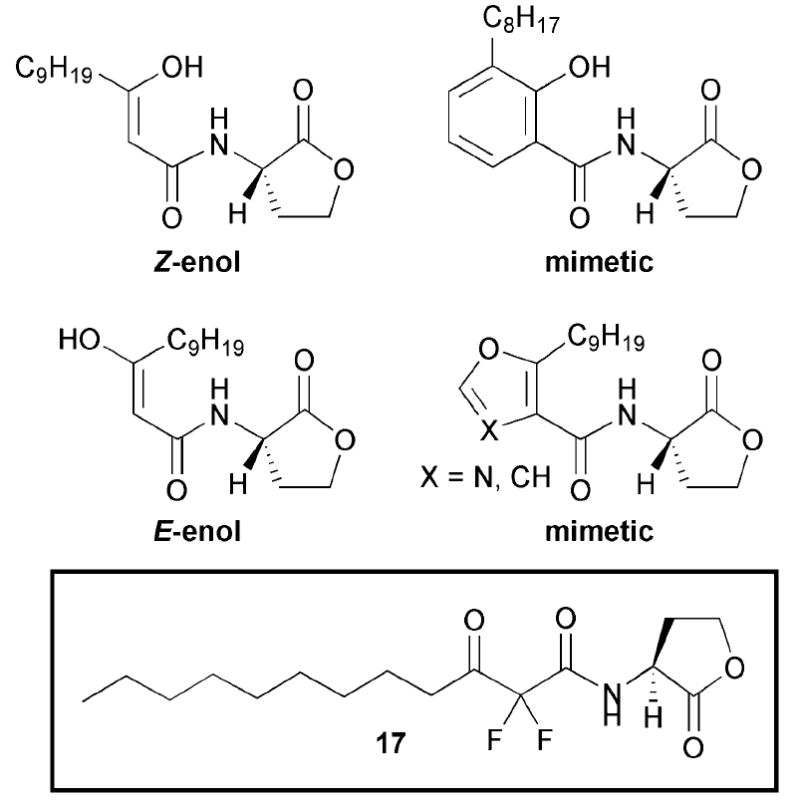
Structural features of AHLs tested against LasR by Kline and co-workers. AHL 17 is a non-enolizable agonist of LasR.
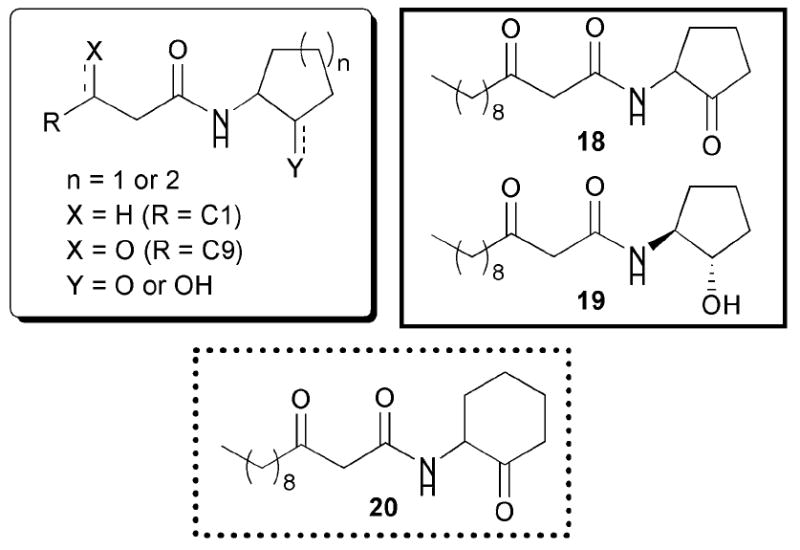
Structural features of AHLs tested against LasR and RhlR by Suga and co-workers summarized in shaded box; identified agonists and antagonist are outlined in solid and dashed lines, respectively.
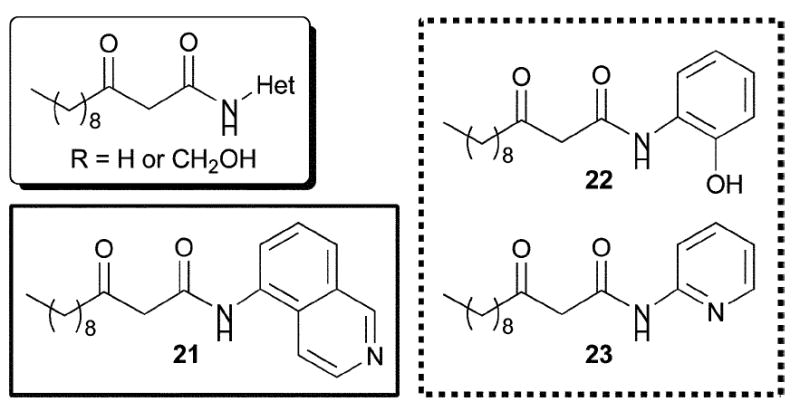
Structural features of AHLs tested against LasR by Suga and co-workers summarized in shaded box; identified agonist and antagonists are outlined in solid and dashed lines, respectively.
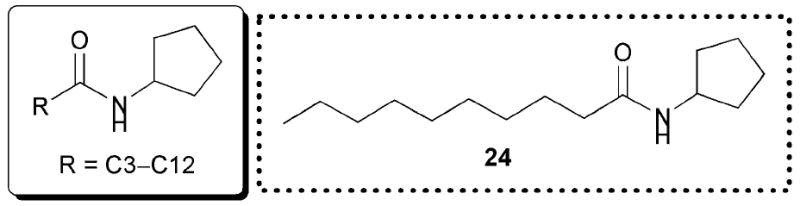
Structural features of AHLs tested against LasR by Kato and co-workers summarized in shaded box; their best antagonist is shown.
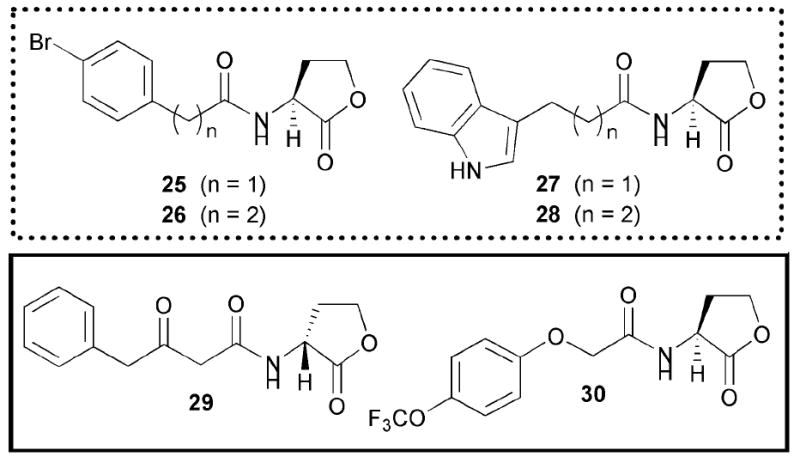
Active non-native AHLs identified by Blackwell and co-workers; significant agonists and antagonists are outlined in solid and dashed lines, respectively. Note, 26 behaves as a partial agonist.
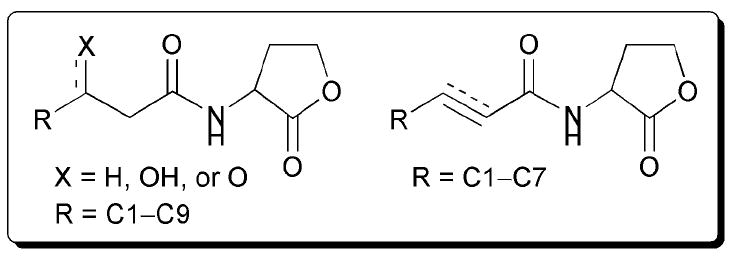
Structural features of AHLs tested against TraR by Winans and co-workers summarized in shaded box; compounds were synthesized and tested as racemates.
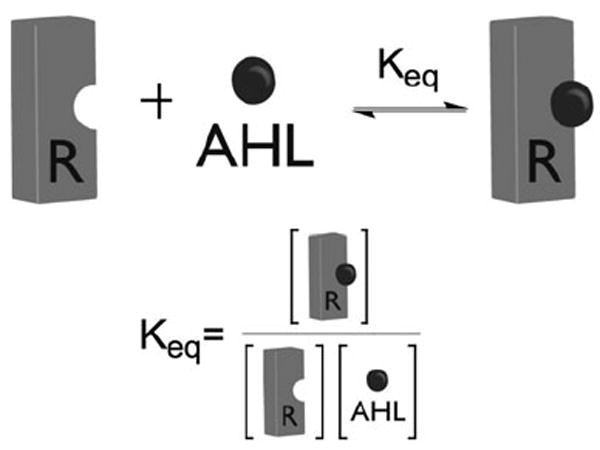
Simplified schematic of the AHL–LuxR-type protein binding equilibrium.
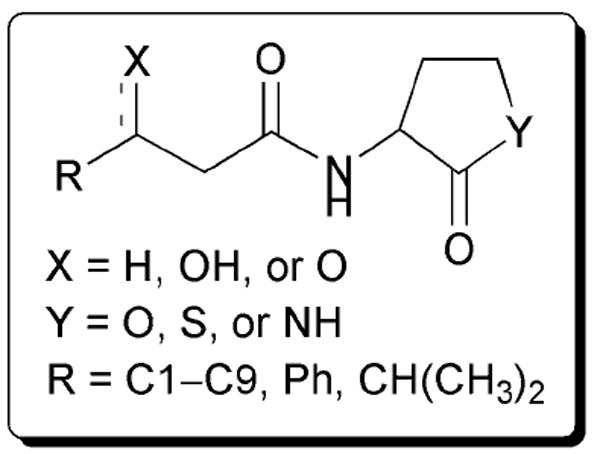
Structural features of AHLs tested by Bycroft and co-workers in E. carotovora summarized in shaded box.
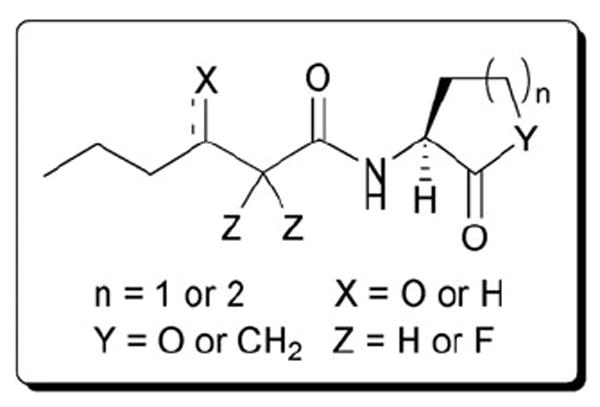
Structural features of AHLs tested by Spring and co-workers in E. carotovora summarized in shaded box.
References
Publication types
MeSH terms
Substances
Grants and funding
LinkOut - more resources
Full Text Sources
Other Literature Sources
