. 2009 Feb;58(2):221-34.
doi: 10.1007/s00262-008-0543-0. Epub 2008 Jun 21.

Identification of novel tumor antigens with patient-derived immune-selected antibodies

Affiliations

Identification of novel tumor antigens with patient-derived immune-selected antibodies

Daniel Rodriguez-Pinto et al. Cancer Immunol Immunother. 2009 Feb.

Abstract

The identification of tumor antigens capable of eliciting an immune response in vivo may be an effective method to identify therapeutic cancer targets. We have developed a method to identify such antigens using frozen tumor-draining lymph node samples from breast cancer patients. Immune responses in tumor-draining lymph nodes were identified by immunostaining lymph node sections for B-cell markers (CD20&CD23) and Ki67 which revealed cell proliferation in germinal center zones. Antigen-dependent somatic hypermutation (SH) and clonal expansion (CE) were present in heavy chain variable (VH) domain cDNA clones obtained from these germinal centers, but not from Ki67 negative germinal centers. Recombinant VH single-domain antibodies were used to screen tumor proteins and affinity select potential tumor antigens. Neuroplastin (NPTN) was identified as a candidate breast tumor antigen using proteomic identification of affinity selected tumor proteins with a recombinant VH single chain antibody. NPTN was found to be highly expressed in approximately 20% of invasive breast carcinomas and 50% of breast carcinomas with distal metastasis using a breast cancer tissue array. Additionally, NPTN over-expression in a breast cancer cell line resulted in a significant increase in tumor growth and angiogenesis in vivo which was related to increased VEGF production in the transfected cells. These results validate NPTN as a tumor-associated antigen which could promote breast tumor growth and metastasis if aberrantly expressed. These studies also demonstrate that humoral immune responses in tumor-draining lymph nodes can provide antibody reagents useful in identifying tumor antigens with applications for biomarker screening, diagnostics and therapeutic interventions.


Figures

Fig. 1
Fig. 1
Immunohistological analysis of B cell zones in tumor-draining lymph nodes from breast cancer patients. a Immunohistochemistry staining for CD20, CD23 and Ki67 in serial sections of a tumor-draining lymph node (bar = 1,000 μm). b Merged image of the three stains in the zone highlighted in a. Masks of different colors were applied to each marker: CD20 yellow, CD23 blue, and Ki67 pink (bar = 1,000 μm). c Number of zones positive for CD20, CD20 and CD23 or a combination of the three markers in each lymph node (average and standard deviations are shown, n = 32)
Fig. 2
Fig. 2
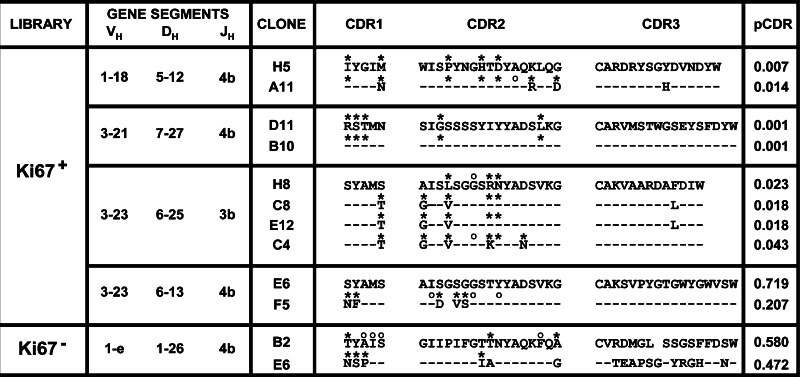
Alignment of amino acid sequences of the CDRs of VH clones that shared VDJ rearrangements. The VH, DH and JH gene segments used by each clonal group from a Ki67 + and Ki67 libraries are indicated. Amino acid sequences are provided for each clone and aligned with similar VH, DH, and JH clones. Dashes indicate same amino acid sequence and asterisks (*) above each amino acid indicates difference from germline sequence (not shown). Locations of silent mutations are indicated by open circles above their respective amino acids. CDR3 sequences could not be compared to germline through direct database matching thus differences from germline are not reported for CDR3. The p value for clustering of replacement mutations in CDR1&2 (pCDR) according to the method described by Lossos et al. [19] are provided for each clone, P ≤ 0.05 is considered significant
Fig. 3
Fig. 3
Identification of NPTN in tumor protein extracts. a Alignment of amino acid sequences of A3 and H1 sdAbs. Dashes indicate same amino acid between A3 and H1 clones. Replacement mutations in FRs 1, 2 and 3 and CDRs 1 and 2 are indicated by an asterisk (*), CDR3 was not directly compared to germline sequences (germline sequence not shown). Gray boxes indicate CDRs 1–3. b Amino acid sequence of NPTN beta. The peptide identified by LC-MS/MS is boxed. c Immunoblot of 5 primary breast tumor samples using anti-NPTN (NP) (top panel) or A3 sdAb (tagged with c-myc) and detected with anti-c-myc antibody (bottom panel)
Fig. 4
Fig. 4
Neuroplastin is expressed in a subset of breast tumors. A tissue array containing normal breast and breast cancer tissue cores was stained by immunohistochemistry with an anti-NPTN antibody. Representative cases are shown: a Normal breast, b Invasive ductal breast carcinoma, node negative. c Invasive ductal breast carcinoma, node positive. d Invasive ductal breast carcinoma, distant metastasis (bar = 100 μm). e Percentage of cases from each group that had a score of 3 or higher for NPTN staining; N0 node negative, N ≥ 1 node positive, M1 distant metastasis
Fig. 5
Fig. 5
NPTN expression in MDA-MB-435 cells does not affect in vitro cell growth. a The stable expression of NPTN in MDA-MB-435 cells by immunoblot. Top panel Detection of V5 epitope tag in extracts from parental MDA-MB-435 (435) cells, cells expressing EGFP (MDA-MB-435-GFP) (GFP), and two lines expressing NPTN-V5 (NP-1, NP-2), middle panel Detection of V5-epitope after treatment of extracts with N- and O-glycosidases. Bottom panel Control for extract loading with β-actin immunoblot. b MTT viability assay of cells plated in triplicate after overnight seeding (time 0), 48 and 72 h later. MDA-MB-435-GFP (GFP), MDA-MB-435-NPTN (NP) and a 1:1 ratio of both (NP:GFP) cells were analyzed. No statistical difference was observed at any time point
Fig. 6
Fig. 6
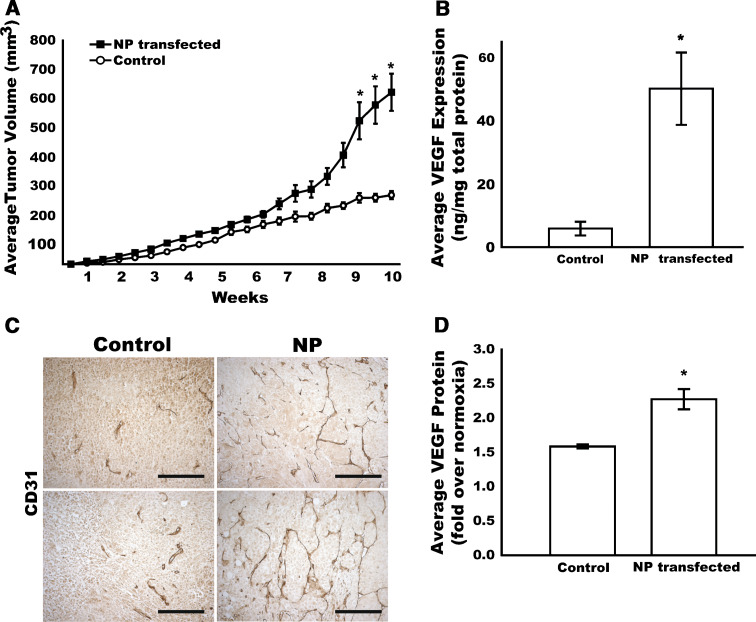
NPTN expression in MDA-MB-435 cells stimulates tumor growth and angiogenesis in vivo. a Control MDA-MB-435 or NPTN-transfected (NP) cells were injected into the mammary fat pad of athymic nude mice and tumors were measured twice a week. Average tumor volumes (ave. ± SEM) for NPTN-transfected (filled square) and control (open circle) tumors are shown (n = 7). b Vascular immunostaining (CD31) in MDA-MB-435-GFP tumors (Control) or NPTN-overexpressing (NP) tumors. Two representative cases for each group are shown (bar = 100 μm). c VEGF protein expression in NPTN-overexpressing and control tumor lysates normalized to the total amount of protein in each sample (n = 7). d Hypoxia induced VEGF secretion into media by MDA-MB-435 cells (control) or with overexpression of NPTN (NP) over 24 h (n = 3) (*P ≤ 0.05)

References

    1. Agarwal A, Munoz-Najar U, Klueh U, Shih SC, Claffey KP. N-acetyl-cysteine promotes angiostatin production and vascular collapse in an orthotopic model of breast cancer. Am J Pathol. 2004;164(5):1683–1696. - PMC - PubMed
    1. Aihara K, Yamada K, Murakami H, Nomura Y, Omura H. Production of human–human hybridomas secreting monoclonal antibodies reactive to breast cancer cell lines. In Vitro Cell Dev Biol. 1988;24(9):959–962. doi: 10.1007/BF02623911. - DOI - PubMed
    1. Angelin-Duclos C, Cattoretti G, Lin KI, Calame K. Commitment of B lymphocytes to a plasma cell fate is associated with Blimp-1 expression in vivo. J Immunol. 2000;165(10):5462–5471. - PubMed
    1. Annibali NV, Baldi A. Characterization of the ETSA-21 antigen, a glycosylphosphatidyl-inositol anchor glycoprotein identified in breast cancer cells using monoclonal antibody B21. Hybridoma. 1997;16(2):139–145. - PubMed
    1. Bernstein HG, Smalla KH, Bogerts B, Gordon-Weeks PR, Beesley PW, Gundelfinger ED, Kreutz MR. The immunolocalization of the synaptic glycoprotein neuroplastin differs substantially between the human and the rodent brain. Brain Res. 2007;1134(1):107–112. doi: 10.1016/j.brainres.2006.11.090. - DOI - PubMed

Publication types

MeSH terms