


Interventions on frequent attenders in primary care. A systematic literature review
- PMID: 18570010
- PMCID: PMC3406646
- DOI: 10.1080/02813430802112997
Interventions on frequent attenders in primary care. A systematic literature review
Abstract
Objective: To analyse which interventions are effective in influencing morbidity, quality of life, and healthcare utilization of frequently attending patients (FAs) in primary care.
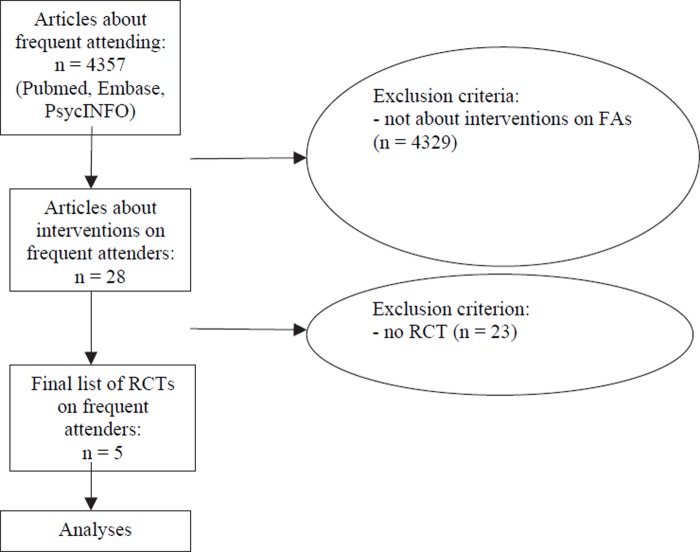
Methods: A systematic literature search was performed for articles describing interventions on FAs in primary care (Medline, Embase, and PsycINFO). Outcomes were morbidity, quality of life (QoL), and use of healthcare. Two independent assessors selected all randomized clinical trials (RCT) and assessed the quality of the selected RCTs. Results. Five primary care based RCTs were identified. Three RCTs used frequent attendance to select patients at risk of distress, major depression, and anxiety disorders. These RCTs applied psychological and psychiatric interventions and focused on undiagnosed psychiatric morbidity of FAs. Two of them found more depression-free days and a better QoL after treating major depressive disorder in FAs. No other RCT found any positive effect on morbidity or QoL. Two RCTs studied an intervention which focused on reducing frequent attendance. No intervention significantly lowered attendance. Due to the difference in study settings and the variation in methods of selecting patients, meta-analysis of the results was not possible.
Conclusion: No study showed convincing evidence that an intervention improves QoL or morbidity of frequent attending primary care patients, although a small effect might be possible in a subgroup of depressed frequent attenders. No evidence was found that it is possible to influence healthcare utilization of FAs.
Figures
References
-
- Vedsted P, Christensen MB. Frequent attenders in general practice care: A literature review with special reference to methodological considerations. Public Health. 2005;119:118–37. - PubMed
-
- Gill D, Sharpe M. Frequent consulters in general practice: A systematic review of studies of prevalence, associations and outcome. J Psychosom Res. 1999;47:115–30. - PubMed
-
- Karlsson H, Joukamaa M, Lahti I, Lehtinen V, Kokki-Saarinen T. Frequent attender profiles: Different clinical subgroups among frequent attender patients in primary care. J Psychosom Res. 1997;42:157–66. - PubMed
-
- Katon W, Von KM, Lin E, Lipscomb P, Russo J, Wagner E, et al. Distressed high utilizers of medical care. DSM-III-R diagnoses and treatment needs. Gen Hosp Psychiatry. 1990;12:355–62. - PubMed
Publication types
MeSH terms
LinkOut - more resources
Full Text Sources
Research Materials
Miscellaneous
