. 2008 Dec;41(12):1587-95.
doi: 10.1021/ar800018v.

Gold nanocages: synthesis, properties, and applications

Affiliations

Gold nanocages: synthesis, properties, and applications

Sara E Skrabalak et al. Acc Chem Res. 2008 Dec.

Abstract

Noble-metal nanocages comprise a novel class of nanostructures possessing hollow interiors and porous walls. They are prepared using a remarkably simple galvanic replacement reaction between solutions containing metal precursor salts and Ag nanostructures prepared through polyol reduction. The electrochemical potential difference between the two species drives the reaction, with the reduced metal depositing on the surface of the Ag nanostructure. In our most studied example, involving HAuCl(4) as the metal precursor, the resultant Au is deposited epitaxially on the surface of the Ag nanocubes, adopting their underlying cubic form. Concurrent with this deposition, the interior Ag is oxidized and removed, together with alloying and dealloying, to produce hollow and, eventually, porous structures that we commonly refer to as Au nanocages. This approach is versatile, with a wide range of morphologies (e.g., nanorings, prism-shaped nanoboxes, nanotubes, and multiple-walled nanoshells or nanotubes) available upon changing the shape of the initial Ag template. In addition to Au-based structures, switching the metal salt precursors to Na(2)PtCl(4) and Na(2)PdCl(4) allows for the preparation of Pt- and Pd-containing hollow nanostructures, respectively. We have found that changing the amount of metal precursor added to the suspension of Ag nanocubes is a simple means of tuning both the composition and the localized surface plasmon resonance (LSPR) of the metal nanocages. Using this approach, we are developing structures for biomedical and catalytic applications. Because discrete dipole approximations predicted that the Au nanocages would have large absorption cross-sections and because their LSPR can be tuned into the near-infrared (where the attenuation of light by blood and soft tissue is greatly reduced), they are attractive materials for biomedical applications in which the selective absorption of light at great depths is desirable. For example, we have explored their use as contrast enhancement agents for both optical coherence tomography and photoacoustic tomography, with improved performance observed in each case. Because the Au nanocages have large absorption cross-sections, they are also effective photothermal transducers; thus, they might provide a therapeutic effect through selective hyperthermia-induced killing of targeted cancer cells. Our studies in vitro have illustrated the feasibility of applying this technique as a less-invasive form of cancer treatment.


Figures
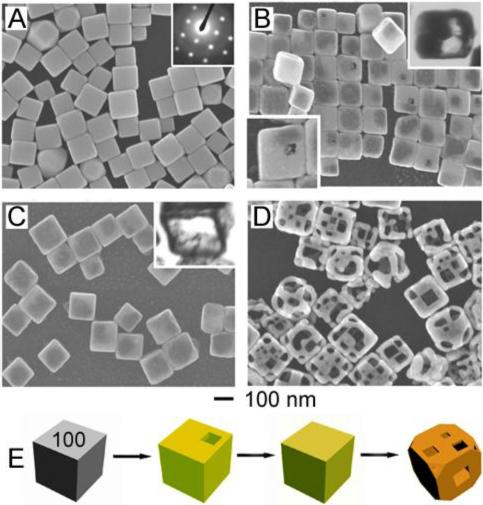
FIGURE 1
FIGURE 1
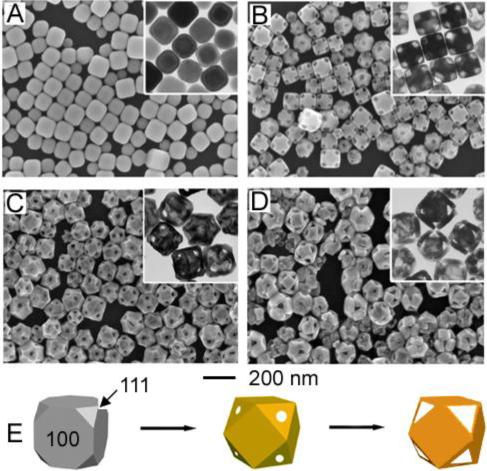
(A) SEM of Ag nanocubes. Inset: electron diffraction indicates they are single-crystals. (B) SEM of product after 0.30 mL of 1 mM HAuCl4 solution was added to a 5-mL 0.8 mM Ag nanocube suspension; a pinhole (lower inset) is observed on the exposed face of ∼1 in 6 nanocubes. Upper inset: TEM of a microtomed sample reveals early hollowing out. (C) SEM of product after 0.50 mL of HAuCl4 solution was added. Inset: TEM of a microtomed sample reveals the hollow interior of the nanobox. (D) SEM of product after 2.25 mL of HAuCl4 solution was added. Porous nanocages produced. (E) Illustration summarizing morphological changes. Coloration indicates the conversion of a Ag nanocube into a Au/Ag nanobox then a predominately Au nanocage.
FIGURE 2
FIGURE 2
SEM and TEM (inset) (A) of Ag nanocubes with rounded corners and (B-D) product after reaction with 0.6, 1.6, and 3.0 mL of 0.1 mM HAuCl4 solution, respectively. (E) Illustration summarizing morphological changes. Coloration indicates conversion of a Ag nanocube into a Au/Ag nanocage then a predominately Au nanocage.
FIGURE 3
FIGURE 3
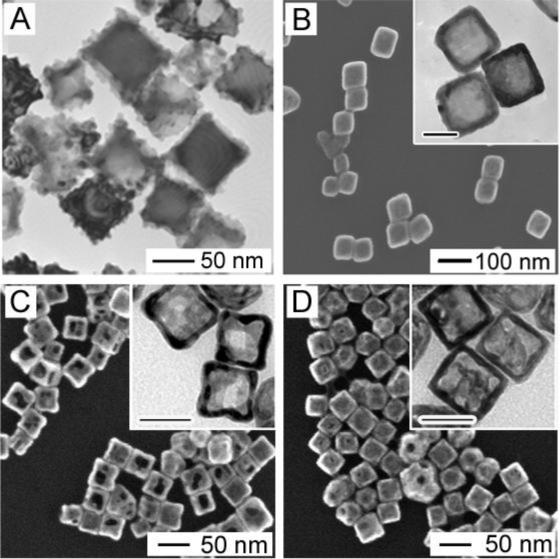
(A) TEM of Pt/Ag nanoboxes from the galvanic replacement reaction between Ag nanocubes and Na2PtCl4 solution. (B) SEM and TEM (inset) of Pd/Ag nanoboxes from the galvanic replacement reaction between Ag nanocubes and Na2PdCl4 solution. (C) and (D) SEM and TEM (inset) of Ag/Au/Pd nanocages from the galvanic replacement reaction between Ag nanocubes and (C) Na2PdCl4 solution, followed by HAuCl4 solution and (D) HAuCl4 solution, followed by Na2PdCl4 solution. Inset scale bars = 40 nm.,
FIGURE 4
FIGURE 4
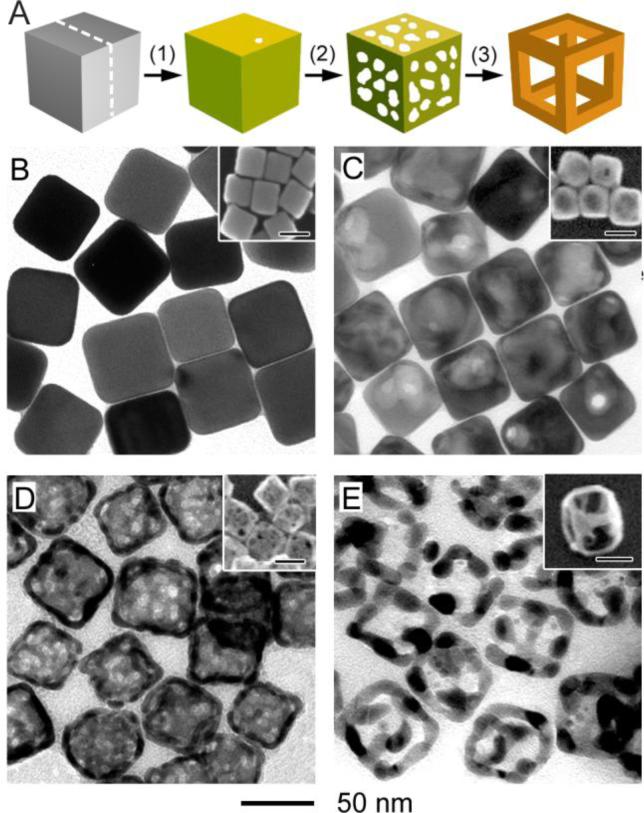
(A) Illustration summarizing cubic Au nanoframe formation. Beginning with Ag nanocubes, Au/Ag nanoboxes are prepared by galvanic replacement (step 1). Then a wet etchant removes remaining Ag to form a porous nanocage (step 2), which with more etchant, evolves into a cubic nanoframe (step 3). (B-E) TEM and SEM (inset) of (B) 50 nm Ag nanocubes, (C) Au/Ag nanoboxes prepared by galvanic replacement, and (D) nanocages and (E) nanoframes prepared with Fe(NO3)3 as a Ag etchant. Coloration indicates the conversion of a Ag nanocube into a Au/Ag nanocage then a predominately Au nanocage.
Figure 5
Figure 5
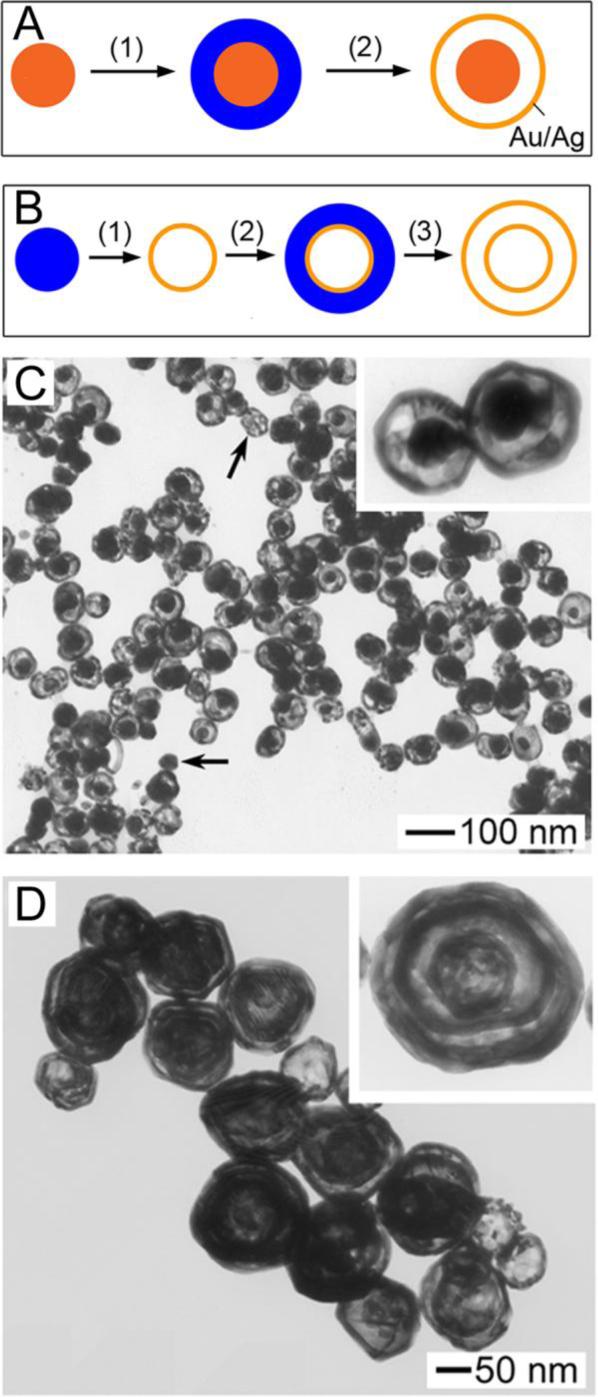
(A) Schematic illustrating the multi-step preparation of nanorattles. To a Au/Ag (in orange) nanoparticle, Ag (in blue) is deposited on its surface; the galvanic replacement reaction with HAuCl4 then transforms the Ag layer into a Au/Ag shell. (B) Schematic illustrating the multi-step preparation of multiple-walled nanoshells, beginning with a Ag nanoparticle. (C) TEM of nanorattles. (D) TEM of multiple-walled Au/Ag nanoshells.
FIGURE 6
FIGURE 6
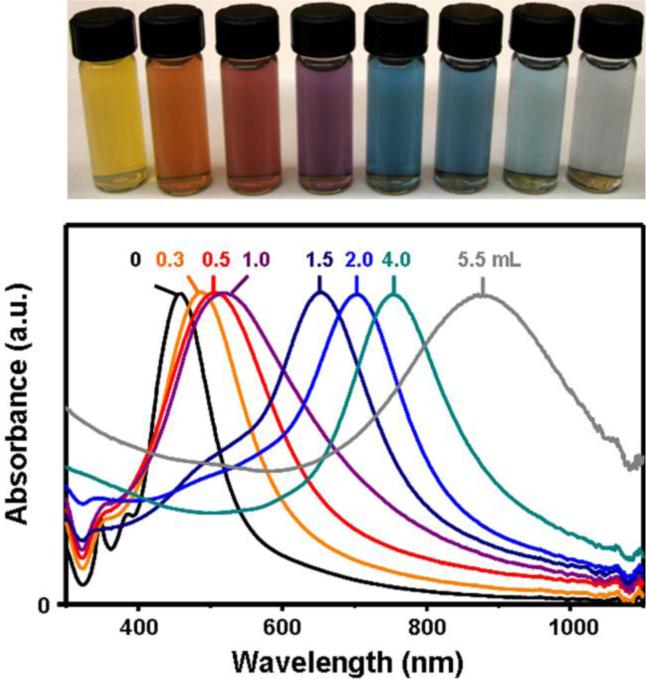
Top panel: vials containing Au nanocages prepared by reacting 5 mL of a ∼0.2 nM Ag nanocube (edge length: 40 nm) suspension with different volumes of a 0.1 mM HAuCl4 solution. Lower panel: the corresponding UV-visible absorbance spectra of Ag nanocubes and Au nanocages.
FIGURE 7
FIGURE 7
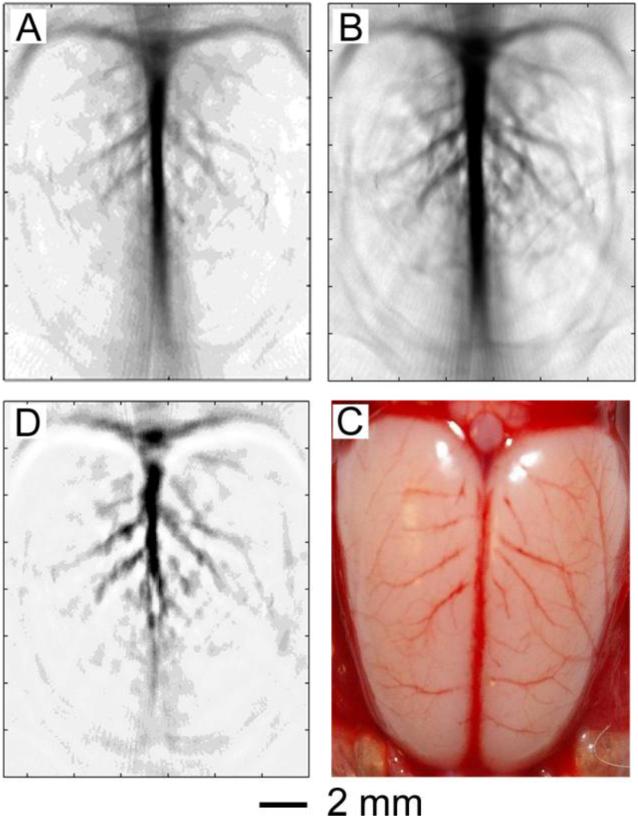
PAT of a rat's cerebral cortex (A) before and (B) ∼2 h after the final injection of PEGylated Au nanocages (the peak enhancement point). (C) A differential PAT image. (D) A open-skull photograph of the rat's cerebral cortex, revealing features of the vasculature.
FIGURE 8
FIGURE 8
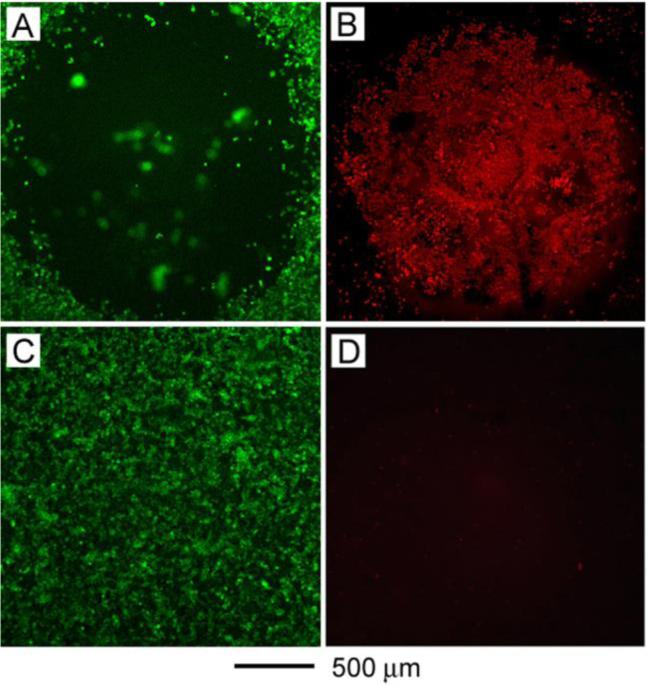
(A) and (B) SK-BR-3 breast cancer cells treated with immuno Au nanocages then irradiated with 810 nm light at a power density of 1.5 W/cm2 for 5 min. A well-defined zone of cellular death revealed by (A) calcein AM (green fluorescence indicates live cells) and (B) ethidium homodimer-1 (EthD-1, red fluorescence indicates dead cells) assays. (C) and (D) SKBR-3 cells irradiated under the same conditions but without immuno Au nanocages treatment. The cells maintained viability, indicated by (C) calcein AM and (D) EthD-1 assays.
None

References

    1. Shipway AN, Katz E, Willner I. Nanoparticle arrays on surfaces for electronic, optical, and sensor applications. ChemPhysChem. 2000;1:18–52. - PubMed
    1. Murphy CJ, San TK, Gole AM, Orendorff CJ, Gao JX, Gou L, Hunyadi SE, Li T. Anisotropic metal nanoparticles: synthesis, assembly, and optical applications. J. Phys. Chem. B. 2005;109:13857–13870. - PubMed
    1. Willets KA, Van Duyne RP. Localized surface plasmon resonance spectroscopy and sensing. Annu. Rev. Phys. Chem. 2007;58:267–297. - PubMed
    1. Aiken JD, Finke RG. A review of modern transition-metal nanoclusters: their synthesis, characterization, and applications in catalysis. J. Mol. Catal. A-Chem. 1999;145:1–44.
    1. Murray CB, Kagan CR, Bawendi MG. Synthesis and characterization of monodisperse nanocrystals and close-packed nanocrystal assemblies. Annu. Rev. Mater. Sci. 2000;30:545–610.

Publication types