


Vigorous physical activity increases fracture risk in children irrespective of bone mass: a prospective study of the independent risk factors for fractures in healthy children
- PMID: 18570539
- PMCID: PMC2742075
- DOI: 10.1359/jbmr.080303
Vigorous physical activity increases fracture risk in children irrespective of bone mass: a prospective study of the independent risk factors for fractures in healthy children
Abstract
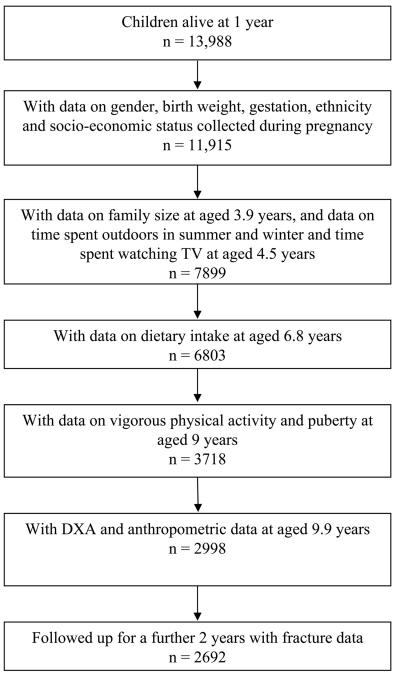
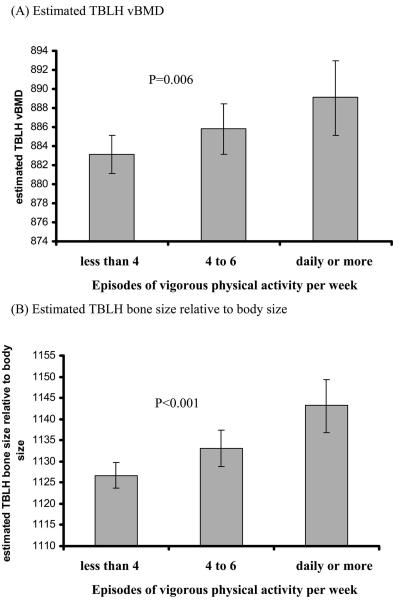
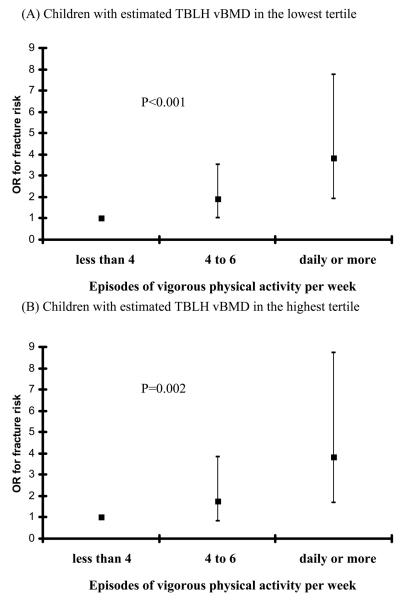
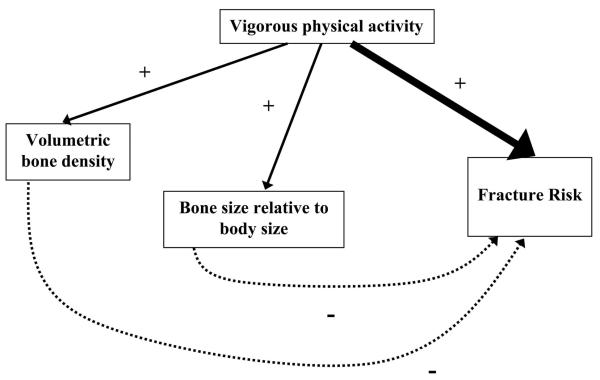
Low bone mass is a determinant of fractures in healthy children. Small studies provide limited evidence on the association between ethnicity, birth weight, family size, socioeconomic status, dietary calcium intake, or physical activity and fracture incidence. No studies have investigated whether these determinants of fracture risk act through affecting bone mass or through other mechanisms. The aim of this study was to use a population-based birth cohort to confirm which variables are determinants of fracture risk and to further study which of these risk factors act independently of bone mass. Children from the Avon Longitudinal Study of Parents and Children have been followed up from birth to 11 yr of age. Maternal self-reported data have been collected contemporaneously on early life factors, diet, puberty, and physical activity. These were linked to reported fractures between 9 and 11 yr of age. Multivariable logistic regression techniques were used to assess whether these potential determinants were independent of, or worked through, estimated volumetric BMD or estimated bone size relative to body size measured by total body DXA scan at 9.9 yr of age. A total of 2692 children had full data. One hundred ninety-three (7.2%) reported at least one fracture over the 2-yr follow-up period. Children who reported daily or more episodes of vigorous physical activity had double the fracture risk compared with those children who reported less than four episodes per week (OR, 2.06; 95% CI, 1.21-1.76). No other independent determinants of fracture risk in healthy children were found. In conclusion, reported vigorous physical activity is an independent risk factor for childhood fracture risk. However, the interrelationship between physical activity, bone mass, and childhood fracture risk suggests that the higher bone mass associated with increased physical activity does not compensate for the risk caused by increased exposure to injuries.
Figures
Comment in
-
Increasing wrist fracture rates in children may have major implications for future adult fracture burden.Acta Orthop. 2016 Jun;87(3):296-300. doi: 10.3109/17453674.2016.1152855. Epub 2016 Feb 24. Acta Orthop. 2016. PMID: 26905618 Free PMC article.
References
-
- Landin LA. Fracture patterns in children. Acta Orthop Scand. 1983;54(Suppl 202):1–109. - PubMed
-
- Tiderius CJ, Landin LA, Duppe H. Decreasing incidence of fractures in children. Acta Orthop Scand. 1999;70:622–626. - PubMed
-
- Ferrari S, Chevalley T, Bonjour JP, Rizzoli R. Childhood fractures are associated with decreased bone mass gain during puberty: An early marker of persistent bone fragility? J Bone Miner Res. 2006;21:501–507. - PubMed
